

296
J. C. Pardo-Novoa and C. M. Cerda-García-Rojas
the calculation of the Flack parameters, and therefore the assignment of the absolute
configuration for all compounds. It is relevant to comment that, when dissolved,
the crystals of hemiacetal esters experienced a tautomeric equilibrium inverting the
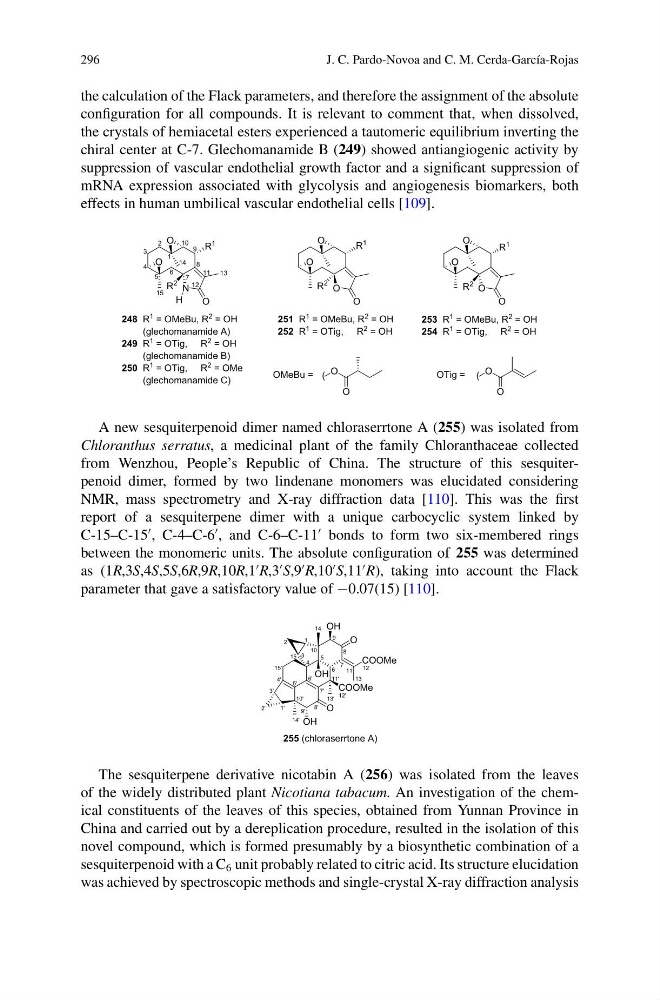
chiral center at C-7. Glechomanamide B (249) showed antiangiogenic activity by
suppression of vascular endothelial growth factor and a significant suppression of
mRNA expression associated with glycolysis and angiogenesis biomarkers, both
effects in human umbilical vascular endothelial cells [109].
N
O
O
1
3
5
7
9
10
11 13
12
15
14
248 R
1 = OMeBu, R
2 = OH
(glechomanamide A)
249 R
1 = OTig, R
2 = OH
(glechomanamide B)
250 R
1 = OTig, R
2 = OMe
(glechomanamide C)
2
4
6
8
O
R
1
R
2
O
O
O
O
R
1
R
2
O
O
O
O
R
1
R
2
H
251 R
1 = OMeBu, R
2 = OH
252 R
1 = OTig, R
2 = OH
253 R
1 = OMeBu, R
2 = OH
254 R
1 = OTig, R
2 = OH
OMeBu =
O
O
(
O
O
(
OTig =
A new sesquiterpenoid dimer named chloraserrtone A (255) was isolated from
Chloranthus serratus, a medicinal plant of the family Chloranthaceae collected
from Wenzhou, People’s Republic of China. The structure of this sesquiterpenoid dimer, formed by two lindenane monomers was elucidated considering
NMR, mass spectrometry and X-ray diffraction data [110]. This was the first
report of a sesquiterpene dimer with a unique carbocyclic system linked by
C-15–C-15
, C-4–C-6
, and C-6–C-11
bonds to form two six-membered rings
between the monomeric units. The absolute configuration of 255 was determined
as (1R,3S,4S,5S,6R,9R,10R,1
R,3
S,9
R,10
S,11
R), taking into account the Flack
parameter that gave a satisfactory value of −0.07(15) [110].
OH
OH
O
COOMe
COOMe
O
OH
255 (chloraserrtone A)
1
2
3
4
5
6
7
8
9
10
11
12
13
14
15
15'
4'
5'
6'
7'
8'
9'
10'
11'
12'
13'
14'
1'
2'
3'
The sesquiterpene derivative nicotabin A (256) was isolated from the leaves
of the widely distributed plant Nicotiana tabacum. An investigation of the chemical constituents of the leaves of this species, obtained from Yunnan Province in
China and carried out by a dereplication procedure, resulted in the isolation of this
novel compound, which is formed presumably by a biosynthetic combination of a
sesquiterpenoid with a C 6 unit probably related to citric acid. Its structure elucidation
was achieved by spectroscopic methods and single-crystal X-ray diffraction analysis
J. C. Pardo-Novoa and C. M. Cerda-García-Rojas
the calculation of the Flack parameters, and therefore the assignment of the absolute
configuration for all compounds. It is relevant to comment that, when dissolved,
the crystals of hemiacetal esters experienced a tautomeric equilibrium inverting the
chiral center at C-7. Glechomanamide B (249) showed antiangiogenic activity by
suppression of vascular endothelial growth factor and a significant suppression of
mRNA expression associated with glycolysis and angiogenesis biomarkers, both
effects in human umbilical vascular endothelial cells [109].
N
O
O
1
3
5
7
9
10
11 13
12
15
14
248 R
1 = OMeBu, R
2 = OH
(glechomanamide A)
249 R
1 = OTig, R
2 = OH
(glechomanamide B)
250 R
1 = OTig, R
2 = OMe
(glechomanamide C)
2
4
6
8
O
R
1
R
2
O
O
O
O
R
1
R
2
O
O
O
O
R
1
R
2
H
251 R
1 = OMeBu, R
2 = OH
252 R
1 = OTig, R
2 = OH
253 R
1 = OMeBu, R
2 = OH
254 R
1 = OTig, R
2 = OH
OMeBu =
O
O
(
O
O
(
OTig =
A new sesquiterpenoid dimer named chloraserrtone A (255) was isolated from
Chloranthus serratus, a medicinal plant of the family Chloranthaceae collected
from Wenzhou, People’s Republic of China. The structure of this sesquiterpenoid dimer, formed by two lindenane monomers was elucidated considering
NMR, mass spectrometry and X-ray diffraction data [110]. This was the first
report of a sesquiterpene dimer with a unique carbocyclic system linked by
C-15–C-15
, C-4–C-6
, and C-6–C-11
bonds to form two six-membered rings
between the monomeric units. The absolute configuration of 255 was determined
as (1R,3S,4S,5S,6R,9R,10R,1
R,3
S,9
R,10
S,11
R), taking into account the Flack
parameter that gave a satisfactory value of −0.07(15) [110].
OH
OH
O
COOMe
COOMe
O
OH
255 (chloraserrtone A)
1
2
3
4
5
6
7
8
9
10
11
12
13
14
15
15'
4'
5'
6'
7'
8'
9'
10'
11'
12'
13'
14'
1'
2'
3'
The sesquiterpene derivative nicotabin A (256) was isolated from the leaves
of the widely distributed plant Nicotiana tabacum. An investigation of the chemical constituents of the leaves of this species, obtained from Yunnan Province in
China and carried out by a dereplication procedure, resulted in the isolation of this
novel compound, which is formed presumably by a biosynthetic combination of a
sesquiterpenoid with a C 6 unit probably related to citric acid. Its structure elucidation
was achieved by spectroscopic methods and single-crystal X-ray diffraction analysis