

New Techniques of Structure Elucidation for Sesquiterpenes
295
OH
OH
O
OH
O
O
OH
O
O
OH
240 (jasminol A)
241 (jasminol G)
242 (jasminol H)
243 (jasminol B)
1
2
3
4
5
6
7
8
9
10
11
12
13
14
15
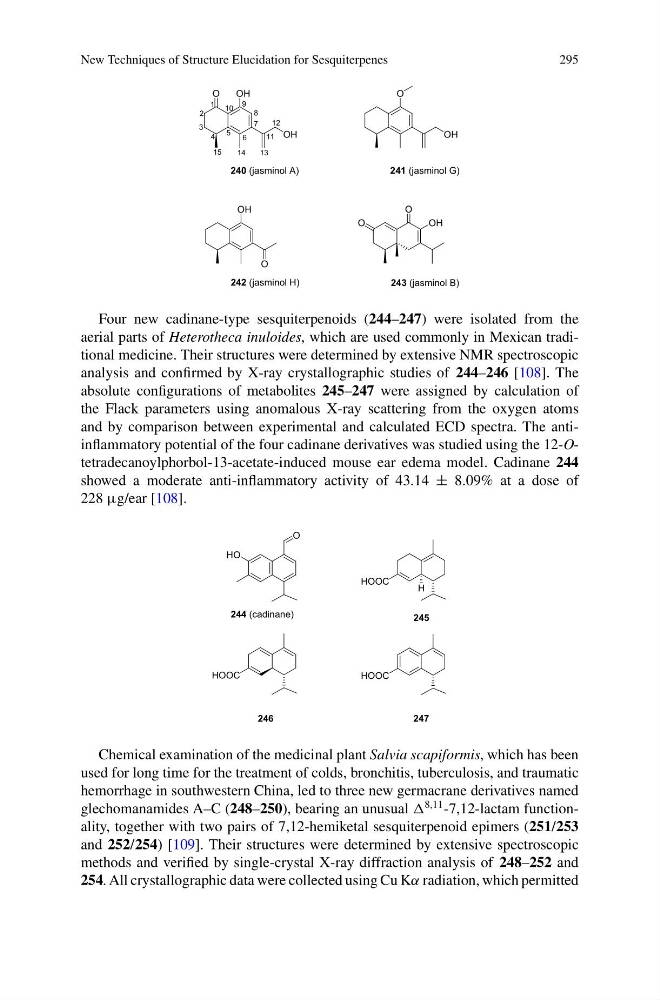
Four new cadinane-type sesquiterpenoids (244–247) were isolated from the
aerial parts of Heterotheca inuloides, which are used commonly in Mexican traditional medicine. Their structures were determined by extensive NMR spectroscopic
analysis and confirmed by X-ray crystallographic studies of 244–246 [108]. The
absolute configurations of metabolites 245–247 were assigned by calculation of
the Flack parameters using anomalous X-ray scattering from the oxygen atoms
and by comparison between experimental and calculated ECD spectra. The antiinflammatory potential of the four cadinane derivatives was studied using the 12-Otetradecanoylphorbol-13-acetate-induced mouse ear edema model. Cadinane 244
showed a moderate anti-inflammatory activity of 43.14 ± 8.09% at a dose of
228 μg/ear [108].
245
246
HOOC
247
H
HOOC
HOOC
244 (cadinane)
HO
O
Chemical examination of the medicinal plant Salvia scapiformis, which has been
used for long time for the treatment of colds, bronchitis, tuberculosis, and traumatic
hemorrhage in southwestern China, led to three new germacrane derivatives named
glechomanamides A–C (248–250), bearing an unusual
8,11 -7,12-lactam functionality, together with two pairs of 7,12-hemiketal sesquiterpenoid epimers (251/253
and 252/254) [109]. Their structures were determined by extensive spectroscopic
methods and verified by single-crystal X-ray diffraction analysis of 248–252 and
254. All crystallographic data were collected using Cu Kα radiation, which permitted
295
OH
OH
O
OH
O
O
OH
O
O
OH
240 (jasminol A)
241 (jasminol G)
242 (jasminol H)
243 (jasminol B)
1
2
3
4
5
6
7
8
9
10
11
12
13
14
15
Four new cadinane-type sesquiterpenoids (244–247) were isolated from the
aerial parts of Heterotheca inuloides, which are used commonly in Mexican traditional medicine. Their structures were determined by extensive NMR spectroscopic
analysis and confirmed by X-ray crystallographic studies of 244–246 [108]. The
absolute configurations of metabolites 245–247 were assigned by calculation of
the Flack parameters using anomalous X-ray scattering from the oxygen atoms
and by comparison between experimental and calculated ECD spectra. The antiinflammatory potential of the four cadinane derivatives was studied using the 12-Otetradecanoylphorbol-13-acetate-induced mouse ear edema model. Cadinane 244
showed a moderate anti-inflammatory activity of 43.14 ± 8.09% at a dose of
228 μg/ear [108].
245
246
HOOC
247
H
HOOC
HOOC
244 (cadinane)
HO
O
Chemical examination of the medicinal plant Salvia scapiformis, which has been
used for long time for the treatment of colds, bronchitis, tuberculosis, and traumatic
hemorrhage in southwestern China, led to three new germacrane derivatives named
glechomanamides A–C (248–250), bearing an unusual
8,11 -7,12-lactam functionality, together with two pairs of 7,12-hemiketal sesquiterpenoid epimers (251/253
and 252/254) [109]. Their structures were determined by extensive spectroscopic
methods and verified by single-crystal X-ray diffraction analysis of 248–252 and
254. All crystallographic data were collected using Cu Kα radiation, which permitted