

New Techniques of Structure Elucidation for Sesquiterpenes
279
O
O
O
O
O
O
O
OH
O
149 (aquatolide)
150 (caespitenone)
151 (sporol)
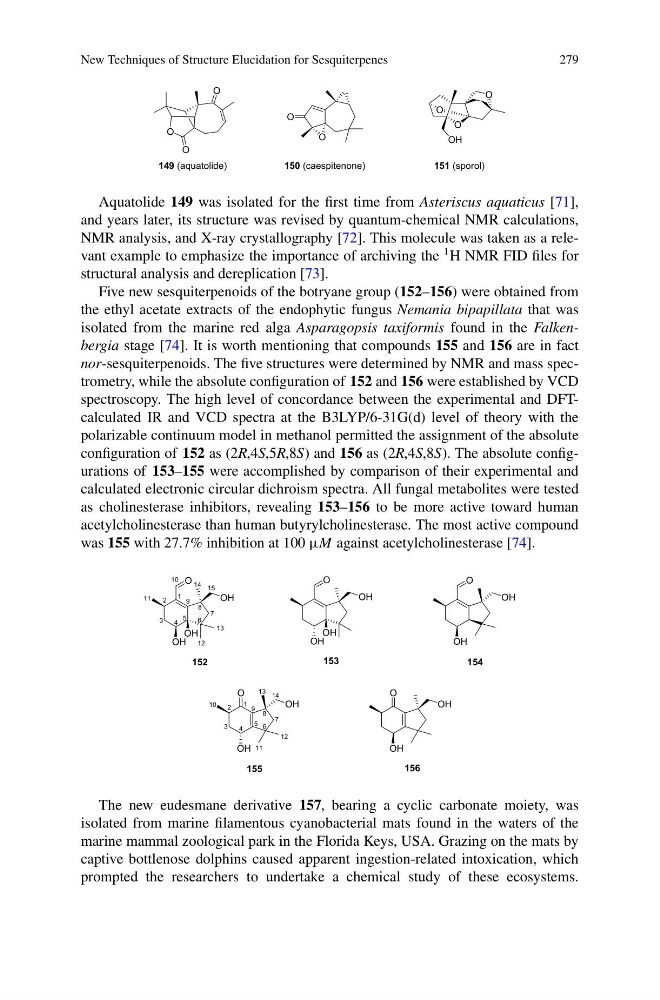
Aquatolide 149 was isolated for the first time from Asteriscus aquaticus [71],
and years later, its structure was revised by quantum-chemical NMR calculations,
NMR analysis, and X-ray crystallography [72]. This molecule was taken as a relevant example to emphasize the importance of archiving the
1 H NMR FID files for
structural analysis and dereplication [73].
Five new sesquiterpenoids of the botryane group (152–156) were obtained from
the ethyl acetate extracts of the endophytic fungus Nemania bipapillata that was
isolated from the marine red alga Asparagopsis taxiformis found in the Falkenbergia stage [74]. It is worth mentioning that compounds 155 and 156 are in fact
nor-sesquiterpenoids. The five structures were determined by NMR and mass spectrometry, while the absolute configuration of 152 and 156 were established by VCD
spectroscopy. The high level of concordance between the experimental and DFTcalculated IR and VCD spectra at the B3LYP/6-31G(d) level of theory with the
polarizable continuum model in methanol permitted the assignment of the absolute
configuration of 152 as (2R,4S,5R,8S) and 156 as (2R,4S,8S). The absolute configurations of 153–155 were accomplished by comparison of their experimental and
calculated electronic circular dichroism spectra. All fungal metabolites were tested
as cholinesterase inhibitors, revealing 153–156 to be more active toward human
acetylcholinesterase than human butyrylcholinesterase. The most active compound
was 155 with 27.7% inhibition at 100 μM against acetylcholinesterase [74].
OH
OH
O
OH
OH
OH
O
OH
OH
O
OH
OH
O
OH
OH
O
OH
152
153
154
155
156
1
2
3
4
5 6
7
8
9
10
11
12
13
14 15
1
2
3
4
5
6
7
8
9
10
11
12
13
14
The new eudesmane derivative 157, bearing a cyclic carbonate moiety, was
isolated from marine filamentous cyanobacterial mats found in the waters of the
marine mammal zoological park in the Florida Keys, USA. Grazing on the mats by
captive bottlenose dolphins caused apparent ingestion-related intoxication, which
prompted the researchers to undertake a chemical study of these ecosystems.
279
O
O
O
O
O
O
O
OH
O
149 (aquatolide)
150 (caespitenone)
151 (sporol)
Aquatolide 149 was isolated for the first time from Asteriscus aquaticus [71],
and years later, its structure was revised by quantum-chemical NMR calculations,
NMR analysis, and X-ray crystallography [72]. This molecule was taken as a relevant example to emphasize the importance of archiving the
1 H NMR FID files for
structural analysis and dereplication [73].
Five new sesquiterpenoids of the botryane group (152–156) were obtained from
the ethyl acetate extracts of the endophytic fungus Nemania bipapillata that was
isolated from the marine red alga Asparagopsis taxiformis found in the Falkenbergia stage [74]. It is worth mentioning that compounds 155 and 156 are in fact
nor-sesquiterpenoids. The five structures were determined by NMR and mass spectrometry, while the absolute configuration of 152 and 156 were established by VCD
spectroscopy. The high level of concordance between the experimental and DFTcalculated IR and VCD spectra at the B3LYP/6-31G(d) level of theory with the
polarizable continuum model in methanol permitted the assignment of the absolute
configuration of 152 as (2R,4S,5R,8S) and 156 as (2R,4S,8S). The absolute configurations of 153–155 were accomplished by comparison of their experimental and
calculated electronic circular dichroism spectra. All fungal metabolites were tested
as cholinesterase inhibitors, revealing 153–156 to be more active toward human
acetylcholinesterase than human butyrylcholinesterase. The most active compound
was 155 with 27.7% inhibition at 100 μM against acetylcholinesterase [74].
OH
OH
O
OH
OH
OH
O
OH
OH
O
OH
OH
O
OH
OH
O
OH
152
153
154
155
156
1
2
3
4
5 6
7
8
9
10
11
12
13
14 15
1
2
3
4
5
6
7
8
9
10
11
12
13
14
The new eudesmane derivative 157, bearing a cyclic carbonate moiety, was
isolated from marine filamentous cyanobacterial mats found in the waters of the
marine mammal zoological park in the Florida Keys, USA. Grazing on the mats by
captive bottlenose dolphins caused apparent ingestion-related intoxication, which
prompted the researchers to undertake a chemical study of these ecosystems.