

278
J. C. Pardo-Novoa and C. M. Cerda-García-Rojas
The absolute configuration of the biologically active sesquiterpene lactone
farinosin (145) isolated from the plant species Encelia farinosa, collected near
Hermosillo, Mexico, was studied with VCD spectroscopy [68]. The experimental
conditions for the measurement involved the use of 100% atom-D CDCl 3 solutions
of 145 in BaF 2 cells with an acquisition time of 20 h. The sample stability was monitored by
1 H NMR analysis immediately before and after the VCD measurements.
The VCD calculations involved conformational searches by means of molecular
mechanics force field calculations (MMFF94), followed by structural optimization
of the more stable conformers and calculation of the VCD spectra. These tasks were
carried out with DFT calculations using the functional B3PW91 and the DGDZVP
basis set. The stereochemical study of this eudesmanolide (145) was reinforced by
calculation of the Hooft X-ray parameters [68].
The volatile components present in the steam distillation oil of the roots of
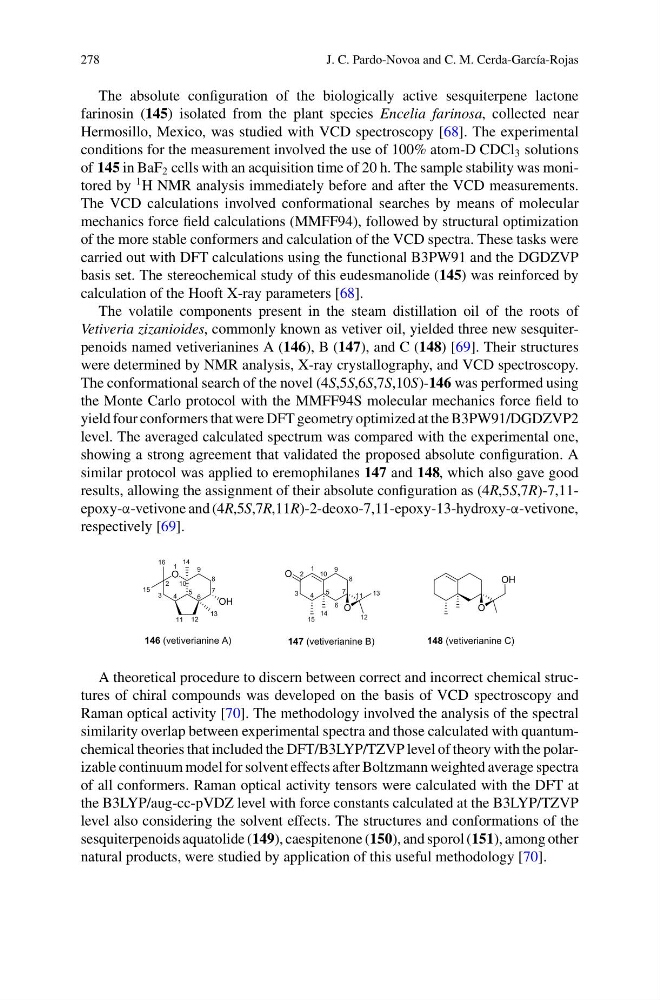
Vetiveria zizanioides, commonly known as vetiver oil, yielded three new sesquiterpenoids named vetiverianines A (146), B (147), and C (148) [69]. Their structures
were determined by NMR analysis, X-ray crystallography, and VCD spectroscopy.
The conformational search of the novel (4S,5S,6S,7S,10S)-146 was performed using
the Monte Carlo protocol with the MMFF94S molecular mechanics force field to
yield four conformers that were DFT geometry optimized at the B3PW91/DGDZVP2
level. The averaged calculated spectrum was compared with the experimental one,
showing a strong agreement that validated the proposed absolute configuration. A
similar protocol was applied to eremophilanes 147 and 148, which also gave good
results, allowing the assignment of their absolute configuration as (4R,5S,7R)-7,11epoxy-α-vetivone and (4R,5S,7R,11R)-2-deoxo-7,11-epoxy-13-hydroxy-α-vetivone,
respectively [69].
O
OH
O
O
O
OH
146 (vetiverianine A)
147 (vetiverianine B)
148 (vetiverianine C)
1
2
3
4
5
6
7
8
9
10
11 12
13
14
15
1
2
3
4
5
6
7
8
9
10
11
12
13
14
15
16
A theoretical procedure to discern between correct and incorrect chemical structures of chiral compounds was developed on the basis of VCD spectroscopy and
Raman optical activity [70]. The methodology involved the analysis of the spectral
similarity overlap between experimental spectra and those calculated with quantumchemical theories that included the DFT/B3LYP/TZVP level of theory with the polarizable continuum model for solvent effects after Boltzmann weighted average spectra
of all conformers. Raman optical activity tensors were calculated with the DFT at
the B3LYP/aug-cc-pVDZ level with force constants calculated at the B3LYP/TZVP
level also considering the solvent effects. The structures and conformations of the
sesquiterpenoids aquatolide (149), caespitenone (150), and sporol (151), among other
natural products, were studied by application of this useful methodology [70].
J. C. Pardo-Novoa and C. M. Cerda-García-Rojas
The absolute configuration of the biologically active sesquiterpene lactone
farinosin (145) isolated from the plant species Encelia farinosa, collected near
Hermosillo, Mexico, was studied with VCD spectroscopy [68]. The experimental
conditions for the measurement involved the use of 100% atom-D CDCl 3 solutions
of 145 in BaF 2 cells with an acquisition time of 20 h. The sample stability was monitored by
1 H NMR analysis immediately before and after the VCD measurements.
The VCD calculations involved conformational searches by means of molecular
mechanics force field calculations (MMFF94), followed by structural optimization
of the more stable conformers and calculation of the VCD spectra. These tasks were
carried out with DFT calculations using the functional B3PW91 and the DGDZVP
basis set. The stereochemical study of this eudesmanolide (145) was reinforced by
calculation of the Hooft X-ray parameters [68].
The volatile components present in the steam distillation oil of the roots of
Vetiveria zizanioides, commonly known as vetiver oil, yielded three new sesquiterpenoids named vetiverianines A (146), B (147), and C (148) [69]. Their structures
were determined by NMR analysis, X-ray crystallography, and VCD spectroscopy.
The conformational search of the novel (4S,5S,6S,7S,10S)-146 was performed using
the Monte Carlo protocol with the MMFF94S molecular mechanics force field to
yield four conformers that were DFT geometry optimized at the B3PW91/DGDZVP2
level. The averaged calculated spectrum was compared with the experimental one,
showing a strong agreement that validated the proposed absolute configuration. A
similar protocol was applied to eremophilanes 147 and 148, which also gave good
results, allowing the assignment of their absolute configuration as (4R,5S,7R)-7,11epoxy-α-vetivone and (4R,5S,7R,11R)-2-deoxo-7,11-epoxy-13-hydroxy-α-vetivone,
respectively [69].
O
OH
O
O
O
OH
146 (vetiverianine A)
147 (vetiverianine B)
148 (vetiverianine C)
1
2
3
4
5
6
7
8
9
10
11 12
13
14
15
1
2
3
4
5
6
7
8
9
10
11
12
13
14
15
16
A theoretical procedure to discern between correct and incorrect chemical structures of chiral compounds was developed on the basis of VCD spectroscopy and
Raman optical activity [70]. The methodology involved the analysis of the spectral
similarity overlap between experimental spectra and those calculated with quantumchemical theories that included the DFT/B3LYP/TZVP level of theory with the polarizable continuum model for solvent effects after Boltzmann weighted average spectra
of all conformers. Raman optical activity tensors were calculated with the DFT at
the B3LYP/aug-cc-pVDZ level with force constants calculated at the B3LYP/TZVP
level also considering the solvent effects. The structures and conformations of the
sesquiterpenoids aquatolide (149), caespitenone (150), and sporol (151), among other
natural products, were studied by application of this useful methodology [70].