

280
J. C. Pardo-Novoa and C. M. Cerda-García-Rojas
Sequencing of 16S rDNA disclosed that the mats contained closely related Oscillatoriacean species, including an unknown cyanobacterium belonging to the genus
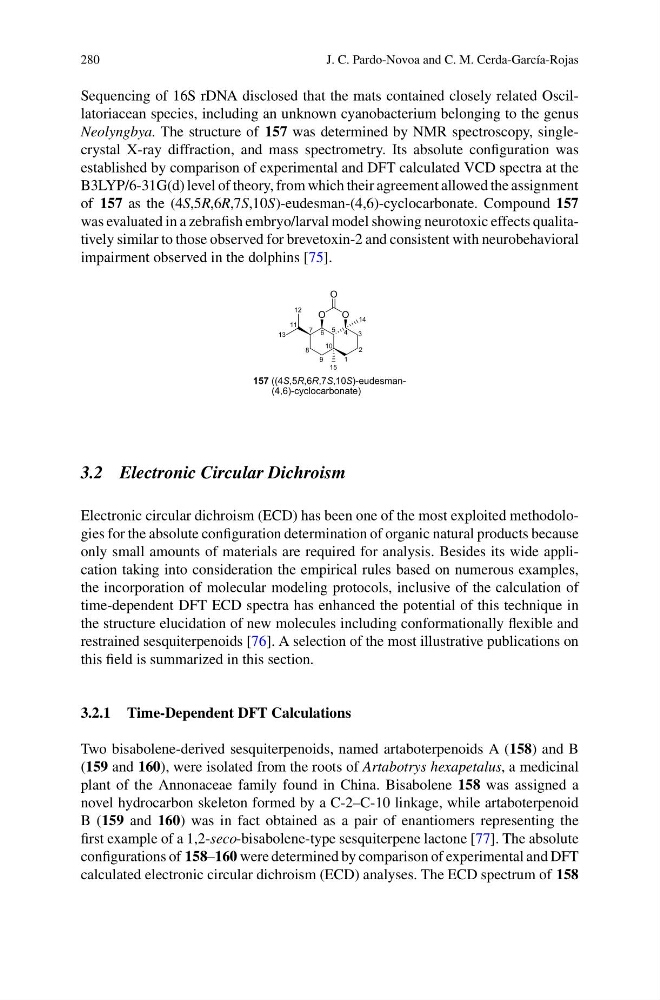
Neolyngbya. The structure of 157 was determined by NMR spectroscopy, singlecrystal X-ray diffraction, and mass spectrometry. Its absolute configuration was
established by comparison of experimental and DFT calculated VCD spectra at the
B3LYP/6-31G(d) level of theory, from which their agreement allowed the assignment
of 157 as the (4S,5R,6R,7S,10S)-eudesman-(4,6)-cyclocarbonate. Compound 157
was evaluated in a zebrafish embryo/larval model showing neurotoxic effects qualitatively similar to those observed for brevetoxin-2 and consistent with neurobehavioral
impairment observed in the dolphins [75].
O
O
O
157 ((4S,5R,6R,7S,10S)-eudesman(4,6)-cyclocarbonate)
1
2
3
4
5
6
7
8
9
10
11
12
13
14
15
3.2 Electronic Circular Dichroism
Electronic circular dichroism (ECD) has been one of the most exploited methodologies for the absolute configuration determination of organic natural products because
only small amounts of materials are required for analysis. Besides its wide application taking into consideration the empirical rules based on numerous examples,
the incorporation of molecular modeling protocols, inclusive of the calculation of
time-dependent DFT ECD spectra has enhanced the potential of this technique in
the structure elucidation of new molecules including conformationally flexible and
restrained sesquiterpenoids [76]. A selection of the most illustrative publications on
this field is summarized in this section.
3.2.1 Time-Dependent DFT Calculations
Two bisabolene-derived sesquiterpenoids, named artaboterpenoids A (158) and B
(159 and 160), were isolated from the roots of Artabotrys hexapetalus, a medicinal
plant of the Annonaceae family found in China. Bisabolene 158 was assigned a
novel hydrocarbon skeleton formed by a C-2–C-10 linkage, while artaboterpenoid
B (159 and 160) was in fact obtained as a pair of enantiomers representing the
first example of a 1,2-seco-bisabolene-type sesquiterpene lactone [77]. The absolute
configurations of 158–160 were determined by comparison of experimental and DFT
calculated electronic circular dichroism (ECD) analyses. The ECD spectrum of 158
J. C. Pardo-Novoa and C. M. Cerda-García-Rojas
Sequencing of 16S rDNA disclosed that the mats contained closely related Oscillatoriacean species, including an unknown cyanobacterium belonging to the genus
Neolyngbya. The structure of 157 was determined by NMR spectroscopy, singlecrystal X-ray diffraction, and mass spectrometry. Its absolute configuration was
established by comparison of experimental and DFT calculated VCD spectra at the
B3LYP/6-31G(d) level of theory, from which their agreement allowed the assignment
of 157 as the (4S,5R,6R,7S,10S)-eudesman-(4,6)-cyclocarbonate. Compound 157
was evaluated in a zebrafish embryo/larval model showing neurotoxic effects qualitatively similar to those observed for brevetoxin-2 and consistent with neurobehavioral
impairment observed in the dolphins [75].
O
O
O
157 ((4S,5R,6R,7S,10S)-eudesman(4,6)-cyclocarbonate)
1
2
3
4
5
6
7
8
9
10
11
12
13
14
15
3.2 Electronic Circular Dichroism
Electronic circular dichroism (ECD) has been one of the most exploited methodologies for the absolute configuration determination of organic natural products because
only small amounts of materials are required for analysis. Besides its wide application taking into consideration the empirical rules based on numerous examples,
the incorporation of molecular modeling protocols, inclusive of the calculation of
time-dependent DFT ECD spectra has enhanced the potential of this technique in
the structure elucidation of new molecules including conformationally flexible and
restrained sesquiterpenoids [76]. A selection of the most illustrative publications on
this field is summarized in this section.
3.2.1 Time-Dependent DFT Calculations
Two bisabolene-derived sesquiterpenoids, named artaboterpenoids A (158) and B
(159 and 160), were isolated from the roots of Artabotrys hexapetalus, a medicinal
plant of the Annonaceae family found in China. Bisabolene 158 was assigned a
novel hydrocarbon skeleton formed by a C-2–C-10 linkage, while artaboterpenoid
B (159 and 160) was in fact obtained as a pair of enantiomers representing the
first example of a 1,2-seco-bisabolene-type sesquiterpene lactone [77]. The absolute
configurations of 158–160 were determined by comparison of experimental and DFT
calculated electronic circular dichroism (ECD) analyses. The ECD spectrum of 158