

272
J. C. Pardo-Novoa and C. M. Cerda-García-Rojas
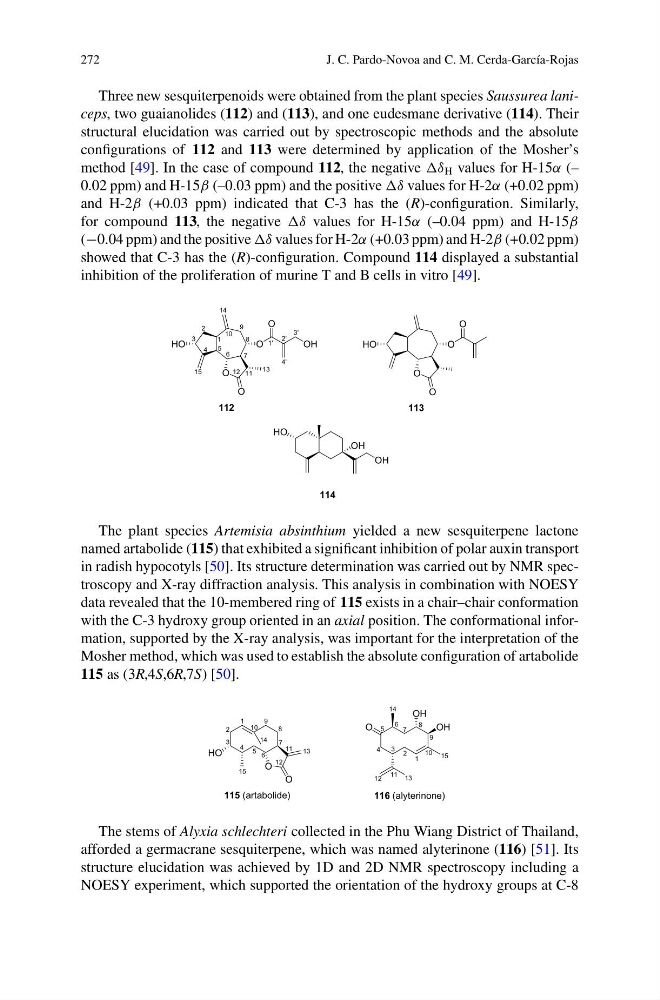
Three new sesquiterpenoids were obtained from the plant species Saussurea laniceps, two guaianolides (112) and (113), and one eudesmane derivative (114). Their
structural elucidation was carried out by spectroscopic methods and the absolute
configurations of 112 and 113 were determined by application of the Mosher’s
method [49]. In the case of compound 112, the negative H values for H-15α (–
0.02 ppm) and H-15β (–0.03 ppm) and the positive δ values for H-2α (+0.02 ppm)
and H-2β (+0.03 ppm) indicated that C-3 has the (R)-configuration. Similarly,
for compound 113, the negative δ values for H-15α (–0.04 ppm) and H-15β
(−0.04 ppm) and the positive δ values for H-2α (+0.03 ppm) and H-2β (+0.02 ppm)
showed that C-3 has the (R)-configuration. Compound 114 displayed a substantial
inhibition of the proliferation of murine T and B cells in vitro [49].
O
O
O
O
OH
HO
O
O
O
O
HO
1
3
5
10
14
8
7
12 11
1'
2'
3'
4'
13
15
112
113
2
4
6
9
HO
OH
OH
114
The plant species Artemisia absinthium yielded a new sesquiterpene lactone
named artabolide (115) that exhibited a significant inhibition of polar auxin transport
in radish hypocotyls [50]. Its structure determination was carried out by NMR spectroscopy and X-ray diffraction analysis. This analysis in combination with NOESY
data revealed that the 10-membered ring of 115 exists in a chair–chair conformation
with the C-3 hydroxy group oriented in an axial position. The conformational information, supported by the X-ray analysis, was important for the interpretation of the
Mosher method, which was used to establish the absolute configuration of artabolide
115 as (3R,4S,6R,7S) [50].
O
HO
O
1
3
5
7
9
10
11
13
12
15
14
115 (artabolide)
2
4
6
8
O
OH
OH
116 (alyterinone)
1
2
3
4
5
6
7
8
9
10
11
12
13
14
15
The stems of Alyxia schlechteri collected in the Phu Wiang District of Thailand,
afforded a germacrane sesquiterpene, which was named alyterinone (116) [51]. Its
structure elucidation was achieved by 1D and 2D NMR spectroscopy including a
NOESY experiment, which supported the orientation of the hydroxy groups at C-8
J. C. Pardo-Novoa and C. M. Cerda-García-Rojas
Three new sesquiterpenoids were obtained from the plant species Saussurea laniceps, two guaianolides (112) and (113), and one eudesmane derivative (114). Their
structural elucidation was carried out by spectroscopic methods and the absolute
configurations of 112 and 113 were determined by application of the Mosher’s
method [49]. In the case of compound 112, the negative H values for H-15α (–
0.02 ppm) and H-15β (–0.03 ppm) and the positive δ values for H-2α (+0.02 ppm)
and H-2β (+0.03 ppm) indicated that C-3 has the (R)-configuration. Similarly,
for compound 113, the negative δ values for H-15α (–0.04 ppm) and H-15β
(−0.04 ppm) and the positive δ values for H-2α (+0.03 ppm) and H-2β (+0.02 ppm)
showed that C-3 has the (R)-configuration. Compound 114 displayed a substantial
inhibition of the proliferation of murine T and B cells in vitro [49].
O
O
O
O
OH
HO
O
O
O
O
HO
1
3
5
10
14
8
7
12 11
1'
2'
3'
4'
13
15
112
113
2
4
6
9
HO
OH
OH
114
The plant species Artemisia absinthium yielded a new sesquiterpene lactone
named artabolide (115) that exhibited a significant inhibition of polar auxin transport
in radish hypocotyls [50]. Its structure determination was carried out by NMR spectroscopy and X-ray diffraction analysis. This analysis in combination with NOESY
data revealed that the 10-membered ring of 115 exists in a chair–chair conformation
with the C-3 hydroxy group oriented in an axial position. The conformational information, supported by the X-ray analysis, was important for the interpretation of the
Mosher method, which was used to establish the absolute configuration of artabolide
115 as (3R,4S,6R,7S) [50].
O
HO
O
1
3
5
7
9
10
11
13
12
15
14
115 (artabolide)
2
4
6
8
O
OH
OH
116 (alyterinone)
1
2
3
4
5
6
7
8
9
10
11
12
13
14
15
The stems of Alyxia schlechteri collected in the Phu Wiang District of Thailand,
afforded a germacrane sesquiterpene, which was named alyterinone (116) [51]. Its
structure elucidation was achieved by 1D and 2D NMR spectroscopy including a
NOESY experiment, which supported the orientation of the hydroxy groups at C-8