

New Techniques of Structure Elucidation for Sesquiterpenes
271
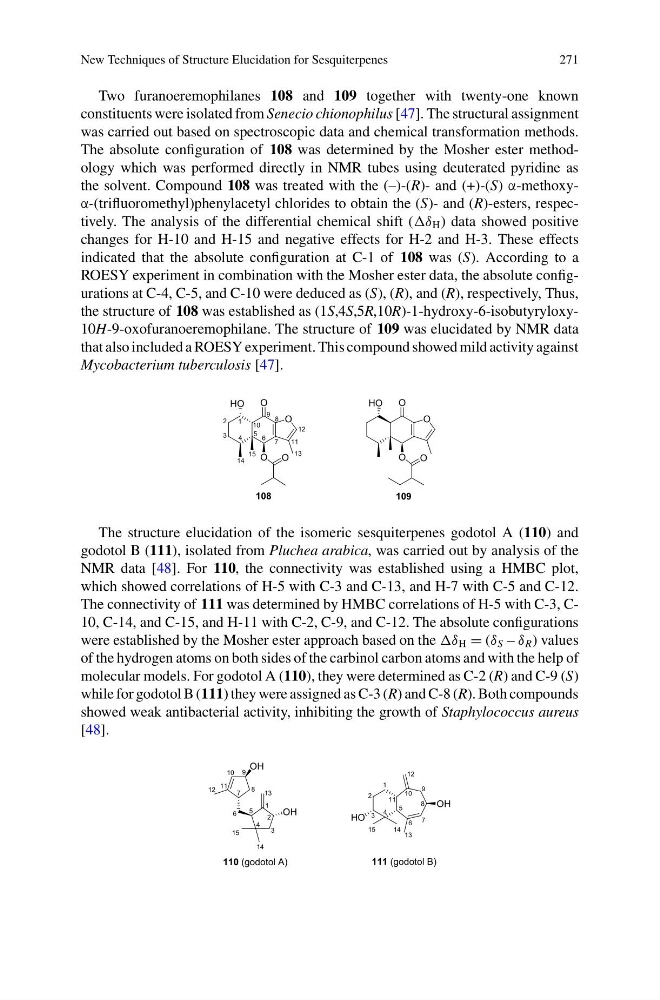
Two furanoeremophilanes 108 and 109 together with twenty-one known
constituents were isolated from Senecio chionophilus [47]. The structural assignment
was carried out based on spectroscopic data and chemical transformation methods.
The absolute configuration of 108 was determined by the Mosher ester methodology which was performed directly in NMR tubes using deuterated pyridine as
the solvent. Compound 108 was treated with the (–)-(R)- and (+)-(S) α-methoxyα-(trifluoromethyl)phenylacetyl chlorides to obtain the (S)- and (R)-esters, respectively. The analysis of the differential chemical shift ( H ) data showed positive
changes for H-10 and H-15 and negative effects for H-2 and H-3. These effects
indicated that the absolute configuration at C-1 of 108 was (S). According to a
ROESY experiment in combination with the Mosher ester data, the absolute configurations at C-4, C-5, and C-10 were deduced as (S), (R), and (R), respectively, Thus,
the structure of 108 was established as (1S,4S,5R,10R)-1-hydroxy-6-isobutyryloxy10H-9-oxofuranoeremophilane. The structure of 109 was elucidated by NMR data
that also included a ROESY experiment. This compound showed mild activity against
Mycobacterium tuberculosis [47].
O
O
O
HO
O
O
O
HO
1
2
3
4
5 6 7
8
9
10
11
12
13
14
15
O
O
108
109
The structure elucidation of the isomeric sesquiterpenes godotol A (110) and
godotol B (111), isolated from Pluchea arabica, was carried out by analysis of the
NMR data [48]. For 110, the connectivity was established using a HMBC plot,
which showed correlations of H-5 with C-3 and C-13, and H-7 with C-5 and C-12.
The connectivity of 111 was determined by HMBC correlations of H-5 with C-3, C10, C-14, and C-15, and H-11 with C-2, C-9, and C-12. The absolute configurations
were established by the Mosher ester approach based on the H = (δ S – δ R ) values
of the hydrogen atoms on both sides of the carbinol carbon atoms and with the help of
molecular models. For godotol A (110), they were determined as C-2 (R) and C-9 (S)
while for godotol B (111) they were assigned as C-3 (R) and C-8 (R). Both compounds
showed weak antibacterial activity, inhibiting the growth of Staphylococcus aureus
[48].
OH
OH
HO
OH
110 (godotol A)
111 (godotol B)
1
2
3
4
5
6
7
8
9
10
11
12
13
14
15
1
2
3 4
5
6 7
8
9
10
11
12
13
14
15
271
Two furanoeremophilanes 108 and 109 together with twenty-one known
constituents were isolated from Senecio chionophilus [47]. The structural assignment
was carried out based on spectroscopic data and chemical transformation methods.
The absolute configuration of 108 was determined by the Mosher ester methodology which was performed directly in NMR tubes using deuterated pyridine as
the solvent. Compound 108 was treated with the (–)-(R)- and (+)-(S) α-methoxyα-(trifluoromethyl)phenylacetyl chlorides to obtain the (S)- and (R)-esters, respectively. The analysis of the differential chemical shift ( H ) data showed positive
changes for H-10 and H-15 and negative effects for H-2 and H-3. These effects
indicated that the absolute configuration at C-1 of 108 was (S). According to a
ROESY experiment in combination with the Mosher ester data, the absolute configurations at C-4, C-5, and C-10 were deduced as (S), (R), and (R), respectively, Thus,
the structure of 108 was established as (1S,4S,5R,10R)-1-hydroxy-6-isobutyryloxy10H-9-oxofuranoeremophilane. The structure of 109 was elucidated by NMR data
that also included a ROESY experiment. This compound showed mild activity against
Mycobacterium tuberculosis [47].
O
O
O
HO
O
O
O
HO
1
2
3
4
5 6 7
8
9
10
11
12
13
14
15
O
O
108
109
The structure elucidation of the isomeric sesquiterpenes godotol A (110) and
godotol B (111), isolated from Pluchea arabica, was carried out by analysis of the
NMR data [48]. For 110, the connectivity was established using a HMBC plot,
which showed correlations of H-5 with C-3 and C-13, and H-7 with C-5 and C-12.
The connectivity of 111 was determined by HMBC correlations of H-5 with C-3, C10, C-14, and C-15, and H-11 with C-2, C-9, and C-12. The absolute configurations
were established by the Mosher ester approach based on the H = (δ S – δ R ) values
of the hydrogen atoms on both sides of the carbinol carbon atoms and with the help of
molecular models. For godotol A (110), they were determined as C-2 (R) and C-9 (S)
while for godotol B (111) they were assigned as C-3 (R) and C-8 (R). Both compounds
showed weak antibacterial activity, inhibiting the growth of Staphylococcus aureus
[48].
OH
OH
HO
OH
110 (godotol A)
111 (godotol B)
1
2
3
4
5
6
7
8
9
10
11
12
13
14
15
1
2
3 4
5
6 7
8
9
10
11
12
13
14
15