

New Techniques of Structure Elucidation for Sesquiterpenes
273
and C-9 that exist in a trans configuration. Also, H-6α showed NOESY correlations
with H-4α and H-12 of the α-isopropenyl group, while H-8 and Me-14 showed
a correlation that indicated their axial β-orientation. Application of the Mosher
methodology gave the corresponding monoesters at C-8, revealing that this chiral
center was (S) and allowing the full assignment of the absolute configuration of
alyterinone (116) [51].
A new hirsutane sesquiterpenoid with an uncommon variation in the hydrocarbon
skeleton was isolated from the cultures of the basidiomycete fungus Lentinus cf.
fasciatus [52]. This tricyclic compound, named lentinulactam (117), exhibited a
conjugated bridged lactam as the distinctive feature. Its structure and absolute configuration were established by NMR spectroscopy in combination with Mosher ester
analysis and calculation of a molecular mechanics model. The analysis of the absolute configuration indicated that lentinulactam (117) has the opposite configuration
to that of related hirsutane derivatives [52].
OH
NH
O
HO
117 (lentinulactam)
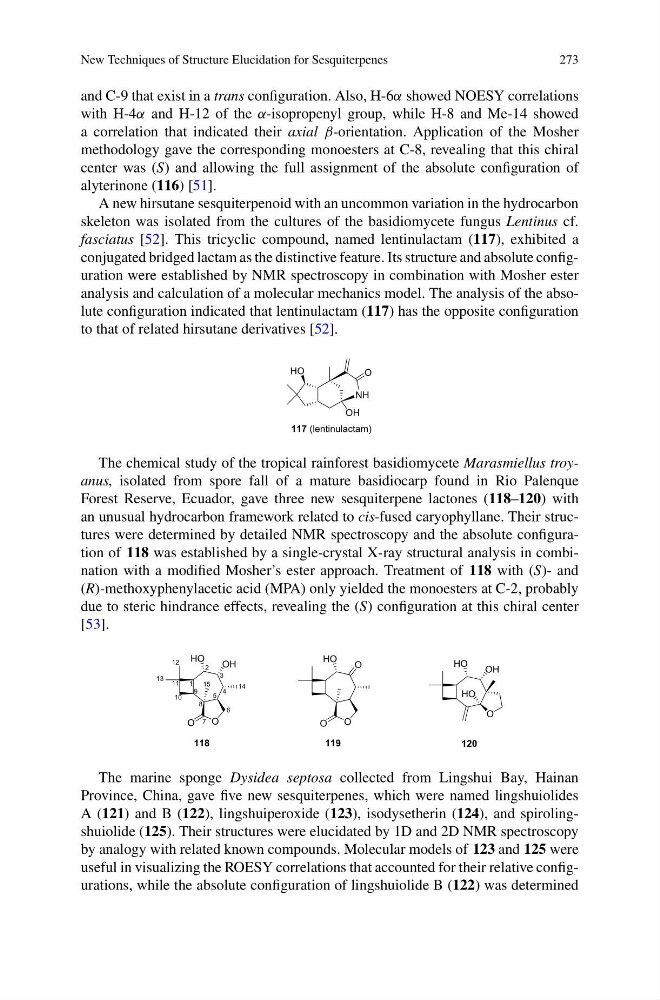
The chemical study of the tropical rainforest basidiomycete Marasmiellus troyanus, isolated from spore fall of a mature basidiocarp found in Rio Palenque
Forest Reserve, Ecuador, gave three new sesquiterpene lactones (118–120) with
an unusual hydrocarbon framework related to cis-fused caryophyllane. Their structures were determined by detailed NMR spectroscopy and the absolute configuration of 118 was established by a single-crystal X-ray structural analysis in combination with a modified Mosher’s ester approach. Treatment of 118 with (S)- and
(R)-methoxyphenylacetic acid (MPA) only yielded the monoesters at C-2, probably
due to steric hindrance effects, revealing the (S) configuration at this chiral center
[53].
O
HO
OH
O
O
HO
O
O
HO
OH
O
HO
118
119
120
1
2
3
4
5
6
7
8
9
10
11
12
13
14
15
The marine sponge Dysidea septosa collected from Lingshui Bay, Hainan
Province, China, gave five new sesquiterpenes, which were named lingshuiolides
A (121) and B (122), lingshuiperoxide (123), isodysetherin (124), and spirolingshuiolide (125). Their structures were elucidated by 1D and 2D NMR spectroscopy
by analogy with related known compounds. Molecular models of 123 and 125 were
useful in visualizing the ROESY correlations that accounted for their relative configurations, while the absolute configuration of lingshuiolide B (122) was determined
273
and C-9 that exist in a trans configuration. Also, H-6α showed NOESY correlations
with H-4α and H-12 of the α-isopropenyl group, while H-8 and Me-14 showed
a correlation that indicated their axial β-orientation. Application of the Mosher
methodology gave the corresponding monoesters at C-8, revealing that this chiral
center was (S) and allowing the full assignment of the absolute configuration of
alyterinone (116) [51].
A new hirsutane sesquiterpenoid with an uncommon variation in the hydrocarbon
skeleton was isolated from the cultures of the basidiomycete fungus Lentinus cf.
fasciatus [52]. This tricyclic compound, named lentinulactam (117), exhibited a
conjugated bridged lactam as the distinctive feature. Its structure and absolute configuration were established by NMR spectroscopy in combination with Mosher ester
analysis and calculation of a molecular mechanics model. The analysis of the absolute configuration indicated that lentinulactam (117) has the opposite configuration
to that of related hirsutane derivatives [52].
OH
NH
O
HO
117 (lentinulactam)
The chemical study of the tropical rainforest basidiomycete Marasmiellus troyanus, isolated from spore fall of a mature basidiocarp found in Rio Palenque
Forest Reserve, Ecuador, gave three new sesquiterpene lactones (118–120) with
an unusual hydrocarbon framework related to cis-fused caryophyllane. Their structures were determined by detailed NMR spectroscopy and the absolute configuration of 118 was established by a single-crystal X-ray structural analysis in combination with a modified Mosher’s ester approach. Treatment of 118 with (S)- and
(R)-methoxyphenylacetic acid (MPA) only yielded the monoesters at C-2, probably
due to steric hindrance effects, revealing the (S) configuration at this chiral center
[53].
O
HO
OH
O
O
HO
O
O
HO
OH
O
HO
118
119
120
1
2
3
4
5
6
7
8
9
10
11
12
13
14
15
The marine sponge Dysidea septosa collected from Lingshui Bay, Hainan
Province, China, gave five new sesquiterpenes, which were named lingshuiolides
A (121) and B (122), lingshuiperoxide (123), isodysetherin (124), and spirolingshuiolide (125). Their structures were elucidated by 1D and 2D NMR spectroscopy
by analogy with related known compounds. Molecular models of 123 and 125 were
useful in visualizing the ROESY correlations that accounted for their relative configurations, while the absolute configuration of lingshuiolide B (122) was determined