

Bioactive Compounds from Medicinal Plants in Myanmar
215
O
O
O
O
O
R
O
HO
OH
HO
HO
O
O
O
O
HO
OH
HO
HO
O
418 (sweroside)
O
HO
OH
HO
HO
O
O
OR
O
HO
419 (8-epi-loganin) R = Me
420 (8-epi-loganic acid) R = H
O
O
O
O
O
O
O
HO
OH
HO
HO
O
O
O
O
421 (sylvestroside IV dimethyl acetal)
416 (abelioside A methyl acetal) R = CH(OMe) 2
417 (abelioside A) R = CHO
O
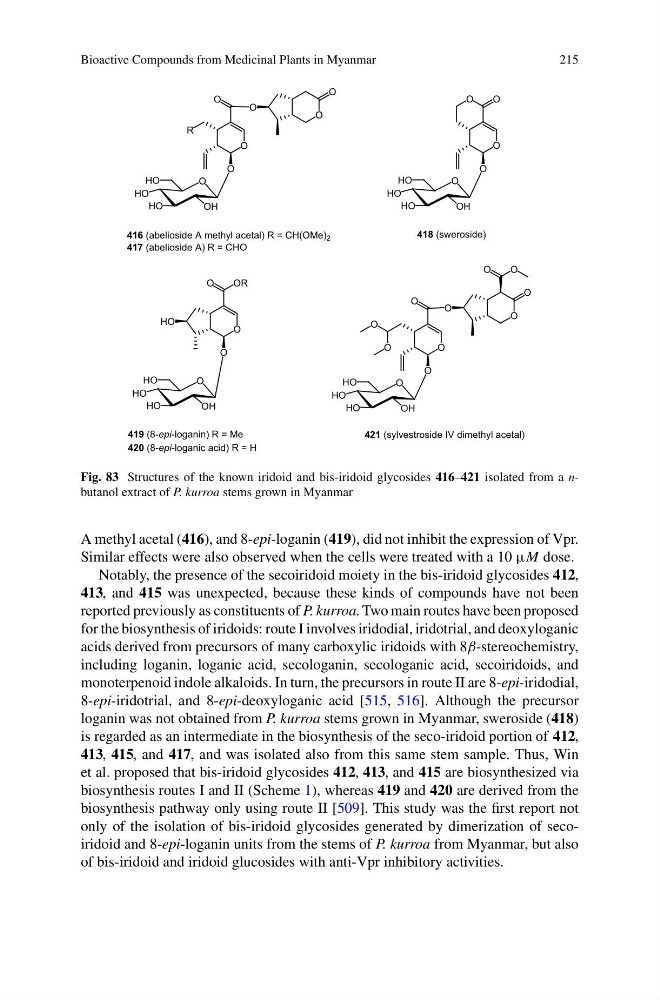
Fig. 83 Structures of the known iridoid and bis-iridoid glycosides 416–421 isolated from a nbutanol extract of P. kurroa stems grown in Myanmar
A methyl acetal (416), and 8-epi-loganin (419), did not inhibit the expression of Vpr.
Similar effects were also observed when the cells were treated with a 10 μM dose.
Notably, the presence of the secoiridoid moiety in the bis-iridoid glycosides 412,
413, and 415 was unexpected, because these kinds of compounds have not been
reported previously as constituents of P. kurroa. Two main routes have been proposed
for the biosynthesis of iridoids: route I involves iridodial, iridotrial, and deoxyloganic
acids derived from precursors of many carboxylic iridoids with 8β-stereochemistry,
including loganin, loganic acid, secologanin, secologanic acid, secoiridoids, and
monoterpenoid indole alkaloids. In turn, the precursors in route II are 8-epi-iridodial,
8-epi-iridotrial, and 8-epi-deoxyloganic acid [515, 516]. Although the precursor
loganin was not obtained from P. kurroa stems grown in Myanmar, sweroside (418)
is regarded as an intermediate in the biosynthesis of the seco-iridoid portion of 412,
413, 415, and 417, and was isolated also from this same stem sample. Thus, Win
et al. proposed that bis-iridoid glycosides 412, 413, and 415 are biosynthesized via
biosynthesis routes I and II (Scheme 1), whereas 419 and 420 are derived from the
biosynthesis pathway only using route II [509]. This study was the first report not
only of the isolation of bis-iridoid glycosides generated by dimerization of secoiridoid and 8-epi-loganin units from the stems of P. kurroa from Myanmar, but also
of bis-iridoid and iridoid glucosides with anti-Vpr inhibitory activities.
215
O
O
O
O
O
R
O
HO
OH
HO
HO
O
O
O
O
HO
OH
HO
HO
O
418 (sweroside)
O
HO
OH
HO
HO
O
O
OR
O
HO
419 (8-epi-loganin) R = Me
420 (8-epi-loganic acid) R = H
O
O
O
O
O
O
O
HO
OH
HO
HO
O
O
O
O
421 (sylvestroside IV dimethyl acetal)
416 (abelioside A methyl acetal) R = CH(OMe) 2
417 (abelioside A) R = CHO
O
Fig. 83 Structures of the known iridoid and bis-iridoid glycosides 416–421 isolated from a nbutanol extract of P. kurroa stems grown in Myanmar
A methyl acetal (416), and 8-epi-loganin (419), did not inhibit the expression of Vpr.
Similar effects were also observed when the cells were treated with a 10 μM dose.
Notably, the presence of the secoiridoid moiety in the bis-iridoid glycosides 412,
413, and 415 was unexpected, because these kinds of compounds have not been
reported previously as constituents of P. kurroa. Two main routes have been proposed
for the biosynthesis of iridoids: route I involves iridodial, iridotrial, and deoxyloganic
acids derived from precursors of many carboxylic iridoids with 8β-stereochemistry,
including loganin, loganic acid, secologanin, secologanic acid, secoiridoids, and
monoterpenoid indole alkaloids. In turn, the precursors in route II are 8-epi-iridodial,
8-epi-iridotrial, and 8-epi-deoxyloganic acid [515, 516]. Although the precursor
loganin was not obtained from P. kurroa stems grown in Myanmar, sweroside (418)
is regarded as an intermediate in the biosynthesis of the seco-iridoid portion of 412,
413, 415, and 417, and was isolated also from this same stem sample. Thus, Win
et al. proposed that bis-iridoid glycosides 412, 413, and 415 are biosynthesized via
biosynthesis routes I and II (Scheme 1), whereas 419 and 420 are derived from the
biosynthesis pathway only using route II [509]. This study was the first report not
only of the isolation of bis-iridoid glycosides generated by dimerization of secoiridoid and 8-epi-loganin units from the stems of P. kurroa from Myanmar, but also
of bis-iridoid and iridoid glucosides with anti-Vpr inhibitory activities.