

214
N. N. Win and H. Morita
O
HO
OH
HO
HO
O
O
O
O
O
O
O
O
R
O
HO
OH
HO
HO
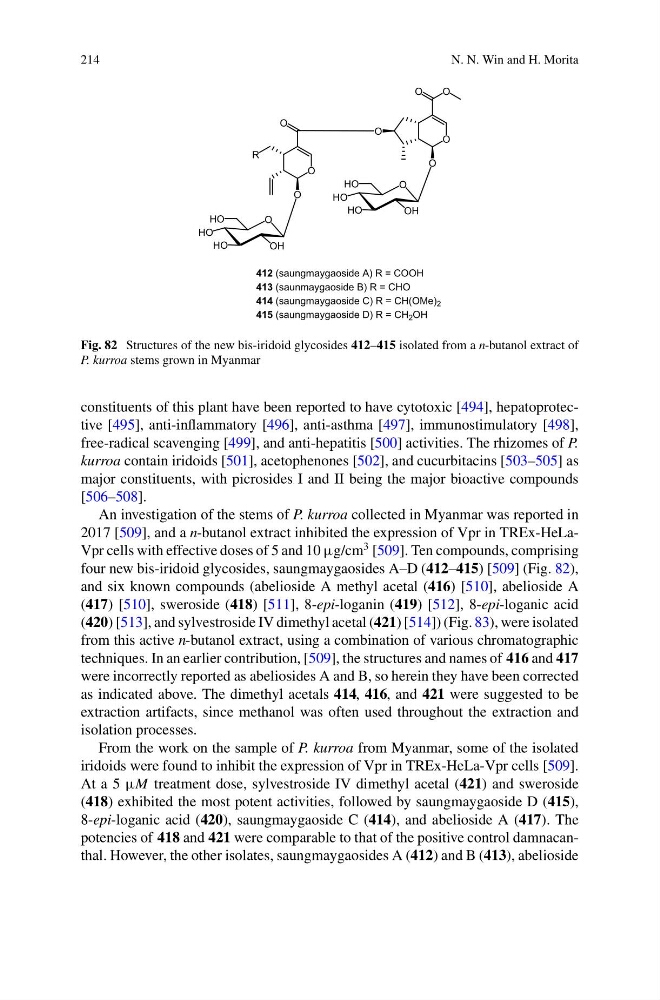
412 (saungmaygaoside A) R = COOH
413 (saunmaygaoside B) R = CHO
414 (saungmaygaoside C) R = CH(OMe) 2
415 (saungmaygaoside D) R = CH 2 OH
Fig. 82 Structures of the new bis-iridoid glycosides 412–415 isolated from a n-butanol extract of
P. kurroa stems grown in Myanmar
constituents of this plant have been reported to have cytotoxic [494], hepatoprotective [495], anti-inflammatory [496], anti-asthma [497], immunostimulatory [498],
free-radical scavenging [499], and anti-hepatitis [500] activities. The rhizomes of P.
kurroa contain iridoids [501], acetophenones [502], and cucurbitacins [503–505] as
major constituents, with picrosides I and II being the major bioactive compounds
[506–508].
An investigation of the stems of P. kurroa collected in Myanmar was reported in
2017 [509], and a n-butanol extract inhibited the expression of Vpr in TREx-HeLaVpr cells with effective doses of 5 and 10 μg/cm
3 [509]. Ten compounds, comprising
four new bis-iridoid glycosides, saungmaygaosides A–D (412–415) [509] (Fig. 82),
and six known compounds (abelioside A methyl acetal (416) [510], abelioside A
(417) [510], sweroside (418) [511], 8-epi-loganin (419) [512], 8-epi-loganic acid
(420) [513], and sylvestroside IV dimethyl acetal (421) [514]) (Fig. 83), were isolated
from this active n-butanol extract, using a combination of various chromatographic
techniques. In an earlier contribution, [509], the structures and names of 416 and 417
were incorrectly reported as abeliosides A and B, so herein they have been corrected
as indicated above. The dimethyl acetals 414, 416, and 421 were suggested to be
extraction artifacts, since methanol was often used throughout the extraction and
isolation processes.
From the work on the sample of P. kurroa from Myanmar, some of the isolated
iridoids were found to inhibit the expression of Vpr in TREx-HeLa-Vpr cells [509].
At a 5 μM treatment dose, sylvestroside IV dimethyl acetal (421) and sweroside
(418) exhibited the most potent activities, followed by saungmaygaoside D (415),
8-epi-loganic acid (420), saungmaygaoside C (414), and abelioside A (417). The
potencies of 418 and 421 were comparable to that of the positive control damnacanthal. However, the other isolates, saungmaygaosides A (412) and B (413), abelioside
N. N. Win and H. Morita
O
HO
OH
HO
HO
O
O
O
O
O
O
O
O
R
O
HO
OH
HO
HO
412 (saungmaygaoside A) R = COOH
413 (saunmaygaoside B) R = CHO
414 (saungmaygaoside C) R = CH(OMe) 2
415 (saungmaygaoside D) R = CH 2 OH
Fig. 82 Structures of the new bis-iridoid glycosides 412–415 isolated from a n-butanol extract of
P. kurroa stems grown in Myanmar
constituents of this plant have been reported to have cytotoxic [494], hepatoprotective [495], anti-inflammatory [496], anti-asthma [497], immunostimulatory [498],
free-radical scavenging [499], and anti-hepatitis [500] activities. The rhizomes of P.
kurroa contain iridoids [501], acetophenones [502], and cucurbitacins [503–505] as
major constituents, with picrosides I and II being the major bioactive compounds
[506–508].
An investigation of the stems of P. kurroa collected in Myanmar was reported in
2017 [509], and a n-butanol extract inhibited the expression of Vpr in TREx-HeLaVpr cells with effective doses of 5 and 10 μg/cm
3 [509]. Ten compounds, comprising
four new bis-iridoid glycosides, saungmaygaosides A–D (412–415) [509] (Fig. 82),
and six known compounds (abelioside A methyl acetal (416) [510], abelioside A
(417) [510], sweroside (418) [511], 8-epi-loganin (419) [512], 8-epi-loganic acid
(420) [513], and sylvestroside IV dimethyl acetal (421) [514]) (Fig. 83), were isolated
from this active n-butanol extract, using a combination of various chromatographic
techniques. In an earlier contribution, [509], the structures and names of 416 and 417
were incorrectly reported as abeliosides A and B, so herein they have been corrected
as indicated above. The dimethyl acetals 414, 416, and 421 were suggested to be
extraction artifacts, since methanol was often used throughout the extraction and
isolation processes.
From the work on the sample of P. kurroa from Myanmar, some of the isolated
iridoids were found to inhibit the expression of Vpr in TREx-HeLa-Vpr cells [509].
At a 5 μM treatment dose, sylvestroside IV dimethyl acetal (421) and sweroside
(418) exhibited the most potent activities, followed by saungmaygaoside D (415),
8-epi-loganic acid (420), saungmaygaoside C (414), and abelioside A (417). The
potencies of 418 and 421 were comparable to that of the positive control damnacanthal. However, the other isolates, saungmaygaosides A (412) and B (413), abelioside