

200
N. N. Win and H. Morita
O
O
O
O
O
OH
353 (javanicin B)
O
O
O
O
O
O
353 (javanicin F)
O
O
O
O
O
O
353 (javanicin B)
O
O
O
O
353 (picrasin A)
HO
O
O
O
O
O
O
O
353 (2’-isopicrasin A)
HO
O
O
O
360 (lanosta-7,24-dien-3-one)
O
O
HO
O
O
361 (scopoletin)
N
N
O
362 (canthin-6-one)
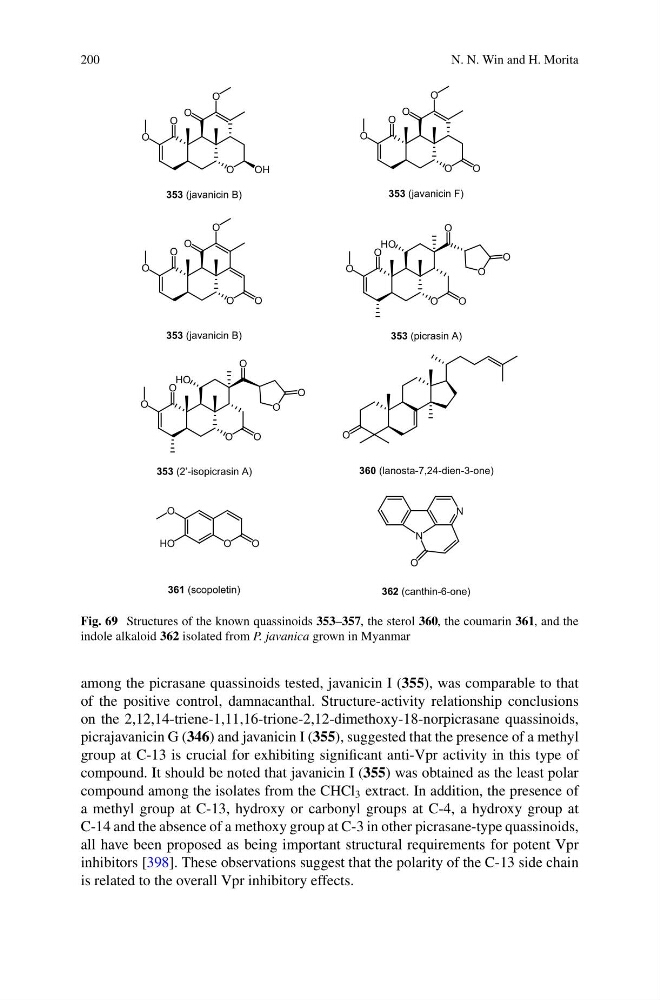
Fig. 69 Structures of the known quassinoids 353–357, the sterol 360, the coumarin 361, and the
indole alkaloid 362 isolated from P. javanica grown in Myanmar
among the picrasane quassinoids tested, javanicin I (355), was comparable to that
of the positive control, damnacanthal. Structure-activity relationship conclusions
on the 2,12,14-triene-1,11,16-trione-2,12-dimethoxy-18-norpicrasane quassinoids,
picrajavanicin G (346) and javanicin I (355), suggested that the presence of a methyl
group at C-13 is crucial for exhibiting significant anti-Vpr activity in this type of
compound. It should be noted that javanicin I (355) was obtained as the least polar
compound among the isolates from the CHCl 3 extract. In addition, the presence of
a methyl group at C-13, hydroxy or carbonyl groups at C-4, a hydroxy group at
C-14 and the absence of a methoxy group at C-3 in other picrasane-type quassinoids,
all have been proposed as being important structural requirements for potent Vpr
inhibitors [398]. These observations suggest that the polarity of the C-13 side chain
is related to the overall Vpr inhibitory effects.
N. N. Win and H. Morita
O
O
O
O
O
OH
353 (javanicin B)
O
O
O
O
O
O
353 (javanicin F)
O
O
O
O
O
O
353 (javanicin B)
O
O
O
O
353 (picrasin A)
HO
O
O
O
O
O
O
O
353 (2’-isopicrasin A)
HO
O
O
O
360 (lanosta-7,24-dien-3-one)
O
O
HO
O
O
361 (scopoletin)
N
N
O
362 (canthin-6-one)
Fig. 69 Structures of the known quassinoids 353–357, the sterol 360, the coumarin 361, and the
indole alkaloid 362 isolated from P. javanica grown in Myanmar
among the picrasane quassinoids tested, javanicin I (355), was comparable to that
of the positive control, damnacanthal. Structure-activity relationship conclusions
on the 2,12,14-triene-1,11,16-trione-2,12-dimethoxy-18-norpicrasane quassinoids,
picrajavanicin G (346) and javanicin I (355), suggested that the presence of a methyl
group at C-13 is crucial for exhibiting significant anti-Vpr activity in this type of
compound. It should be noted that javanicin I (355) was obtained as the least polar
compound among the isolates from the CHCl 3 extract. In addition, the presence of
a methyl group at C-13, hydroxy or carbonyl groups at C-4, a hydroxy group at
C-14 and the absence of a methoxy group at C-3 in other picrasane-type quassinoids,
all have been proposed as being important structural requirements for potent Vpr
inhibitors [398]. These observations suggest that the polarity of the C-13 side chain
is related to the overall Vpr inhibitory effects.