

Bioactive Compounds from Medicinal Plants in Myanmar
201
The constituents of P. javanica wood were described in 2019 [399]. Two unprecedented quassinoids, (16R)-methoxyjavanicin B (358) and (16S)-methoxyjavanicin B
(359) [399] (Fig. 68), and the known compounds, lanosta-7,24-dien-3-one (360)
[400], scopoletin (361) [401], and canthin-6-one (362) [402] (Fig. 69), were isolated
from a CHCl 3 -soluble portion of the MeOH extract of this plant part. P. javanica
wood contains also picrajavanicins B (341) and C (342) [396] and javanicins B (353)
[386] and F (354) [388], the same chemical constituents as found in P. javanica
bark (Fig. 69). Lanosta-7,24-dien-3-one (360) showed some activity against the
human lung (A549), breast (MCF7), and cervical (HeLa) cancer cell lines and the
normal fibroblast cell line tested, with IC 50 values ranging from 48.6 to 65.9 μM.
In contrast, (16R)-methoxyjavanicin B (358) and (16S)-methoxyjavanicin B (359)
exhibited higher activity (each with an MIC value of 1.6 μM), whereas 353 and 341
had inhibitory activity (MIC values of 6.3 and 3.1 μM) against the Gram-positive
bacterium, Bacillus subtilis.
2.20 Curcuma amada Roxb.
Curcuma amada is an important member of the genus Curcuma genus (family Zingiberaceae) and is known colloquially as mango ginger, due to the raw mango-like
aroma of the rhizomes. This herbaceous perennial plant is referred to in Myanmar
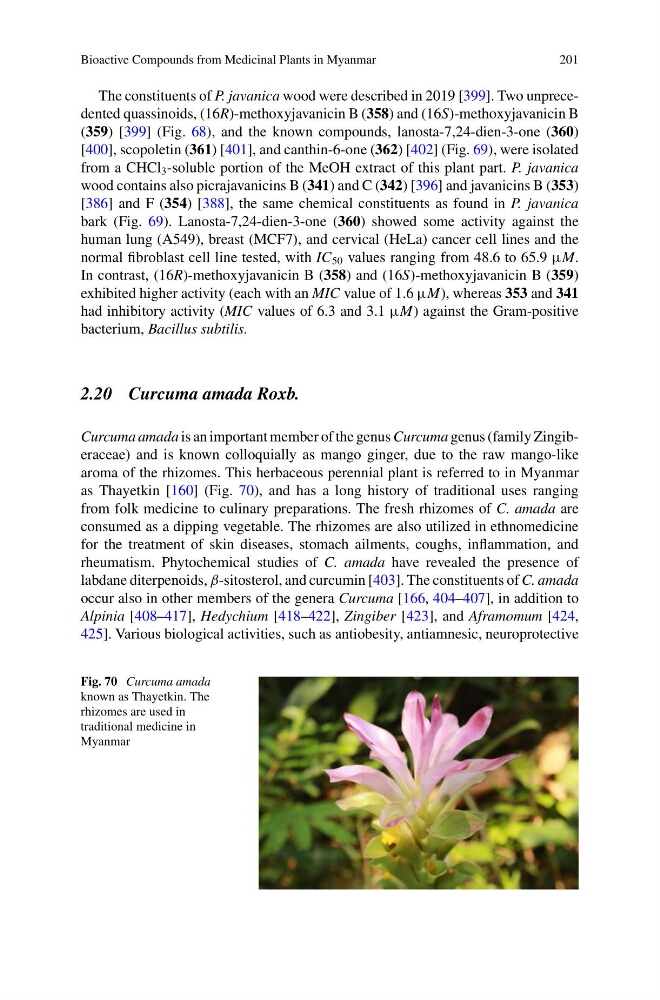
as Thayetkin [160] (Fig. 70), and has a long history of traditional uses ranging
from folk medicine to culinary preparations. The fresh rhizomes of C. amada are
consumed as a dipping vegetable. The rhizomes are also utilized in ethnomedicine
for the treatment of skin diseases, stomach ailments, coughs, inflammation, and
rheumatism. Phytochemical studies of C. amada have revealed the presence of
labdane diterpenoids, β-sitosterol, and curcumin [403]. The constituents of C. amada
occur also in other members of the genera Curcuma [166, 404–407], in addition to
Alpinia [408–417], Hedychium [418–422], Zingiber [423], and Aframomum [424,
425]. Various biological activities, such as antiobesity, antiamnesic, neuroprotective
Fig. 70 Curcuma amada
known as Thayetkin. The
rhizomes are used in
traditional medicine in
Myanmar
201
The constituents of P. javanica wood were described in 2019 [399]. Two unprecedented quassinoids, (16R)-methoxyjavanicin B (358) and (16S)-methoxyjavanicin B
(359) [399] (Fig. 68), and the known compounds, lanosta-7,24-dien-3-one (360)
[400], scopoletin (361) [401], and canthin-6-one (362) [402] (Fig. 69), were isolated
from a CHCl 3 -soluble portion of the MeOH extract of this plant part. P. javanica
wood contains also picrajavanicins B (341) and C (342) [396] and javanicins B (353)
[386] and F (354) [388], the same chemical constituents as found in P. javanica
bark (Fig. 69). Lanosta-7,24-dien-3-one (360) showed some activity against the
human lung (A549), breast (MCF7), and cervical (HeLa) cancer cell lines and the
normal fibroblast cell line tested, with IC 50 values ranging from 48.6 to 65.9 μM.
In contrast, (16R)-methoxyjavanicin B (358) and (16S)-methoxyjavanicin B (359)
exhibited higher activity (each with an MIC value of 1.6 μM), whereas 353 and 341
had inhibitory activity (MIC values of 6.3 and 3.1 μM) against the Gram-positive
bacterium, Bacillus subtilis.
2.20 Curcuma amada Roxb.
Curcuma amada is an important member of the genus Curcuma genus (family Zingiberaceae) and is known colloquially as mango ginger, due to the raw mango-like
aroma of the rhizomes. This herbaceous perennial plant is referred to in Myanmar
as Thayetkin [160] (Fig. 70), and has a long history of traditional uses ranging
from folk medicine to culinary preparations. The fresh rhizomes of C. amada are
consumed as a dipping vegetable. The rhizomes are also utilized in ethnomedicine
for the treatment of skin diseases, stomach ailments, coughs, inflammation, and
rheumatism. Phytochemical studies of C. amada have revealed the presence of
labdane diterpenoids, β-sitosterol, and curcumin [403]. The constituents of C. amada
occur also in other members of the genera Curcuma [166, 404–407], in addition to
Alpinia [408–417], Hedychium [418–422], Zingiber [423], and Aframomum [424,
425]. Various biological activities, such as antiobesity, antiamnesic, neuroprotective
Fig. 70 Curcuma amada
known as Thayetkin. The
rhizomes are used in
traditional medicine in
Myanmar