

Bioactive Compounds from Medicinal Plants in Myanmar
199
O
O
O
O
O
O
R
2
R
1
R
3
R
4
340 (picrajavanicin A) R 1 = R 2 = R 4 = H, R 3 = CHO
344 (picrajavanicin E) R 1 = OMe, R 2 = R 4 = H, R 3 = Me
345 (picrajavanicin F) R 1 = OMe, R 2 = H, R 3 = Me, R 4 = OH
347 (picrajavanicin H) R 1 = R 2 = R 4 = H, R 3 = CH 2 OH
349 (picrajavanicin J) R 1 = OMe, R 2 = R 4 = H, R 3 = CH 2 OH
350 (picrajavanicin K) R 1 = R 4 = H, R 2 = =O, R3 = Me
351 (picrajavanicin L) R1 = R 4 = H, R 2 = β-OH, R 3 = Me
352 (picrajavanicin M) R 1 = R 4 = H, R 2 = α-OH, R 3 = Me
O
O
O
R
1
O
O
O
R
1
R
2
R
3
O
O
O
O
O
O
O
O
O
O
O
R
341 (picrajavanicin B) R
1 = R
3 = H, R
2 = Me
342 (picrajavanicin C) R
1 = R
2 = Me, R
3 = H
343 (picrajavanicin D) R
1 = H, R
2 = Me, R
3 = OH
348 (picrajavanicin I) R
1 = R
3 = H, R
2 = CH 2 OH
358 ((16R)-methoxyjavanicin B) R = α-OMe
359 ((16S)-methoxyjavanicin B) R = β-OMe
346 (picrajavanicin G)
OH
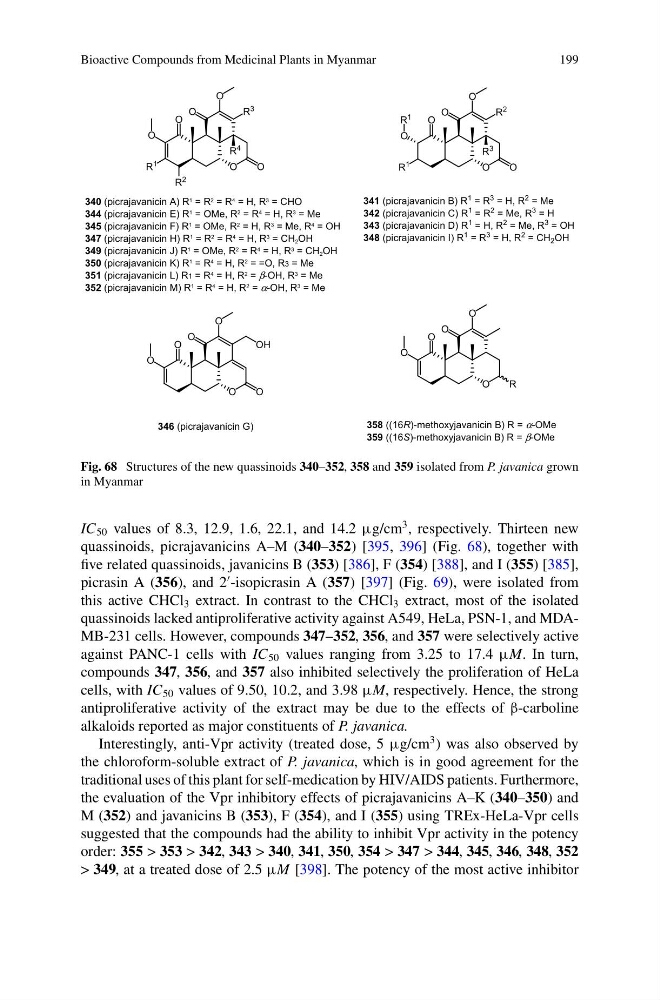
Fig. 68 Structures of the new quassinoids 340–352, 358 and 359 isolated from P. javanica grown
in Myanmar
IC 50 values of 8.3, 12.9, 1.6, 22.1, and 14.2 μg/cm
3 , respectively. Thirteen new
quassinoids, picrajavanicins A–M (340–352) [395, 396] (Fig. 68), together with
five related quassinoids, javanicins B (353) [386], F (354) [388], and I (355) [385],
picrasin A (356), and 2
-isopicrasin A (357) [397] (Fig. 69), were isolated from
this active CHCl 3 extract. In contrast to the CHCl 3 extract, most of the isolated
quassinoids lacked antiproliferative activity against A549, HeLa, PSN-1, and MDAMB-231 cells. However, compounds 347–352, 356, and 357 were selectively active
against PANC-1 cells with IC 50 values ranging from 3.25 to 17.4 μM. In turn,
compounds 347, 356, and 357 also inhibited selectively the proliferation of HeLa
cells, with IC 50 values of 9.50, 10.2, and 3.98 μM, respectively. Hence, the strong
antiproliferative activity of the extract may be due to the effects of β-carboline
alkaloids reported as major constituents of P. javanica.
Interestingly, anti-Vpr activity (treated dose, 5 μg/cm
3 ) was also observed by
the chloroform-soluble extract of P. javanica, which is in good agreement for the
traditional uses of this plant for self-medication by HIV/AIDS patients. Furthermore,
the evaluation of the Vpr inhibitory effects of picrajavanicins A–K (340–350) and
M (352) and javanicins B (353), F (354), and I (355) using TREx-HeLa-Vpr cells
suggested that the compounds had the ability to inhibit Vpr activity in the potency
order: 355 > 353 > 342, 343 > 340, 341, 350, 354 > 347 > 344, 345, 346, 348, 352
> 349, at a treated dose of 2.5 μM [398]. The potency of the most active inhibitor
199
O
O
O
O
O
O
R
2
R
1
R
3
R
4
340 (picrajavanicin A) R 1 = R 2 = R 4 = H, R 3 = CHO
344 (picrajavanicin E) R 1 = OMe, R 2 = R 4 = H, R 3 = Me
345 (picrajavanicin F) R 1 = OMe, R 2 = H, R 3 = Me, R 4 = OH
347 (picrajavanicin H) R 1 = R 2 = R 4 = H, R 3 = CH 2 OH
349 (picrajavanicin J) R 1 = OMe, R 2 = R 4 = H, R 3 = CH 2 OH
350 (picrajavanicin K) R 1 = R 4 = H, R 2 = =O, R3 = Me
351 (picrajavanicin L) R1 = R 4 = H, R 2 = β-OH, R 3 = Me
352 (picrajavanicin M) R 1 = R 4 = H, R 2 = α-OH, R 3 = Me
O
O
O
R
1
O
O
O
R
1
R
2
R
3
O
O
O
O
O
O
O
O
O
O
O
R
341 (picrajavanicin B) R
1 = R
3 = H, R
2 = Me
342 (picrajavanicin C) R
1 = R
2 = Me, R
3 = H
343 (picrajavanicin D) R
1 = H, R
2 = Me, R
3 = OH
348 (picrajavanicin I) R
1 = R
3 = H, R
2 = CH 2 OH
358 ((16R)-methoxyjavanicin B) R = α-OMe
359 ((16S)-methoxyjavanicin B) R = β-OMe
346 (picrajavanicin G)
OH
Fig. 68 Structures of the new quassinoids 340–352, 358 and 359 isolated from P. javanica grown
in Myanmar
IC 50 values of 8.3, 12.9, 1.6, 22.1, and 14.2 μg/cm
3 , respectively. Thirteen new
quassinoids, picrajavanicins A–M (340–352) [395, 396] (Fig. 68), together with
five related quassinoids, javanicins B (353) [386], F (354) [388], and I (355) [385],
picrasin A (356), and 2
-isopicrasin A (357) [397] (Fig. 69), were isolated from
this active CHCl 3 extract. In contrast to the CHCl 3 extract, most of the isolated
quassinoids lacked antiproliferative activity against A549, HeLa, PSN-1, and MDAMB-231 cells. However, compounds 347–352, 356, and 357 were selectively active
against PANC-1 cells with IC 50 values ranging from 3.25 to 17.4 μM. In turn,
compounds 347, 356, and 357 also inhibited selectively the proliferation of HeLa
cells, with IC 50 values of 9.50, 10.2, and 3.98 μM, respectively. Hence, the strong
antiproliferative activity of the extract may be due to the effects of β-carboline
alkaloids reported as major constituents of P. javanica.
Interestingly, anti-Vpr activity (treated dose, 5 μg/cm
3 ) was also observed by
the chloroform-soluble extract of P. javanica, which is in good agreement for the
traditional uses of this plant for self-medication by HIV/AIDS patients. Furthermore,
the evaluation of the Vpr inhibitory effects of picrajavanicins A–K (340–350) and
M (352) and javanicins B (353), F (354), and I (355) using TREx-HeLa-Vpr cells
suggested that the compounds had the ability to inhibit Vpr activity in the potency
order: 355 > 353 > 342, 343 > 340, 341, 350, 354 > 347 > 344, 345, 346, 348, 352
> 349, at a treated dose of 2.5 μM [398]. The potency of the most active inhibitor