

198
N. N. Win and H. Morita
2.19 Picrasma javanica Blume
Picrasma javanica is a medium-sized tree belonging to the family Simaroubaceae.
Plants of this family contain structurally diverse and biologically active quassinoids
and indole alkaloids, with significant cytotoxic and antimalarial activities. P. javanica
is distributed widely in the tropical regions of Asia, including Myanmar, Indonesia,
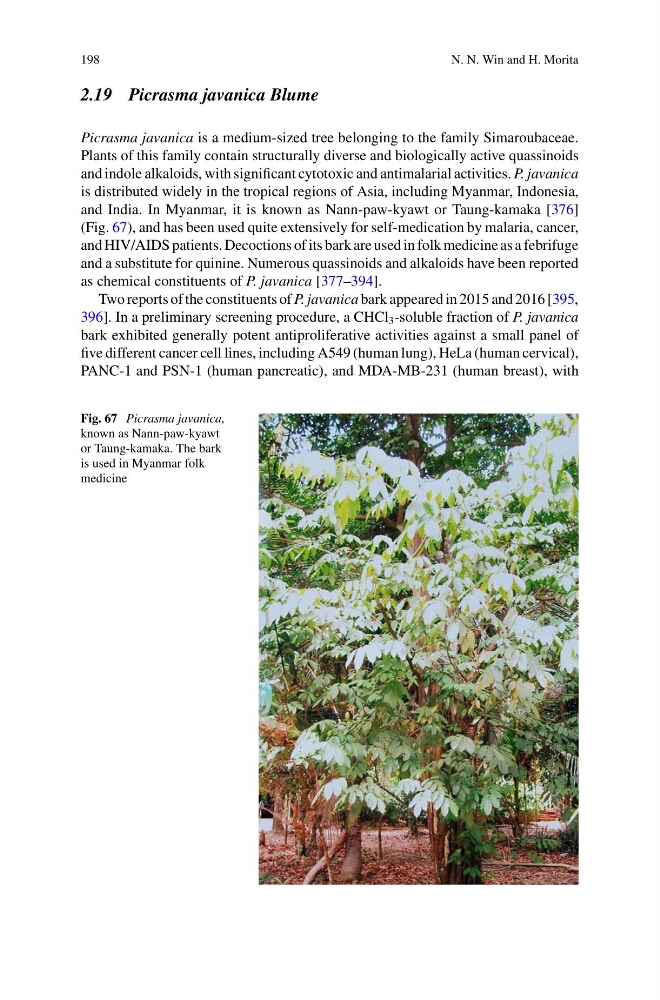
and India. In Myanmar, it is known as Nann-paw-kyawt or Taung-kamaka [376]
(Fig. 67), and has been used quite extensively for self-medication by malaria, cancer,
and HIV/AIDS patients. Decoctions of its bark are used in folk medicine as a febrifuge
and a substitute for quinine. Numerous quassinoids and alkaloids have been reported
as chemical constituents of P. javanica [377–394].
Two reports of the constituents of P. javanica bark appeared in 2015 and 2016 [395,
396]. In a preliminary screening procedure, a CHCl 3 -soluble fraction of P. javanica
bark exhibited generally potent antiproliferative activities against a small panel of
five different cancer cell lines, including A549 (human lung), HeLa (human cervical),
PANC-1 and PSN-1 (human pancreatic), and MDA-MB-231 (human breast), with
Fig. 67 Picrasma javanica,
known as Nann-paw-kyawt
or Taung-kamaka. The bark
is used in Myanmar folk
medicine
N. N. Win and H. Morita
2.19 Picrasma javanica Blume
Picrasma javanica is a medium-sized tree belonging to the family Simaroubaceae.
Plants of this family contain structurally diverse and biologically active quassinoids
and indole alkaloids, with significant cytotoxic and antimalarial activities. P. javanica
is distributed widely in the tropical regions of Asia, including Myanmar, Indonesia,
and India. In Myanmar, it is known as Nann-paw-kyawt or Taung-kamaka [376]
(Fig. 67), and has been used quite extensively for self-medication by malaria, cancer,
and HIV/AIDS patients. Decoctions of its bark are used in folk medicine as a febrifuge
and a substitute for quinine. Numerous quassinoids and alkaloids have been reported
as chemical constituents of P. javanica [377–394].
Two reports of the constituents of P. javanica bark appeared in 2015 and 2016 [395,
396]. In a preliminary screening procedure, a CHCl 3 -soluble fraction of P. javanica
bark exhibited generally potent antiproliferative activities against a small panel of
five different cancer cell lines, including A549 (human lung), HeLa (human cervical),
PANC-1 and PSN-1 (human pancreatic), and MDA-MB-231 (human breast), with
Fig. 67 Picrasma javanica,
known as Nann-paw-kyawt
or Taung-kamaka. The bark
is used in Myanmar folk
medicine