

Bioactive Compounds from Medicinal Plants in Myanmar
197
R
1
R
2
R
3
R
5
332 (9α-hydroxyisopimara-8(14),15-dien-7-one)
R
1 = R
2 = R
5 = H, R
3 = =O, R
4 = OH
333 (7β,9α -dihydroxypimara-8(14),15-diene)
R
1 = R
2 = R
5 = H, R
3 = β-OH, R
4 = OH
334 ((1S,5S,9S,10S,11R,13R)-1,11-dihydroxypimara-8(14),15-diene)
R
1 = R
5 = α-OH, R
2 = R
3 = R
4 = H
335 (sandaracopimaradien-1α,2α -diol)
R
1 = R
2 = α-OH, R
3 = R
4 = R
5 = H
336 ((1R,2S,5S,9S,10S,11R,13R)-1,2,11-trihydroxypimara-8(14),15-diene)
R
1 = R
2 = R
5 = α-OH, R
3 = R
4 = H
337 (7α-hydroxyisopimara-8(14),15-diene)
R
1 = R
2 = R
4 = R
5 = H, R
3 = α-OH
HO
338 ((2R)-ent-2-hydroxyisopimara-8(14),15-diene)
O
O
OEt
339 (ethyl 4-methoxy-(E)-cinnamate)
R
4
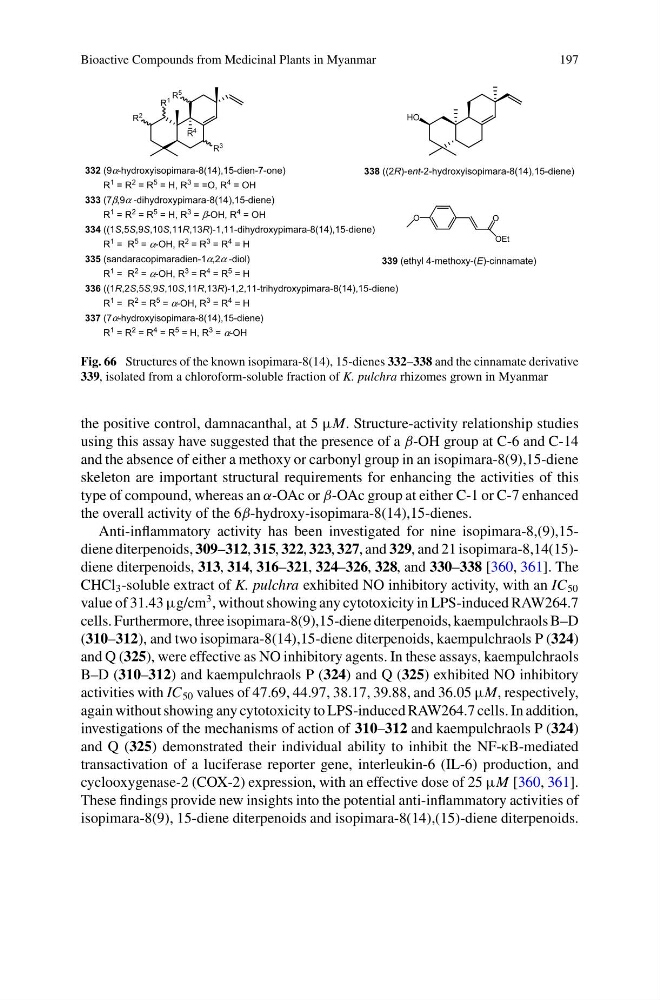
Fig. 66 Structures of the known isopimara-8(14), 15-dienes 332–338 and the cinnamate derivative
339, isolated from a chloroform-soluble fraction of K. pulchra rhizomes grown in Myanmar
the positive control, damnacanthal, at 5 μM. Structure-activity relationship studies
using this assay have suggested that the presence of a β-OH group at C-6 and C-14
and the absence of either a methoxy or carbonyl group in an isopimara-8(9),15-diene
skeleton are important structural requirements for enhancing the activities of this
type of compound, whereas an α-OAc or β-OAc group at either C-1 or C-7 enhanced
the overall activity of the 6β-hydroxy-isopimara-8(14),15-dienes.
Anti-inflammatory activity has been investigated for nine isopimara-8,(9),15diene diterpenoids, 309–312, 315, 322, 323, 327, and 329, and 21 isopimara-8,14(15)diene diterpenoids, 313, 314, 316–321, 324–326, 328, and 330–338 [360, 361]. The
CHCl 3 -soluble extract of K. pulchra exhibited NO inhibitory activity, with an IC 50
value of 31.43 μg/cm
3 , without showing any cytotoxicity in LPS-induced RAW264.7
cells. Furthermore, three isopimara-8(9),15-diene diterpenoids, kaempulchraols B–D
(310–312), and two isopimara-8(14),15-diene diterpenoids, kaempulchraols P (324)
and Q (325), were effective as NO inhibitory agents. In these assays, kaempulchraols
B–D (310–312) and kaempulchraols P (324) and Q (325) exhibited NO inhibitory
activities with IC 50 values of 47.69, 44.97, 38.17, 39.88, and 36.05 μM, respectively,
again without showing any cytotoxicity to LPS-induced RAW264.7 cells. In addition,
investigations of the mechanisms of action of 310–312 and kaempulchraols P (324)
and Q (325) demonstrated their individual ability to inhibit the NF-κB-mediated
transactivation of a luciferase reporter gene, interleukin-6 (IL-6) production, and
cyclooxygenase-2 (COX-2) expression, with an effective dose of 25 μM [360, 361].
These findings provide new insights into the potential anti-inflammatory activities of
isopimara-8(9), 15-diene diterpenoids and isopimara-8(14),(15)-diene diterpenoids.
197
R
1
R
2
R
3
R
5
332 (9α-hydroxyisopimara-8(14),15-dien-7-one)
R
1 = R
2 = R
5 = H, R
3 = =O, R
4 = OH
333 (7β,9α -dihydroxypimara-8(14),15-diene)
R
1 = R
2 = R
5 = H, R
3 = β-OH, R
4 = OH
334 ((1S,5S,9S,10S,11R,13R)-1,11-dihydroxypimara-8(14),15-diene)
R
1 = R
5 = α-OH, R
2 = R
3 = R
4 = H
335 (sandaracopimaradien-1α,2α -diol)
R
1 = R
2 = α-OH, R
3 = R
4 = R
5 = H
336 ((1R,2S,5S,9S,10S,11R,13R)-1,2,11-trihydroxypimara-8(14),15-diene)
R
1 = R
2 = R
5 = α-OH, R
3 = R
4 = H
337 (7α-hydroxyisopimara-8(14),15-diene)
R
1 = R
2 = R
4 = R
5 = H, R
3 = α-OH
HO
338 ((2R)-ent-2-hydroxyisopimara-8(14),15-diene)
O
O
OEt
339 (ethyl 4-methoxy-(E)-cinnamate)
R
4
Fig. 66 Structures of the known isopimara-8(14), 15-dienes 332–338 and the cinnamate derivative
339, isolated from a chloroform-soluble fraction of K. pulchra rhizomes grown in Myanmar
the positive control, damnacanthal, at 5 μM. Structure-activity relationship studies
using this assay have suggested that the presence of a β-OH group at C-6 and C-14
and the absence of either a methoxy or carbonyl group in an isopimara-8(9),15-diene
skeleton are important structural requirements for enhancing the activities of this
type of compound, whereas an α-OAc or β-OAc group at either C-1 or C-7 enhanced
the overall activity of the 6β-hydroxy-isopimara-8(14),15-dienes.
Anti-inflammatory activity has been investigated for nine isopimara-8,(9),15diene diterpenoids, 309–312, 315, 322, 323, 327, and 329, and 21 isopimara-8,14(15)diene diterpenoids, 313, 314, 316–321, 324–326, 328, and 330–338 [360, 361]. The
CHCl 3 -soluble extract of K. pulchra exhibited NO inhibitory activity, with an IC 50
value of 31.43 μg/cm
3 , without showing any cytotoxicity in LPS-induced RAW264.7
cells. Furthermore, three isopimara-8(9),15-diene diterpenoids, kaempulchraols B–D
(310–312), and two isopimara-8(14),15-diene diterpenoids, kaempulchraols P (324)
and Q (325), were effective as NO inhibitory agents. In these assays, kaempulchraols
B–D (310–312) and kaempulchraols P (324) and Q (325) exhibited NO inhibitory
activities with IC 50 values of 47.69, 44.97, 38.17, 39.88, and 36.05 μM, respectively,
again without showing any cytotoxicity to LPS-induced RAW264.7 cells. In addition,
investigations of the mechanisms of action of 310–312 and kaempulchraols P (324)
and Q (325) demonstrated their individual ability to inhibit the NF-κB-mediated
transactivation of a luciferase reporter gene, interleukin-6 (IL-6) production, and
cyclooxygenase-2 (COX-2) expression, with an effective dose of 25 μM [360, 361].
These findings provide new insights into the potential anti-inflammatory activities of
isopimara-8(9), 15-diene diterpenoids and isopimara-8(14),(15)-diene diterpenoids.