

Bioactive Compounds from Medicinal Plants in Myanmar
169
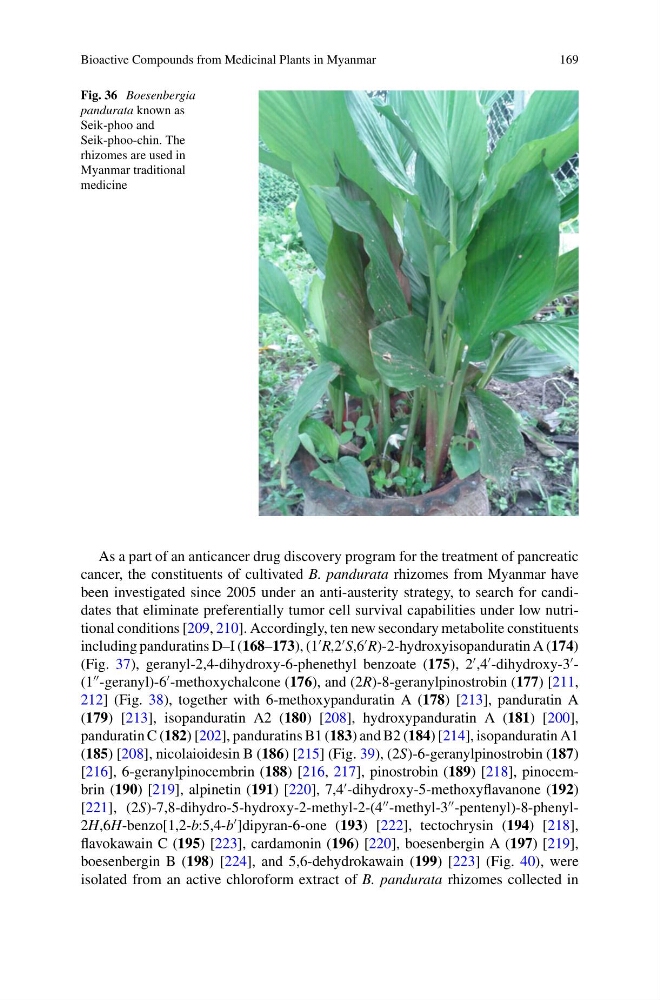
Fig. 36 Boesenbergia
pandurata known as
Seik-phoo and
Seik-phoo-chin. The
rhizomes are used in
Myanmar traditional
medicine
As a part of an anticancer drug discovery program for the treatment of pancreatic
cancer, the constituents of cultivated B. pandurata rhizomes from Myanmar have
been investigated since 2005 under an anti-austerity strategy, to search for candidates that eliminate preferentially tumor cell survival capabilities under low nutritional conditions [209, 210]. Accordingly, ten new secondary metabolite constituents
including panduratins D–I (168–173), (1
R,2
S,6
R)-2-hydroxyisopanduratin A (174)
(Fig. 37), geranyl-2,4-dihydroxy-6-phenethyl benzoate (175), 2
,4
-dihydroxy-3
-
(1
-geranyl)-6
-methoxychalcone (176), and (2R)-8-geranylpinostrobin (177) [211,
212] (Fig. 38), together with 6-methoxypanduratin A (178) [213], panduratin A
(179) [213], isopanduratin A2 (180) [208], hydroxypanduratin A (181) [200],
panduratin C (182) [202], panduratins B1 (183) and B2 (184) [214], isopanduratin A1
(185) [208], nicolaioidesin B (186) [215] (Fig. 39), (2S)-6-geranylpinostrobin (187)
[216], 6-geranylpinocembrin (188) [216, 217], pinostrobin (189) [218], pinocembrin (190) [219], alpinetin (191) [220], 7,4
-dihydroxy-5-methoxyflavanone (192)
[221], (2S)-7,8-dihydro-5-hydroxy-2-methyl-2-(4
-methyl-3
-pentenyl)-8-phenyl2H,6H-benzo[1,2-b:5,4-b
]dipyran-6-one (193) [222], tectochrysin (194) [218],
flavokawain C (195) [223], cardamonin (196) [220], boesenbergin A (197) [219],
boesenbergin B (198) [224], and 5,6-dehydrokawain (199) [223] (Fig. 40), were
isolated from an active chloroform extract of B. pandurata rhizomes collected in
169
Fig. 36 Boesenbergia
pandurata known as
Seik-phoo and
Seik-phoo-chin. The
rhizomes are used in
Myanmar traditional
medicine
As a part of an anticancer drug discovery program for the treatment of pancreatic
cancer, the constituents of cultivated B. pandurata rhizomes from Myanmar have
been investigated since 2005 under an anti-austerity strategy, to search for candidates that eliminate preferentially tumor cell survival capabilities under low nutritional conditions [209, 210]. Accordingly, ten new secondary metabolite constituents
including panduratins D–I (168–173), (1
R,2
S,6
R)-2-hydroxyisopanduratin A (174)
(Fig. 37), geranyl-2,4-dihydroxy-6-phenethyl benzoate (175), 2
,4
-dihydroxy-3
-
(1
-geranyl)-6
-methoxychalcone (176), and (2R)-8-geranylpinostrobin (177) [211,
212] (Fig. 38), together with 6-methoxypanduratin A (178) [213], panduratin A
(179) [213], isopanduratin A2 (180) [208], hydroxypanduratin A (181) [200],
panduratin C (182) [202], panduratins B1 (183) and B2 (184) [214], isopanduratin A1
(185) [208], nicolaioidesin B (186) [215] (Fig. 39), (2S)-6-geranylpinostrobin (187)
[216], 6-geranylpinocembrin (188) [216, 217], pinostrobin (189) [218], pinocembrin (190) [219], alpinetin (191) [220], 7,4
-dihydroxy-5-methoxyflavanone (192)
[221], (2S)-7,8-dihydro-5-hydroxy-2-methyl-2-(4
-methyl-3
-pentenyl)-8-phenyl2H,6H-benzo[1,2-b:5,4-b
]dipyran-6-one (193) [222], tectochrysin (194) [218],
flavokawain C (195) [223], cardamonin (196) [220], boesenbergin A (197) [219],
boesenbergin B (198) [224], and 5,6-dehydrokawain (199) [223] (Fig. 40), were
isolated from an active chloroform extract of B. pandurata rhizomes collected in