

166
N. N. Win and H. Morita
line at three concentrations, 100, 10, and 1 μM, revealed that only (1S,4S,5S,10S)germacrone-1(10),4(5)-diepoxide (140) showed some growth inhibition (71.60%
viability) at 100 μM. Antifungal activities of three curcuminoids (154–156) against
Cladosporium cucumerinum at 20 μg/cm
3 (each inhibition zone, 154 mm
2 ) have
also been reported [146].
2.9 Vitis repens Wight & Arn.
Vitis repens (syn. Cissus repens Lam.) belongs to the family Vitaceae and is
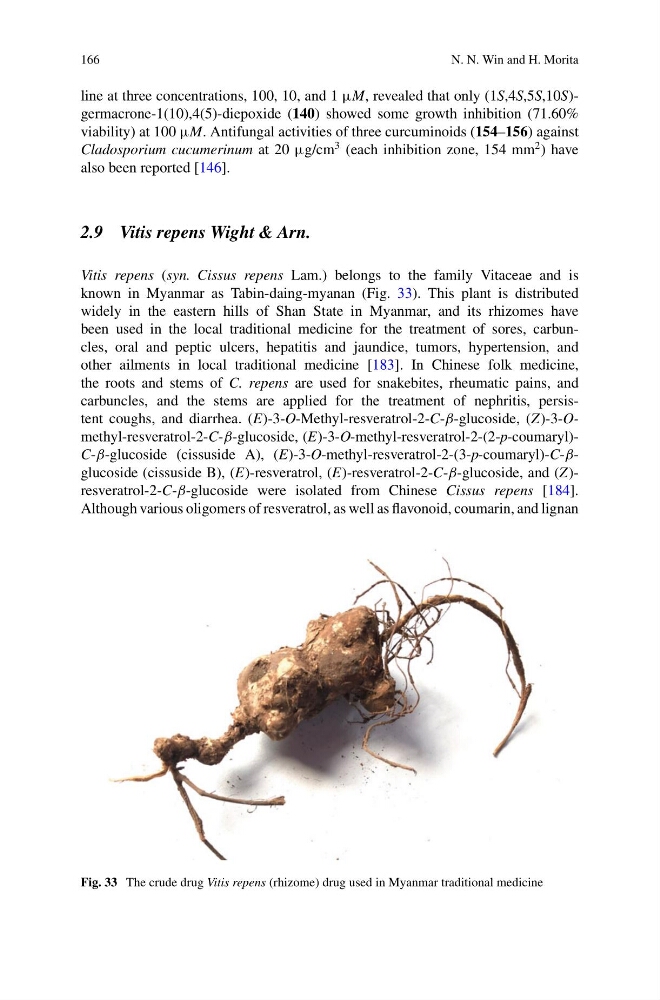
known in Myanmar as Tabin-daing-myanan (Fig. 33). This plant is distributed
widely in the eastern hills of Shan State in Myanmar, and its rhizomes have
been used in the local traditional medicine for the treatment of sores, carbuncles, oral and peptic ulcers, hepatitis and jaundice, tumors, hypertension, and
other ailments in local traditional medicine [183]. In Chinese folk medicine,
the roots and stems of C. repens are used for snakebites, rheumatic pains, and
carbuncles, and the stems are applied for the treatment of nephritis, persistent coughs, and diarrhea. (E)-3-O-Methyl-resveratrol-2-C-β-glucoside, (Z)-3-Omethyl-resveratrol-2-C-β-glucoside, (E)-3-O-methyl-resveratrol-2-(2-p-coumaryl)C-β-glucoside (cissuside A), (E)-3-O-methyl-resveratrol-2-(3-p-coumaryl)-C-βglucoside (cissuside B), (E)-resveratrol, (E)-resveratrol-2-C-β-glucoside, and (Z)resveratrol-2-C-β-glucoside were isolated from Chinese Cissus repens [184].
Although various oligomers of resveratrol, as well as flavonoid, coumarin, and lignan
Fig. 33 The crude drug Vitis repens (rhizome) drug used in Myanmar traditional medicine
N. N. Win and H. Morita
line at three concentrations, 100, 10, and 1 μM, revealed that only (1S,4S,5S,10S)germacrone-1(10),4(5)-diepoxide (140) showed some growth inhibition (71.60%
viability) at 100 μM. Antifungal activities of three curcuminoids (154–156) against
Cladosporium cucumerinum at 20 μg/cm
3 (each inhibition zone, 154 mm
2 ) have
also been reported [146].
2.9 Vitis repens Wight & Arn.
Vitis repens (syn. Cissus repens Lam.) belongs to the family Vitaceae and is
known in Myanmar as Tabin-daing-myanan (Fig. 33). This plant is distributed
widely in the eastern hills of Shan State in Myanmar, and its rhizomes have
been used in the local traditional medicine for the treatment of sores, carbuncles, oral and peptic ulcers, hepatitis and jaundice, tumors, hypertension, and
other ailments in local traditional medicine [183]. In Chinese folk medicine,
the roots and stems of C. repens are used for snakebites, rheumatic pains, and
carbuncles, and the stems are applied for the treatment of nephritis, persistent coughs, and diarrhea. (E)-3-O-Methyl-resveratrol-2-C-β-glucoside, (Z)-3-Omethyl-resveratrol-2-C-β-glucoside, (E)-3-O-methyl-resveratrol-2-(2-p-coumaryl)C-β-glucoside (cissuside A), (E)-3-O-methyl-resveratrol-2-(3-p-coumaryl)-C-βglucoside (cissuside B), (E)-resveratrol, (E)-resveratrol-2-C-β-glucoside, and (Z)resveratrol-2-C-β-glucoside were isolated from Chinese Cissus repens [184].
Although various oligomers of resveratrol, as well as flavonoid, coumarin, and lignan
Fig. 33 The crude drug Vitis repens (rhizome) drug used in Myanmar traditional medicine