

Bioactive Compounds from Medicinal Plants in Myanmar
165
O
OH
O
OH
141 (curcumenol)
142 (isocurcumenol)
144 (procurcumenol)
OH
145 (isoprocurcumenol)
R
1
R
2
R
3
146 (isozedoarondiol)
R
1 = β-H, R
2 = Me, R
3 = OH
147 (zedoarondiol)
R
1 = α-H, R
2 = OH, R
3 = Me
O
O
O
OH
HO
OH
149 (zedoalactone B)
OH
OH
O
O
143 (alismoxide)
151 (gajutsulactone B)
O
O
R
HO
OH
148 (zedoalactone A) R = α-H
150 (zedoarolide B) R = β-OH
O
O
OH
HO
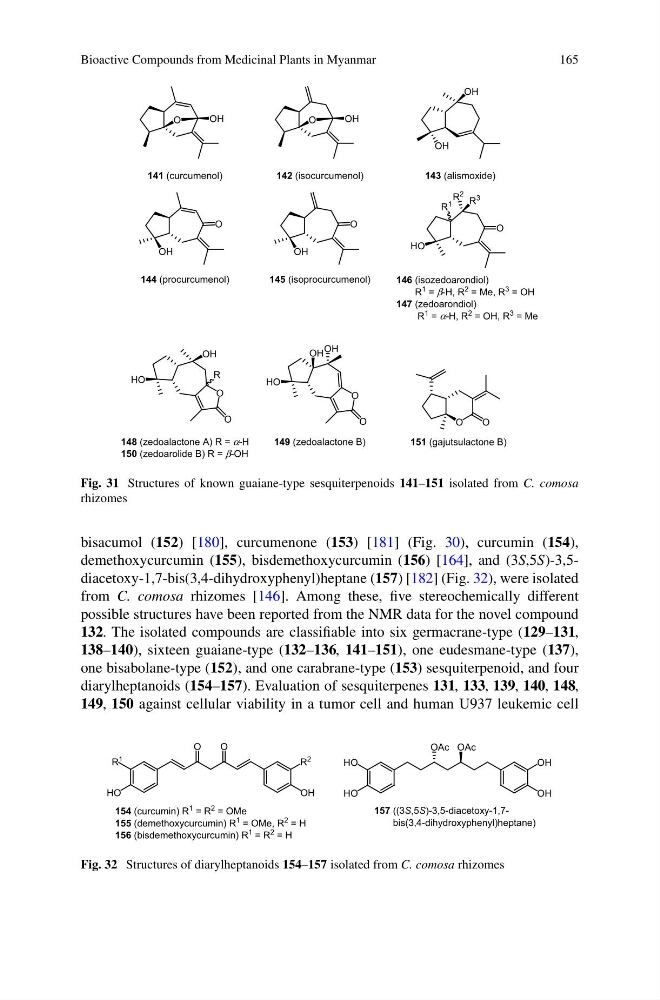
Fig. 31 Structures of known guaiane-type sesquiterpenoids 141–151 isolated from C. comosa
rhizomes
bisacumol (152) [180], curcumenone (153) [181] (Fig. 30), curcumin (154),
demethoxycurcumin (155), bisdemethoxycurcumin (156) [164], and (3S,5S)-3,5diacetoxy-1,7-bis(3,4-dihydroxyphenyl)heptane (157) [182] (Fig. 32), were isolated
from C. comosa rhizomes [146]. Among these, five stereochemically different
possible structures have been reported from the NMR data for the novel compound
132. The isolated compounds are classifiable into six germacrane-type (129–131,
138–140), sixteen guaiane-type (132–136, 141–151), one eudesmane-type (137),
one bisabolane-type (152), and one carabrane-type (153) sesquiterpenoid, and four
diarylheptanoids (154–157). Evaluation of sesquiterpenes 131, 133, 139, 140, 148,
149, 150 against cellular viability in a tumor cell and human U937 leukemic cell
R
1
HO
O
O
R
2
OH
154 (curcumin) R
1 = R
2 = OMe
155 (demethoxycurcumin) R
1 = OMe, R
2 = H
156 (bisdemethoxycurcumin) R
1 = R
2 = H
157 ((3S,5S)-3,5-diacetoxy-1,7bis(3,4-dihydroxyphenyl)heptane)
HO
HO
OAc OAc
OH
OH
Fig. 32 Structures of diarylheptanoids 154–157 isolated from C. comosa rhizomes
165
O
OH
O
OH
141 (curcumenol)
142 (isocurcumenol)
144 (procurcumenol)
OH
145 (isoprocurcumenol)
R
1
R
2
R
3
146 (isozedoarondiol)
R
1 = β-H, R
2 = Me, R
3 = OH
147 (zedoarondiol)
R
1 = α-H, R
2 = OH, R
3 = Me
O
O
O
OH
HO
OH
149 (zedoalactone B)
OH
OH
O
O
143 (alismoxide)
151 (gajutsulactone B)
O
O
R
HO
OH
148 (zedoalactone A) R = α-H
150 (zedoarolide B) R = β-OH
O
O
OH
HO
Fig. 31 Structures of known guaiane-type sesquiterpenoids 141–151 isolated from C. comosa
rhizomes
bisacumol (152) [180], curcumenone (153) [181] (Fig. 30), curcumin (154),
demethoxycurcumin (155), bisdemethoxycurcumin (156) [164], and (3S,5S)-3,5diacetoxy-1,7-bis(3,4-dihydroxyphenyl)heptane (157) [182] (Fig. 32), were isolated
from C. comosa rhizomes [146]. Among these, five stereochemically different
possible structures have been reported from the NMR data for the novel compound
132. The isolated compounds are classifiable into six germacrane-type (129–131,
138–140), sixteen guaiane-type (132–136, 141–151), one eudesmane-type (137),
one bisabolane-type (152), and one carabrane-type (153) sesquiterpenoid, and four
diarylheptanoids (154–157). Evaluation of sesquiterpenes 131, 133, 139, 140, 148,
149, 150 against cellular viability in a tumor cell and human U937 leukemic cell
R
1
HO
O
O
R
2
OH
154 (curcumin) R
1 = R
2 = OMe
155 (demethoxycurcumin) R
1 = OMe, R
2 = H
156 (bisdemethoxycurcumin) R
1 = R
2 = H
157 ((3S,5S)-3,5-diacetoxy-1,7bis(3,4-dihydroxyphenyl)heptane)
HO
HO
OAc OAc
OH
OH
Fig. 32 Structures of diarylheptanoids 154–157 isolated from C. comosa rhizomes