

Bioactive Compounds from Medicinal Plants in Myanmar
159
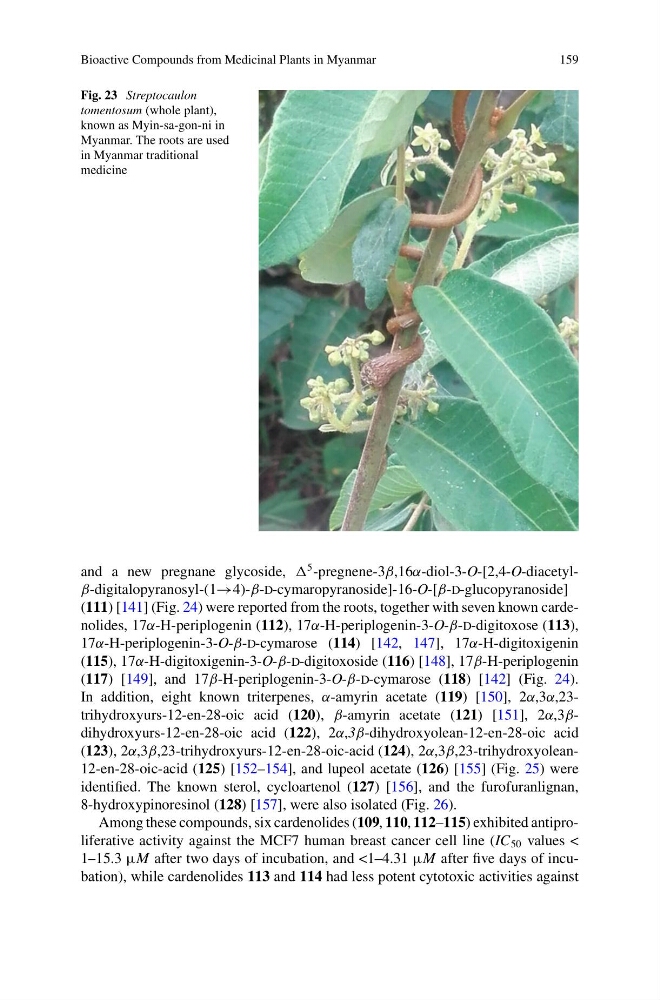
Fig. 23 Streptocaulon
tomentosum (whole plant),
known as Myin-sa-gon-ni in
Myanmar. The roots are used
in Myanmar traditional
medicine
and a new pregnane glycoside,
5 -pregnene-3β,16α-diol-3-O-[2,4-O-diacetylβ-digitalopyranosyl-(1→4)-β-d-cymaropyranoside]-16-O-[β-d-glucopyranoside]
(111) [141] (Fig. 24) were reported from the roots, together with seven known cardenolides, 17α-H-periplogenin (112), 17α-H-periplogenin-3-O-β-d-digitoxose (113),
17α-H-periplogenin-3-O-β-d-cymarose (114) [142, 147], 17α-H-digitoxigenin
(115), 17α-H-digitoxigenin-3-O-β-d-digitoxoside (116) [148], 17β-H-periplogenin
(117) [149], and 17β-H-periplogenin-3-O-β-d-cymarose (118) [142] (Fig. 24).
In addition, eight known triterpenes, α-amyrin acetate (119) [150], 2α,3α,23trihydroxyurs-12-en-28-oic acid (120), β-amyrin acetate (121) [151], 2α,3βdihydroxyurs-12-en-28-oic acid (122), 2α,3β-dihydroxyolean-12-en-28-oic acid
(123), 2α,3β,23-trihydroxyurs-12-en-28-oic-acid (124), 2α,3β,23-trihydroxyolean12-en-28-oic-acid (125) [152–154], and lupeol acetate (126) [155] (Fig. 25) were
identified. The known sterol, cycloartenol (127) [156], and the furofuranlignan,
8-hydroxypinoresinol (128) [157], were also isolated (Fig. 26).
Among these compounds, six cardenolides (109, 110, 112–115) exhibited antiproliferative activity against the MCF7 human breast cancer cell line (IC 50 values <
1–15.3 μM after two days of incubation, and <1–4.31 μM after five days of incubation), while cardenolides 113 and 114 had less potent cytotoxic activities against
159
Fig. 23 Streptocaulon
tomentosum (whole plant),
known as Myin-sa-gon-ni in
Myanmar. The roots are used
in Myanmar traditional
medicine
and a new pregnane glycoside,
5 -pregnene-3β,16α-diol-3-O-[2,4-O-diacetylβ-digitalopyranosyl-(1→4)-β-d-cymaropyranoside]-16-O-[β-d-glucopyranoside]
(111) [141] (Fig. 24) were reported from the roots, together with seven known cardenolides, 17α-H-periplogenin (112), 17α-H-periplogenin-3-O-β-d-digitoxose (113),
17α-H-periplogenin-3-O-β-d-cymarose (114) [142, 147], 17α-H-digitoxigenin
(115), 17α-H-digitoxigenin-3-O-β-d-digitoxoside (116) [148], 17β-H-periplogenin
(117) [149], and 17β-H-periplogenin-3-O-β-d-cymarose (118) [142] (Fig. 24).
In addition, eight known triterpenes, α-amyrin acetate (119) [150], 2α,3α,23trihydroxyurs-12-en-28-oic acid (120), β-amyrin acetate (121) [151], 2α,3βdihydroxyurs-12-en-28-oic acid (122), 2α,3β-dihydroxyolean-12-en-28-oic acid
(123), 2α,3β,23-trihydroxyurs-12-en-28-oic-acid (124), 2α,3β,23-trihydroxyolean12-en-28-oic-acid (125) [152–154], and lupeol acetate (126) [155] (Fig. 25) were
identified. The known sterol, cycloartenol (127) [156], and the furofuranlignan,
8-hydroxypinoresinol (128) [157], were also isolated (Fig. 26).
Among these compounds, six cardenolides (109, 110, 112–115) exhibited antiproliferative activity against the MCF7 human breast cancer cell line (IC 50 values <
1–15.3 μM after two days of incubation, and <1–4.31 μM after five days of incubation), while cardenolides 113 and 114 had less potent cytotoxic activities against