

160
N. N. Win and H. Morita
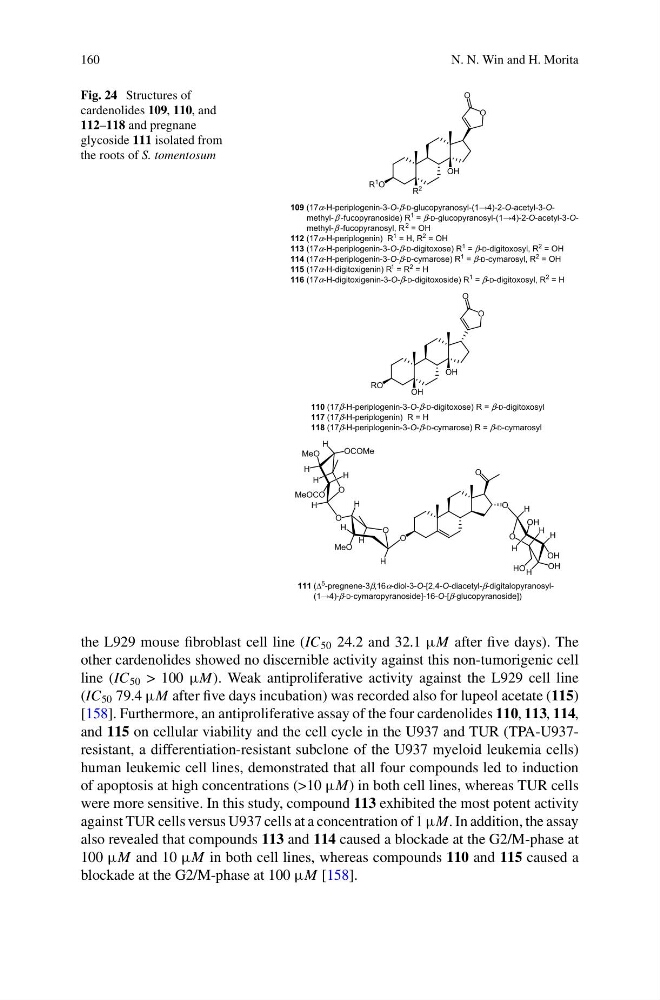
Fig. 24 Structures of
cardenolides 109, 110, and
112–118 and pregnane
glycoside 111 isolated from
the roots of S. tomentosum
R
1 O
R
2
OH
O
O
109 (17α-H-periplogenin-3-O-β-D-glucopyranosyl-(1→4)-2-O-acetyl-3-Omethyl- β -fucopyranoside) R
1 = β-D-glucopyranosyl-(1→4)-2-O-acetyl-3-Omethyl-β -fucopyranosyl, R
2 = OH
112 (17α-H-periplogenin) R
1 = H, R
2 = OH
113 (17α-H-periplogenin-3-O-β-D-digitoxose) R
1 = β-D-digitoxosyl, R
2 = OH
114 (17α-H-periplogenin-3-O-β-D-cymarose) R
1 = β-D-cymarosyl, R
2 = OH
115 (17α-H-digitoxigenin) R
1 = R
2 = H
116 (17α-H-digitoxigenin-3-O-β-D-digitoxoside) R
1 = β-D-digitoxosyl, R
2 = H
RO
OH
OH
O
O
110 (17β-H-periplogenin-3-O-β-D-digitoxose) R = β-D-digitoxosyl
117 (17β-H-periplogenin) R = H
118 (17β-H-periplogenin-3-O-β-D-cymarose) R = β-D-cymarosyl
O
O
O
O
H
OH
H
OH
H
H
OH
H
HO
O
H
O
MeO
H
H
H
O
OCOMe
H
H
MeO
H
H
MeOCO
H
111 (Δ
5 -pregnene-3β,16α-diol-3-O-[2,4-O-diacetyl-β-digitalopyranosyl(1→4)-β-D-cymaropyranoside]-16-O-[β-glucopyranoside])
the L929 mouse fibroblast cell line (IC 50 24.2 and 32.1 μM after five days). The
other cardenolides showed no discernible activity against this non-tumorigenic cell
line (IC 50 > 100 μM). Weak antiproliferative activity against the L929 cell line
(IC 50 79.4 μM after five days incubation) was recorded also for lupeol acetate (115)
[158]. Furthermore, an antiproliferative assay of the four cardenolides 110, 113, 114,
and 115 on cellular viability and the cell cycle in the U937 and TUR (TPA-U937resistant, a differentiation-resistant subclone of the U937 myeloid leukemia cells)
human leukemic cell lines, demonstrated that all four compounds led to induction
of apoptosis at high concentrations (>10 μM) in both cell lines, whereas TUR cells
were more sensitive. In this study, compound 113 exhibited the most potent activity
against TUR cells versus U937 cells at a concentration of 1 μM. In addition, the assay
also revealed that compounds 113 and 114 caused a blockade at the G2/M-phase at
100 μM and 10 μM in both cell lines, whereas compounds 110 and 115 caused a
blockade at the G2/M-phase at 100 μM [158].
N. N. Win and H. Morita
Fig. 24 Structures of
cardenolides 109, 110, and
112–118 and pregnane
glycoside 111 isolated from
the roots of S. tomentosum
R
1 O
R
2
OH
O
O
109 (17α-H-periplogenin-3-O-β-D-glucopyranosyl-(1→4)-2-O-acetyl-3-Omethyl- β -fucopyranoside) R
1 = β-D-glucopyranosyl-(1→4)-2-O-acetyl-3-Omethyl-β -fucopyranosyl, R
2 = OH
112 (17α-H-periplogenin) R
1 = H, R
2 = OH
113 (17α-H-periplogenin-3-O-β-D-digitoxose) R
1 = β-D-digitoxosyl, R
2 = OH
114 (17α-H-periplogenin-3-O-β-D-cymarose) R
1 = β-D-cymarosyl, R
2 = OH
115 (17α-H-digitoxigenin) R
1 = R
2 = H
116 (17α-H-digitoxigenin-3-O-β-D-digitoxoside) R
1 = β-D-digitoxosyl, R
2 = H
RO
OH
OH
O
O
110 (17β-H-periplogenin-3-O-β-D-digitoxose) R = β-D-digitoxosyl
117 (17β-H-periplogenin) R = H
118 (17β-H-periplogenin-3-O-β-D-cymarose) R = β-D-cymarosyl
O
O
O
O
H
OH
H
OH
H
H
OH
H
HO
O
H
O
MeO
H
H
H
O
OCOMe
H
H
MeO
H
H
MeOCO
H
111 (Δ
5 -pregnene-3β,16α-diol-3-O-[2,4-O-diacetyl-β-digitalopyranosyl(1→4)-β-D-cymaropyranoside]-16-O-[β-glucopyranoside])
the L929 mouse fibroblast cell line (IC 50 24.2 and 32.1 μM after five days). The
other cardenolides showed no discernible activity against this non-tumorigenic cell
line (IC 50 > 100 μM). Weak antiproliferative activity against the L929 cell line
(IC 50 79.4 μM after five days incubation) was recorded also for lupeol acetate (115)
[158]. Furthermore, an antiproliferative assay of the four cardenolides 110, 113, 114,
and 115 on cellular viability and the cell cycle in the U937 and TUR (TPA-U937resistant, a differentiation-resistant subclone of the U937 myeloid leukemia cells)
human leukemic cell lines, demonstrated that all four compounds led to induction
of apoptosis at high concentrations (>10 μM) in both cell lines, whereas TUR cells
were more sensitive. In this study, compound 113 exhibited the most potent activity
against TUR cells versus U937 cells at a concentration of 1 μM. In addition, the assay
also revealed that compounds 113 and 114 caused a blockade at the G2/M-phase at
100 μM and 10 μM in both cell lines, whereas compounds 110 and 115 caused a
blockade at the G2/M-phase at 100 μM [158].