

158
N. N. Win and H. Morita
105 (gallic acid)
OH
HO
HO
O
OH
104 (6,10,14-trimethyl-2-pentadecanone)
O
106 (hypophyllanthin)
O
O
O
O
O
O
O
107 (brevifolin carboxylic acid) R = H
108 (methyl brevifolincarboxylate) R = Me
O
OH
OH
HO
O
ROOC
O
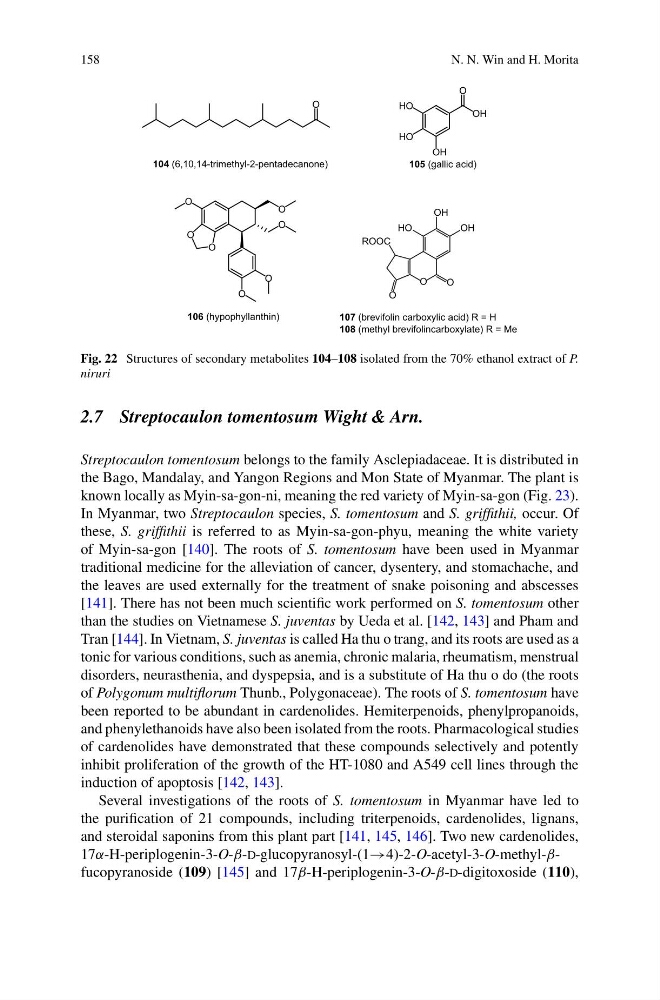
Fig. 22 Structures of secondary metabolites 104–108 isolated from the 70% ethanol extract of P.
niruri
2.7 Streptocaulon tomentosum Wight & Arn.
Streptocaulon tomentosum belongs to the family Asclepiadaceae. It is distributed in
the Bago, Mandalay, and Yangon Regions and Mon State of Myanmar. The plant is
known locally as Myin-sa-gon-ni, meaning the red variety of Myin-sa-gon (Fig. 23).
In Myanmar, two Streptocaulon species, S. tomentosum and S. griffithii, occur. Of
these, S. griffithii is referred to as Myin-sa-gon-phyu, meaning the white variety
of Myin-sa-gon [140]. The roots of S. tomentosum have been used in Myanmar
traditional medicine for the alleviation of cancer, dysentery, and stomachache, and
the leaves are used externally for the treatment of snake poisoning and abscesses
[141]. There has not been much scientific work performed on S. tomentosum other
than the studies on Vietnamese S. juventas by Ueda et al. [142, 143] and Pham and
Tran [144]. In Vietnam, S. juventas is called Ha thu o trang, and its roots are used as a
tonic for various conditions, such as anemia, chronic malaria, rheumatism, menstrual
disorders, neurasthenia, and dyspepsia, and is a substitute of Ha thu o do (the roots
of Polygonum multiflorum Thunb., Polygonaceae). The roots of S. tomentosum have
been reported to be abundant in cardenolides. Hemiterpenoids, phenylpropanoids,
and phenylethanoids have also been isolated from the roots. Pharmacological studies
of cardenolides have demonstrated that these compounds selectively and potently
inhibit proliferation of the growth of the HT-1080 and A549 cell lines through the
induction of apoptosis [142, 143].
Several investigations of the roots of S. tomentosum in Myanmar have led to
the purification of 21 compounds, including triterpenoids, cardenolides, lignans,
and steroidal saponins from this plant part [141, 145, 146]. Two new cardenolides,
17α-H-periplogenin-3-O-β-d-glucopyranosyl-(1→4)-2-O-acetyl-3-O-methyl-βfucopyranoside (109) [145] and 17β-H-periplogenin-3-O-β-d-digitoxoside (110),
N. N. Win and H. Morita
105 (gallic acid)
OH
HO
HO
O
OH
104 (6,10,14-trimethyl-2-pentadecanone)
O
106 (hypophyllanthin)
O
O
O
O
O
O
O
107 (brevifolin carboxylic acid) R = H
108 (methyl brevifolincarboxylate) R = Me
O
OH
OH
HO
O
ROOC
O
Fig. 22 Structures of secondary metabolites 104–108 isolated from the 70% ethanol extract of P.
niruri
2.7 Streptocaulon tomentosum Wight & Arn.
Streptocaulon tomentosum belongs to the family Asclepiadaceae. It is distributed in
the Bago, Mandalay, and Yangon Regions and Mon State of Myanmar. The plant is
known locally as Myin-sa-gon-ni, meaning the red variety of Myin-sa-gon (Fig. 23).
In Myanmar, two Streptocaulon species, S. tomentosum and S. griffithii, occur. Of
these, S. griffithii is referred to as Myin-sa-gon-phyu, meaning the white variety
of Myin-sa-gon [140]. The roots of S. tomentosum have been used in Myanmar
traditional medicine for the alleviation of cancer, dysentery, and stomachache, and
the leaves are used externally for the treatment of snake poisoning and abscesses
[141]. There has not been much scientific work performed on S. tomentosum other
than the studies on Vietnamese S. juventas by Ueda et al. [142, 143] and Pham and
Tran [144]. In Vietnam, S. juventas is called Ha thu o trang, and its roots are used as a
tonic for various conditions, such as anemia, chronic malaria, rheumatism, menstrual
disorders, neurasthenia, and dyspepsia, and is a substitute of Ha thu o do (the roots
of Polygonum multiflorum Thunb., Polygonaceae). The roots of S. tomentosum have
been reported to be abundant in cardenolides. Hemiterpenoids, phenylpropanoids,
and phenylethanoids have also been isolated from the roots. Pharmacological studies
of cardenolides have demonstrated that these compounds selectively and potently
inhibit proliferation of the growth of the HT-1080 and A549 cell lines through the
induction of apoptosis [142, 143].
Several investigations of the roots of S. tomentosum in Myanmar have led to
the purification of 21 compounds, including triterpenoids, cardenolides, lignans,
and steroidal saponins from this plant part [141, 145, 146]. Two new cardenolides,
17α-H-periplogenin-3-O-β-d-glucopyranosyl-(1→4)-2-O-acetyl-3-O-methyl-βfucopyranoside (109) [145] and 17β-H-periplogenin-3-O-β-d-digitoxoside (110),