

148
N. N. Win and H. Morita
the 1997 IUCN Red List of Threatened Plants as having an endangered status [51],
full-scale inventory and resource assessment for this species is highly recommended.
2.4 Caesalpinia crista L.
Caesalpinia crista belongs to the family Caesalpiniaceae, which was formerly part
of the family Leguminosae (or Fabaceae). It is a well-known medicinal plant that is
distributed widely in tropical and subtropical regions of Southeast Asia. The plant
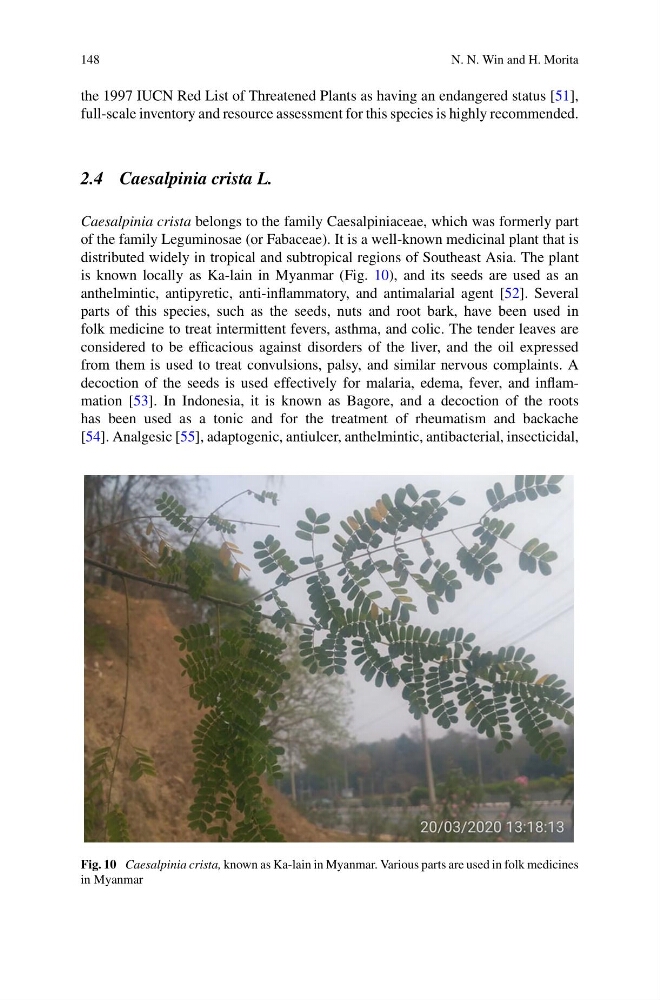
is known locally as Ka-lain in Myanmar (Fig. 10), and its seeds are used as an
anthelmintic, antipyretic, anti-inflammatory, and antimalarial agent [52]. Several
parts of this species, such as the seeds, nuts and root bark, have been used in
folk medicine to treat intermittent fevers, asthma, and colic. The tender leaves are
considered to be efficacious against disorders of the liver, and the oil expressed
from them is used to treat convulsions, palsy, and similar nervous complaints. A
decoction of the seeds is used effectively for malaria, edema, fever, and inflammation [53]. In Indonesia, it is known as Bagore, and a decoction of the roots
has been used as a tonic and for the treatment of rheumatism and backache
[54]. Analgesic [55], adaptogenic, antiulcer, anthelmintic, antibacterial, insecticidal,
Fig. 10 Caesalpinia crista, known as Ka-lain in Myanmar. Various parts are used in folk medicines
in Myanmar
N. N. Win and H. Morita
the 1997 IUCN Red List of Threatened Plants as having an endangered status [51],
full-scale inventory and resource assessment for this species is highly recommended.
2.4 Caesalpinia crista L.
Caesalpinia crista belongs to the family Caesalpiniaceae, which was formerly part
of the family Leguminosae (or Fabaceae). It is a well-known medicinal plant that is
distributed widely in tropical and subtropical regions of Southeast Asia. The plant
is known locally as Ka-lain in Myanmar (Fig. 10), and its seeds are used as an
anthelmintic, antipyretic, anti-inflammatory, and antimalarial agent [52]. Several
parts of this species, such as the seeds, nuts and root bark, have been used in
folk medicine to treat intermittent fevers, asthma, and colic. The tender leaves are
considered to be efficacious against disorders of the liver, and the oil expressed
from them is used to treat convulsions, palsy, and similar nervous complaints. A
decoction of the seeds is used effectively for malaria, edema, fever, and inflammation [53]. In Indonesia, it is known as Bagore, and a decoction of the roots
has been used as a tonic and for the treatment of rheumatism and backache
[54]. Analgesic [55], adaptogenic, antiulcer, anthelmintic, antibacterial, insecticidal,
Fig. 10 Caesalpinia crista, known as Ka-lain in Myanmar. Various parts are used in folk medicines
in Myanmar