

Progress in the Chemistry of Cytochalasans
5
the amino acid residue and reconstruction of the isoindolone moiety may also further
increase the structural diversity of the cytochalasans.
As mentioned in the Introduction, almost all the reported cytochalasans have been
isolated from fungi, mainly inclusive of the genera Chaetomium, Aspergillus, Phoma,
Phomopsis, Xylaria, Spicaria, Periconia, Daldinia, and Hypoxylon. While the first
cytochalasans were isolated from species from the genera Phoma and Helminthosporium, fungi of these genera are not the main sources of cytochalasans. The most
important cytochalasan-producing fungi are members of the genera Chaetomium
and Aspergillus, and nearly 200 cytochalasans, and about 40% of the cytochalasans
reported to date have been isolated from these two genera. Some fungi were found
to produce cytochalasans belonging to more than one structural group, such as
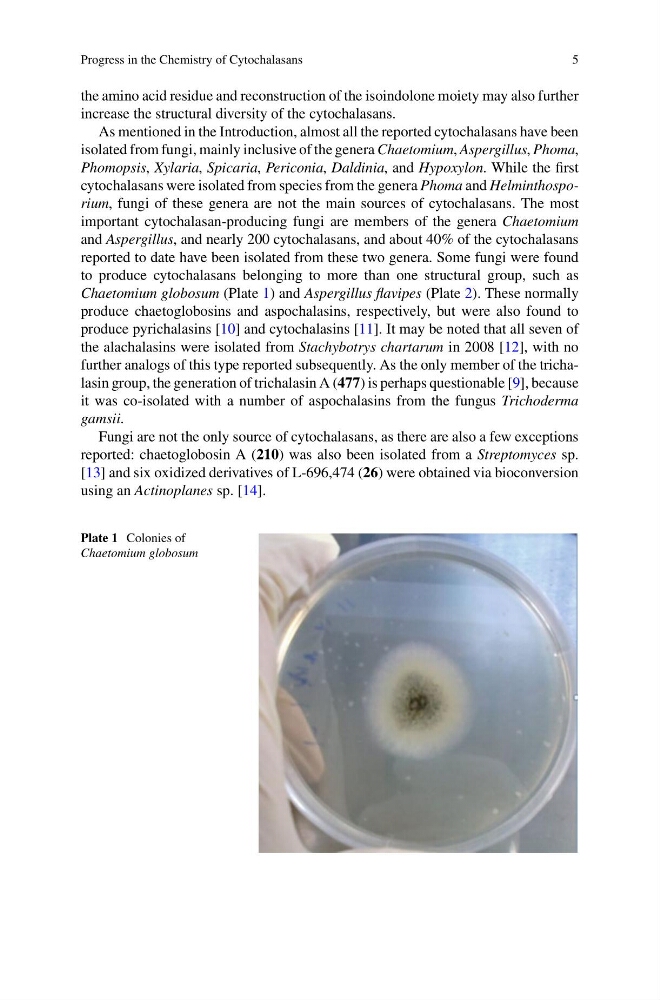
Chaetomium globosum (Plate 1) and Aspergillus flavipes (Plate 2). These normally
produce chaetoglobosins and aspochalasins, respectively, but were also found to
produce pyrichalasins [10] and cytochalasins [11]. It may be noted that all seven of
the alachalasins were isolated from Stachybotrys chartarum in 2008 [12], with no
further analogs of this type reported subsequently. As the only member of the trichalasin group, the generation of trichalasin A (477) is perhaps questionable [9], because
it was co-isolated with a number of aspochalasins from the fungus Trichoderma
gamsii.
Fungi are not the only source of cytochalasans, as there are also a few exceptions
reported: chaetoglobosin A (210) was also been isolated from a Streptomyces sp.
[13] and six oxidized derivatives of L-696,474 (26) were obtained via bioconversion
using an Actinoplanes sp. [14].
Plate 1 Colonies of
Chaetomium globosum
5
the amino acid residue and reconstruction of the isoindolone moiety may also further
increase the structural diversity of the cytochalasans.
As mentioned in the Introduction, almost all the reported cytochalasans have been
isolated from fungi, mainly inclusive of the genera Chaetomium, Aspergillus, Phoma,
Phomopsis, Xylaria, Spicaria, Periconia, Daldinia, and Hypoxylon. While the first
cytochalasans were isolated from species from the genera Phoma and Helminthosporium, fungi of these genera are not the main sources of cytochalasans. The most
important cytochalasan-producing fungi are members of the genera Chaetomium
and Aspergillus, and nearly 200 cytochalasans, and about 40% of the cytochalasans
reported to date have been isolated from these two genera. Some fungi were found
to produce cytochalasans belonging to more than one structural group, such as
Chaetomium globosum (Plate 1) and Aspergillus flavipes (Plate 2). These normally
produce chaetoglobosins and aspochalasins, respectively, but were also found to
produce pyrichalasins [10] and cytochalasins [11]. It may be noted that all seven of
the alachalasins were isolated from Stachybotrys chartarum in 2008 [12], with no
further analogs of this type reported subsequently. As the only member of the trichalasin group, the generation of trichalasin A (477) is perhaps questionable [9], because
it was co-isolated with a number of aspochalasins from the fungus Trichoderma
gamsii.
Fungi are not the only source of cytochalasans, as there are also a few exceptions
reported: chaetoglobosin A (210) was also been isolated from a Streptomyces sp.
[13] and six oxidized derivatives of L-696,474 (26) were obtained via bioconversion
using an Actinoplanes sp. [14].
Plate 1 Colonies of
Chaetomium globosum