

6
H. Zhu et al.
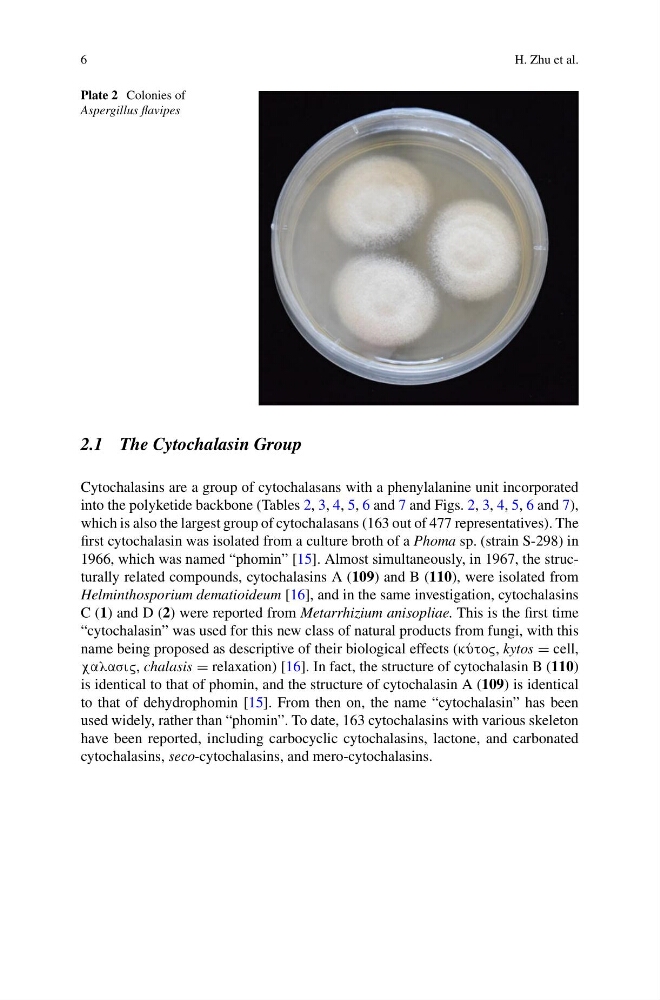
Plate 2 Colonies of
Aspergillus flavipes
2.1 The Cytochalasin Group
Cytochalasins are a group of cytochalasans with a phenylalanine unit incorporated
into the polyketide backbone (Tables 2, 3, 4, 5, 6 and 7 and Figs. 2, 3, 4, 5, 6 and 7),
which is also the largest group of cytochalasans (163 out of 477 representatives). The
first cytochalasin was isolated from a culture broth of a Phoma sp. (strain S-298) in
1966, which was named “phomin” [15]. Almost simultaneously, in 1967, the structurally related compounds, cytochalasins A (109) and B (110), were isolated from
Helminthosporium dematioideum [16], and in the same investigation, cytochalasins
C (1) and D (2) were reported from Metarrhizium anisopliae. This is the first time
“cytochalasin” was used for this new class of natural products from fungi, with this
name being proposed as descriptive of their biological effects (κÚτoς, kytos = cell,
χαλασις, chalasis = relaxation) [16]. In fact, the structure of cytochalasin B (110)
is identical to that of phomin, and the structure of cytochalasin A (109) is identical
to that of dehydrophomin [15]. From then on, the name “cytochalasin” has been
used widely, rather than “phomin”. To date, 163 cytochalasins with various skeleton
have been reported, including carbocyclic cytochalasins, lactone, and carbonated
cytochalasins, seco-cytochalasins, and mero-cytochalasins.
H. Zhu et al.
Plate 2 Colonies of
Aspergillus flavipes
2.1 The Cytochalasin Group
Cytochalasins are a group of cytochalasans with a phenylalanine unit incorporated
into the polyketide backbone (Tables 2, 3, 4, 5, 6 and 7 and Figs. 2, 3, 4, 5, 6 and 7),
which is also the largest group of cytochalasans (163 out of 477 representatives). The
first cytochalasin was isolated from a culture broth of a Phoma sp. (strain S-298) in
1966, which was named “phomin” [15]. Almost simultaneously, in 1967, the structurally related compounds, cytochalasins A (109) and B (110), were isolated from
Helminthosporium dematioideum [16], and in the same investigation, cytochalasins
C (1) and D (2) were reported from Metarrhizium anisopliae. This is the first time
“cytochalasin” was used for this new class of natural products from fungi, with this
name being proposed as descriptive of their biological effects (κÚτoς, kytos = cell,
χαλασις, chalasis = relaxation) [16]. In fact, the structure of cytochalasin B (110)
is identical to that of phomin, and the structure of cytochalasin A (109) is identical
to that of dehydrophomin [15]. From then on, the name “cytochalasin” has been
used widely, rather than “phomin”. To date, 163 cytochalasins with various skeleton
have been reported, including carbocyclic cytochalasins, lactone, and carbonated
cytochalasins, seco-cytochalasins, and mero-cytochalasins.