

"O
:<;
0
.,,
<=
c
::;
::::i
·~
Cl
<.>
<.>
""' "
~
..-1
-~
0
~
N
<=
0
@
<=
"' 0
....
·a
..c
::1
Ol
~
·;::
Q.
~
>S!
a.
"
0
~
u
-ci
0
<=
::l
0
@
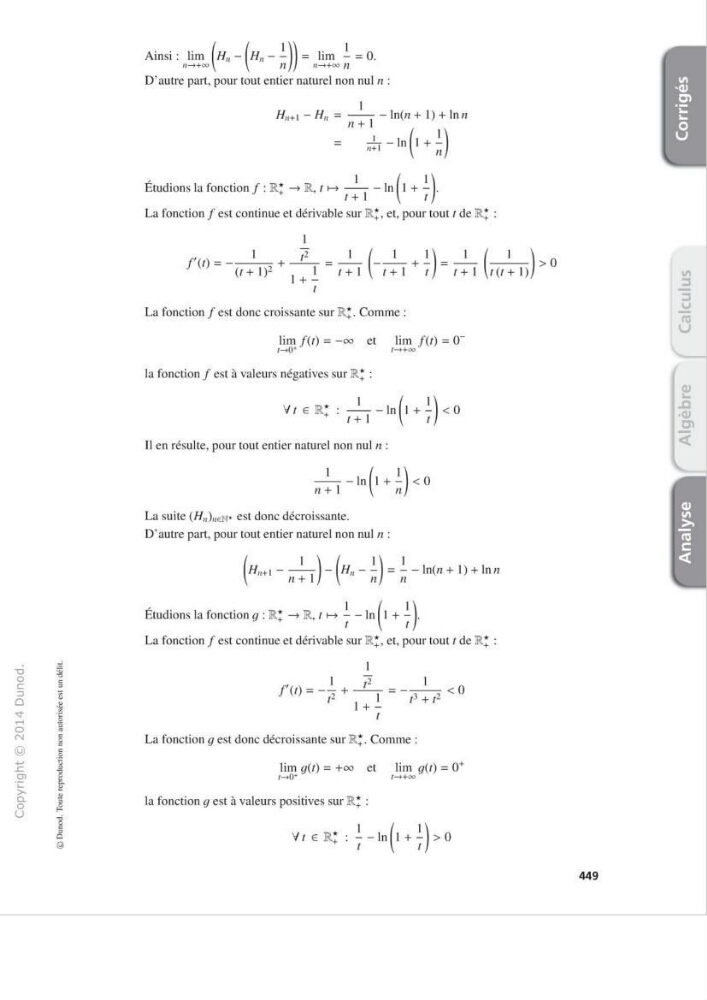
Ainsi : lim (H11 - (H1 1 - ~)) = lim ~ = O.
n->+oo
n
11 -> +oo n
D'autre part, pour tout entier naturel non nul n:
l
H11+ 1 - H 11 = - - - ln(n + 1) +Inn
n + l
-
1
- 1n(1+~)
11+1
n
Étudions la fonction f: R.: ~ R., t H - 1 - - ln (1 + ~).
t + l
t
La fonction f est continue et dérivable sur R.:, et, pour tout t de Ill: :
1
f'(t) =
1
fi
1 (
l
1)
l ( 1 )
.
(t + 1 ) 2 + 1 + ~ = ( + 1 - t + 1 + ï = ï+ï f (t + 1) >
0
(
La fonction f est donc croissante sur R.:. Comme :
lim f(t) = - oo et lim f(t) = 01-->0•
1->+oo
la fonction f est à valeurs négatives sur Ill: :
V t E R: : -
1
- - ln (1 + ~) < 0
f + 1
t
Il en résulte, pour tout entier naturel non nul n :
-
1
- - ln (1 + ~) < 0
n + l
n
La suite (H,,)neN* est donc décroissante.
D 'autre part, pour tout entier naturel non nul n :
( H11+1 - -
1
- )-(H11 - ~) = ~ - ln(n + l) +Inn
n + l
n
n
,
1 ( l)
Etudions la fonction g : R: ~ R, t H ( - ln 1 + Ï .
La fonction f est continue et dérivable sm JR:, et, pom tout t de Ill: :
,,
1
fi
l
f (t) = -- + - - = - - - < 0
t2
l
l
t 3 + t2
+ -
t
La fonction g est donc décroissante sur R!. Comme :
lim g(t) = + oo et lim g(t) = o+
t-+O•
r->+oo
la fonction g est à valeurs positives sur R: :
l ( 1)
V r E R: : Ï - ln l + Ï > 0
449
Il\
~
~
u
- n:s
u
:<;
0
.,,
<=
c
::;
::::i
·~
Cl
<.>
<.>
""' "
~
..-1
-~
0
~
N
<=
0
@
<=
"' 0
....
·a
..c
::1
Ol
~
·;::
Q.
~
>S!
a.
"
0
~
u
-ci
0
<=
::l
0
@
Ainsi : lim (H11 - (H1 1 - ~)) = lim ~ = O.
n->+oo
n
11 -> +oo n
D'autre part, pour tout entier naturel non nul n:
l
H11+ 1 - H 11 = - - - ln(n + 1) +Inn
n + l
-
1
- 1n(1+~)
11+1
n
Étudions la fonction f: R.: ~ R., t H - 1 - - ln (1 + ~).
t + l
t
La fonction f est continue et dérivable sur R.:, et, pour tout t de Ill: :
1
f'(t) =
1
fi
1 (
l
1)
l ( 1 )
.
(t + 1 ) 2 + 1 + ~ = ( + 1 - t + 1 + ï = ï+ï f (t + 1) >
0
(
La fonction f est donc croissante sur R.:. Comme :
lim f(t) = - oo et lim f(t) = 01-->0•
1->+oo
la fonction f est à valeurs négatives sur Ill: :
V t E R: : -
1
- - ln (1 + ~) < 0
f + 1
t
Il en résulte, pour tout entier naturel non nul n :
-
1
- - ln (1 + ~) < 0
n + l
n
La suite (H,,)neN* est donc décroissante.
D 'autre part, pour tout entier naturel non nul n :
( H11+1 - -
1
- )-(H11 - ~) = ~ - ln(n + l) +Inn
n + l
n
n
,
1 ( l)
Etudions la fonction g : R: ~ R, t H ( - ln 1 + Ï .
La fonction f est continue et dérivable sm JR:, et, pom tout t de Ill: :
,,
1
fi
l
f (t) = -- + - - = - - - < 0
t2
l
l
t 3 + t2
+ -
t
La fonction g est donc décroissante sur R!. Comme :
lim g(t) = + oo et lim g(t) = o+
t-+O•
r->+oo
la fonction g est à valeurs positives sur R: :
l ( 1)
V r E R: : Ï - ln l + Ï > 0
449
Il\
~
~
u
- n:s
u