

....
..c
Ol
·;::
>0..
0
u
3. Règles de calcul dans C
Théorème
L'ensemble C peut être muni de deux lois, notées + et x, qui prolongent les lois + et x
de R
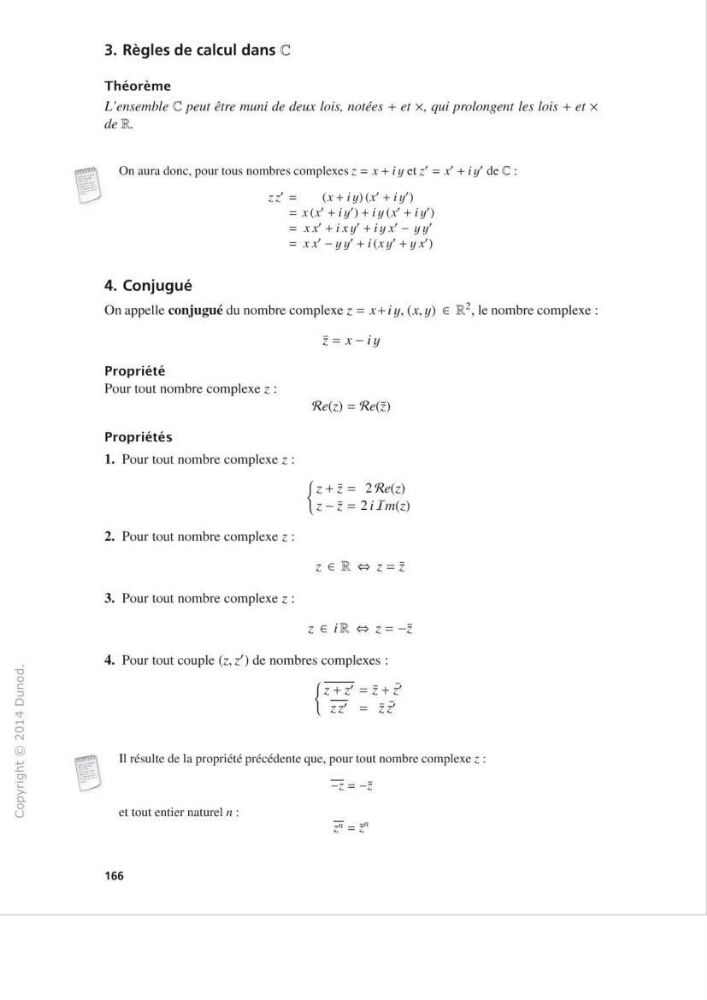
On aura donc, pour tous nombres complexes z = x + i y et z' = x' + i y' de C :
z z' = (x + i y) (x' + i y')
= x (x' + i y') + i y (x' + i y')
= x x' + i x y' + i y x' - y y'
= x x' - y y' + i (x y' +y x')
4. Conjugué
On appelle conjugué du nombre complexez = x+ i y, (x, y) E JR.
2 , le nombre complexe:
Propriété
Pour tout nombre complexe z :
Propriétés
1. Pour tout nombre complexe z :
2. Pour tout nombre complexe z :
3. Pour tout nombre complexe z :
z = x - iy
'Re(z) = 'Re(z)
{
z + z = 2 'Re(z)
z - z = 2iim(z)
zE lR <=} z = z
Z E i JR <::} Z = -z
4. Pour tout couple (z, z') de nombres complexes :
{
z + z' = z + _i'
zz' = zz'
Il résulte de la propriété précédente que, pour tout nombre complexe z :
-z = -z
et tout entier naturel n :
Z
11
= z'
166
..c
Ol
·;::
>0..
0
u
3. Règles de calcul dans C
Théorème
L'ensemble C peut être muni de deux lois, notées + et x, qui prolongent les lois + et x
de R
On aura donc, pour tous nombres complexes z = x + i y et z' = x' + i y' de C :
z z' = (x + i y) (x' + i y')
= x (x' + i y') + i y (x' + i y')
= x x' + i x y' + i y x' - y y'
= x x' - y y' + i (x y' +y x')
4. Conjugué
On appelle conjugué du nombre complexez = x+ i y, (x, y) E JR.
2 , le nombre complexe:
Propriété
Pour tout nombre complexe z :
Propriétés
1. Pour tout nombre complexe z :
2. Pour tout nombre complexe z :
3. Pour tout nombre complexe z :
z = x - iy
'Re(z) = 'Re(z)
{
z + z = 2 'Re(z)
z - z = 2iim(z)
zE lR <=} z = z
Z E i JR <::} Z = -z
4. Pour tout couple (z, z') de nombres complexes :
{
z + z' = z + _i'
zz' = zz'
Il résulte de la propriété précédente que, pour tout nombre complexe z :
-z = -z
et tout entier naturel n :
Z
11
= z'
166