

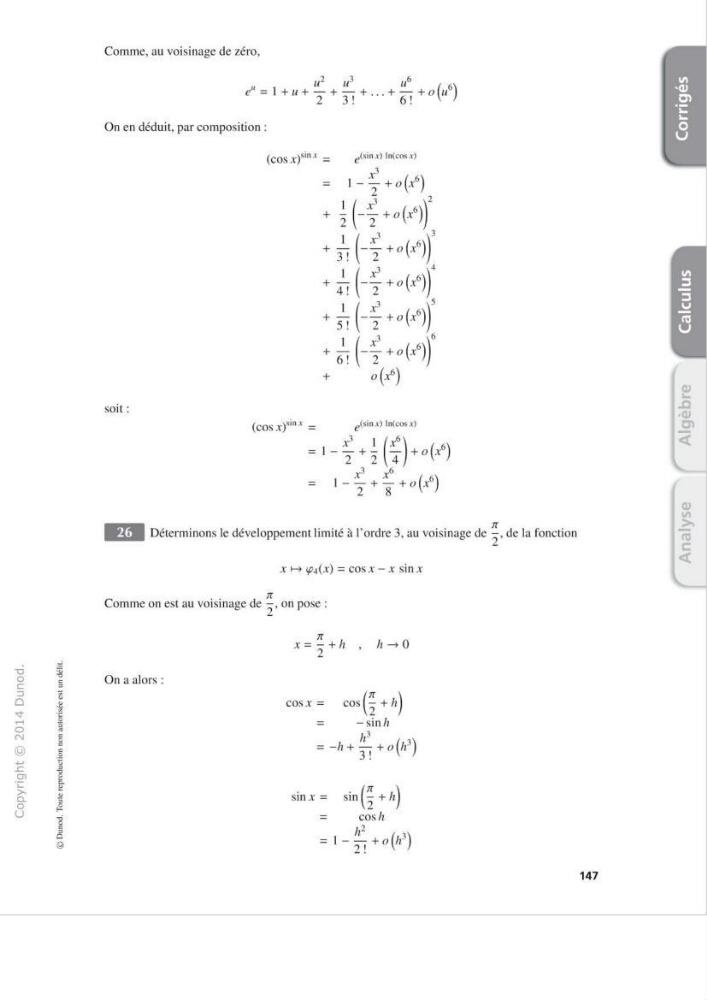
Comme, au voisinage de zéro,
u 2
u 3
u6
e
11 = 1 + u + - + -i + ... + -
6 1 + o (u
6 )
2
3.
.
On en déduit, par composition :
soit:
(cos x)sinx =
e(sin x) ln(cosx)
x3 1 (x6)
= 1 - 2 + 2 4 + o ( x6)
x3
x6
l - 2 + 8 + o (x6)
MN Déterminons le développement limité à l'ordre 3, au voisinage de~' de la fonction
X H
Comme on est au voisinage de Ï , on pose :
"O
:<;
0
.,,
<=
c
::;
On a alors :
::::i
'~
Cl
<.>
<.>
"""
~
..-1
-~
0
~
N
<=
0
@
<=
"' 0
....
·a
..c
::1
Ol
~
·;::
Q.
~
>S!
a.
"
0
~
u
-ci
0
cosx = cos(~+ h)
=
-sinh
h3
= - h + 3i + 0 (h
3
)
<=
::l
0
@
147
u 2
u 3
u6
e
11 = 1 + u + - + -i + ... + -
6 1 + o (u
6 )
2
3.
.
On en déduit, par composition :
soit:
(cos x)sinx =
e(sin x) ln(cosx)
x3 1 (x6)
= 1 - 2 + 2 4 + o ( x6)
x3
x6
l - 2 + 8 + o (x6)
MN Déterminons le développement limité à l'ordre 3, au voisinage de~' de la fonction
X H
Comme on est au voisinage de Ï , on pose :
"O
:<;
0
.,,
<=
c
::;
On a alors :
::::i
'~
Cl
<.>
<.>
"""
~
..-1
-~
0
~
N
<=
0
@
<=
"' 0
....
·a
..c
::1
Ol
~
·;::
Q.
~
>S!
a.
"
0
~
u
-ci
0
cosx = cos(~+ h)
=
-sinh
h3
= - h + 3i + 0 (h
3
)
<=
::l
0
@
147