

Spatial rings and domes 65
n a straight scissor- like elements that are made of rods of equal length 2a
with a pivot in the middle. A similar closed chain can be formed by n b elements with rod length of 2b with again a middle pivot. Both chains are
symmetric about the middle plane on which all middle pivots of scissorlike elements lie. Obviously, both of the chains could become very flexible
while n a and n b are large because of the tolerance in each revolute. One
way to stiffen the structure is to put one chain inside of the other and then
connect them with a number of intermediate ties which are also conventional scissor- like elements to form an integrated larger assembly. The
question that remains to be answered is what the conditions are for the
assembly to retain mobility one.
Name the first chain as the inner loop and the second the outer loop.
For the inner loop, each of the scissor- like elements occupies a sector with
a corresponding central angle
.
(4.1)
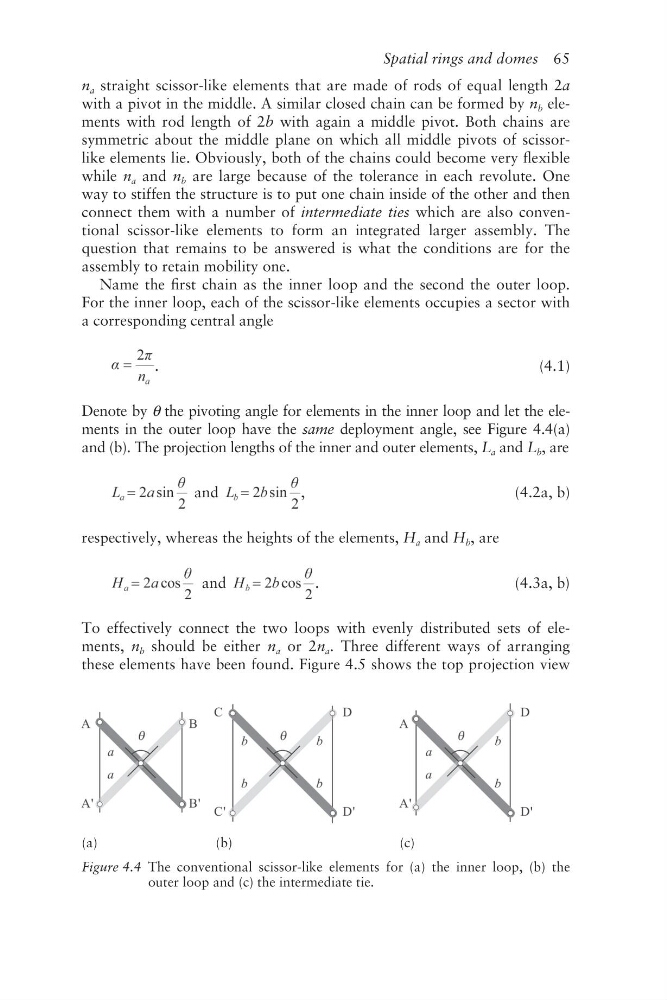
Denote by θ the pivoting angle for elements in the inner loop and let the elements in the outer loop have the same deployment angle, see Figure 4.4(a)
and (b). The projection lengths of the inner and outer elements, L a and L b , are
and
,
(4.2a, b)
respectively, whereas the heights of the elements, H a and H b , are
and
.
(4.3a, b)
To effectively connect the two loops with evenly distributed sets of elements, n b should be either n a or 2n a . Three different ways of arranging
these elements have been found. Figure 4.5 shows the top projection view
(a)
(b)
(c)
Figure 4.4 The conventional scissor-like elements for (a) the inner loop, (b) the
outer loop and (c) the intermediate tie.
n a straight scissor- like elements that are made of rods of equal length 2a
with a pivot in the middle. A similar closed chain can be formed by n b elements with rod length of 2b with again a middle pivot. Both chains are
symmetric about the middle plane on which all middle pivots of scissorlike elements lie. Obviously, both of the chains could become very flexible
while n a and n b are large because of the tolerance in each revolute. One
way to stiffen the structure is to put one chain inside of the other and then
connect them with a number of intermediate ties which are also conventional scissor- like elements to form an integrated larger assembly. The
question that remains to be answered is what the conditions are for the
assembly to retain mobility one.
Name the first chain as the inner loop and the second the outer loop.
For the inner loop, each of the scissor- like elements occupies a sector with
a corresponding central angle
.
(4.1)
Denote by θ the pivoting angle for elements in the inner loop and let the elements in the outer loop have the same deployment angle, see Figure 4.4(a)
and (b). The projection lengths of the inner and outer elements, L a and L b , are
and
,
(4.2a, b)
respectively, whereas the heights of the elements, H a and H b , are
and
.
(4.3a, b)
To effectively connect the two loops with evenly distributed sets of elements, n b should be either n a or 2n a . Three different ways of arranging
these elements have been found. Figure 4.5 shows the top projection view
(a)
(b)
(c)
Figure 4.4 The conventional scissor-like elements for (a) the inner loop, (b) the
outer loop and (c) the intermediate tie.