

66 Spatial rings and domes
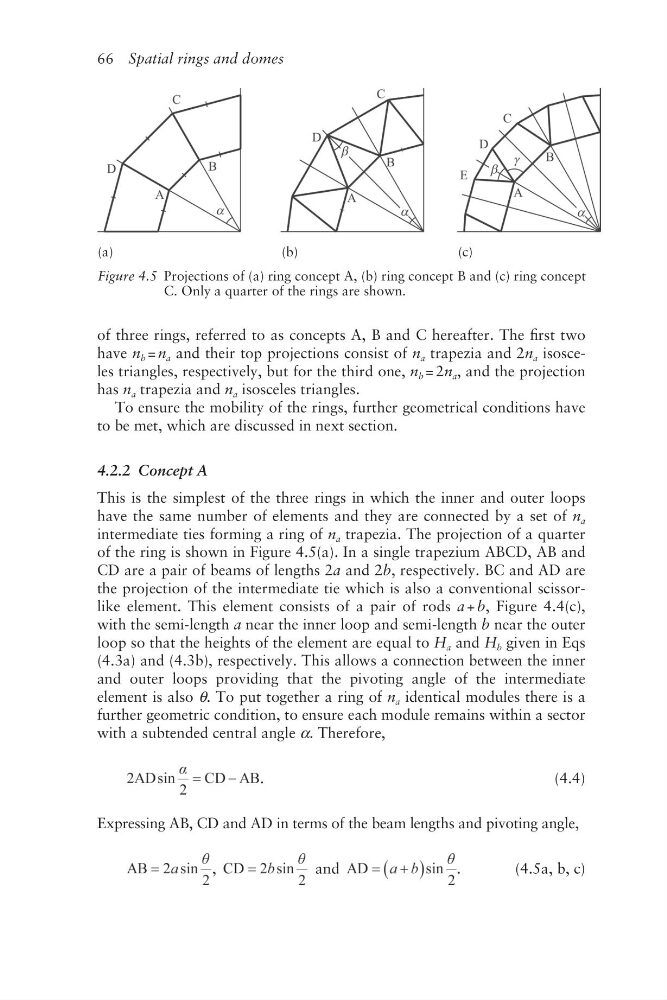
of three rings, referred to as concepts A, B and C hereafter. The first two
have n b = n a and their top projections consist of n a trapezia and 2n a isosceles triangles, respectively, but for the third one, n b = 2n a , and the projection
has n a trapezia and n a isosceles triangles.
To ensure the mobility of the rings, further geometrical conditions have
to be met, which are discussed in next section.
4.2.2 Concept A
This is the simplest of the three rings in which the inner and outer loops
have the same number of elements and they are connected by a set of n a
intermediate ties forming a ring of n a trapezia. The projection of a quarter
of the ring is shown in Figure 4.5(a). In a single trapezium ABCD, AB and
CD are a pair of beams of lengths 2a and 2b, respectively. BC and AD are
the projection of the intermediate tie which is also a conventional scissorlike element. This element consists of a pair of rods a + b, Figure 4.4(c),
with the semi- length a near the inner loop and semi- length b near the outer
loop so that the heights of the element are equal to H a and H b given in Eqs
(4.3a) and (4.3b), respectively. This allows a connection between the inner
and outer loops providing that the pivoting angle of the intermediate
element is also θ. To put together a ring of n a identical modules there is a
further geometric condition, to ensure each module remains within a sector
with a subtended central angle α. Therefore,
.
(4.4)
Expressing AB, CD and AD in terms of the beam lengths and pivoting angle,
,
and
.
(4.5a, b, c)
(a)
(b)
(c)
Figure 4.5 Projections of (a) ring concept A, (b) ring concept B and (c) ring concept
C. Only a quarter of the rings are shown.
of three rings, referred to as concepts A, B and C hereafter. The first two
have n b = n a and their top projections consist of n a trapezia and 2n a isosceles triangles, respectively, but for the third one, n b = 2n a , and the projection
has n a trapezia and n a isosceles triangles.
To ensure the mobility of the rings, further geometrical conditions have
to be met, which are discussed in next section.
4.2.2 Concept A
This is the simplest of the three rings in which the inner and outer loops
have the same number of elements and they are connected by a set of n a
intermediate ties forming a ring of n a trapezia. The projection of a quarter
of the ring is shown in Figure 4.5(a). In a single trapezium ABCD, AB and
CD are a pair of beams of lengths 2a and 2b, respectively. BC and AD are
the projection of the intermediate tie which is also a conventional scissorlike element. This element consists of a pair of rods a + b, Figure 4.4(c),
with the semi- length a near the inner loop and semi- length b near the outer
loop so that the heights of the element are equal to H a and H b given in Eqs
(4.3a) and (4.3b), respectively. This allows a connection between the inner
and outer loops providing that the pivoting angle of the intermediate
element is also θ. To put together a ring of n a identical modules there is a
further geometric condition, to ensure each module remains within a sector
with a subtended central angle α. Therefore,
.
(4.4)
Expressing AB, CD and AD in terms of the beam lengths and pivoting angle,
,
and
.
(4.5a, b, c)
(a)
(b)
(c)
Figure 4.5 Projections of (a) ring concept A, (b) ring concept B and (c) ring concept
C. Only a quarter of the rings are shown.