

Planar double chain linkages 57
The resulting structure will remain mobile, like the original double chain,
provided that the members added to it are not collinear. Repeating the
same arrangement it can be shown that any number of pairs of bars connected by hinges to the double chain will leave its mobility unchanged
despite that the chain grows larger. This is best illustrated by the following
example.
Figure 3.22(a) shows a general, small part of a double chain consisting
of angulated elements. Additional bars are connected to its outer hinges,
Figure 3.22(b). It is obvious that the mobility is retained because all additional members are free to rotate with respect to the original double chain.
If the lengths of the additional bars are made such that the quadrangles
A 2 A 3 B 1 B 2 , B 2 B 3 C 2 C 1 , etc. are parallelograms, ∠A 1 A 2 A 3 , ∠B 1 B 2 B 3 , etc.
remain constant when the double chain is in motion. Consider, for
example, ∠A 1 A 2 A 3 . Because A 1 A 2 and A 2 A 3 remain parallel to B 0 B 1 and
B 1 B 2 , respectively,
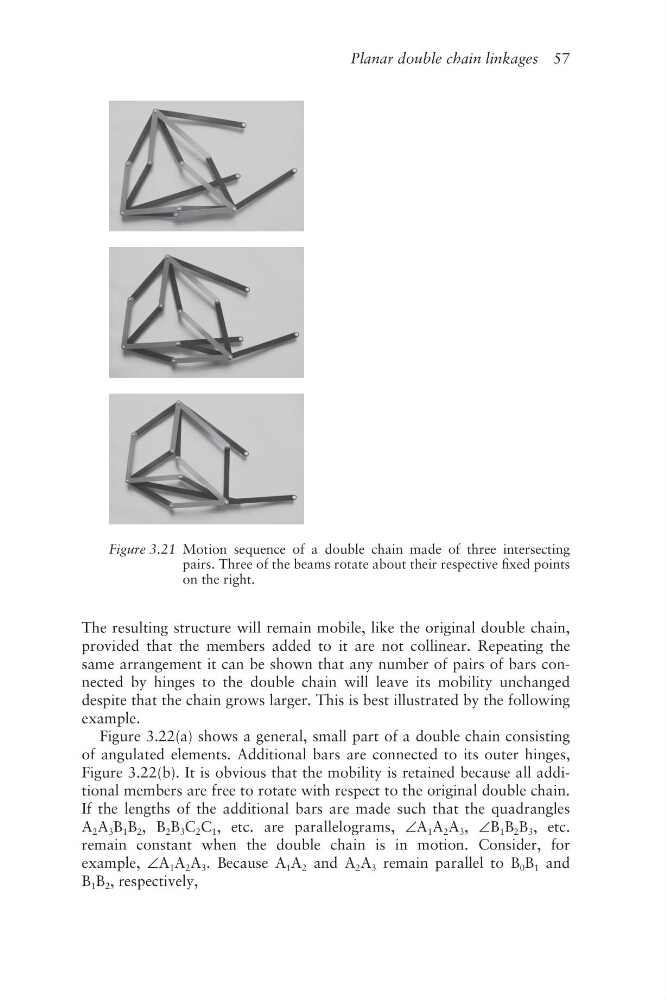
Figure 3.21 Motion sequence of a double chain made of three intersecting
pairs. Three of the beams rotate about their respective fixed points
on the right.
The resulting structure will remain mobile, like the original double chain,
provided that the members added to it are not collinear. Repeating the
same arrangement it can be shown that any number of pairs of bars connected by hinges to the double chain will leave its mobility unchanged
despite that the chain grows larger. This is best illustrated by the following
example.
Figure 3.22(a) shows a general, small part of a double chain consisting
of angulated elements. Additional bars are connected to its outer hinges,
Figure 3.22(b). It is obvious that the mobility is retained because all additional members are free to rotate with respect to the original double chain.
If the lengths of the additional bars are made such that the quadrangles
A 2 A 3 B 1 B 2 , B 2 B 3 C 2 C 1 , etc. are parallelograms, ∠A 1 A 2 A 3 , ∠B 1 B 2 B 3 , etc.
remain constant when the double chain is in motion. Consider, for
example, ∠A 1 A 2 A 3 . Because A 1 A 2 and A 2 A 3 remain parallel to B 0 B 1 and
B 1 B 2 , respectively,
Figure 3.21 Motion sequence of a double chain made of three intersecting
pairs. Three of the beams rotate about their respective fixed points
on the right.