

58 Planar double chain linkages
= constant
(3.33)
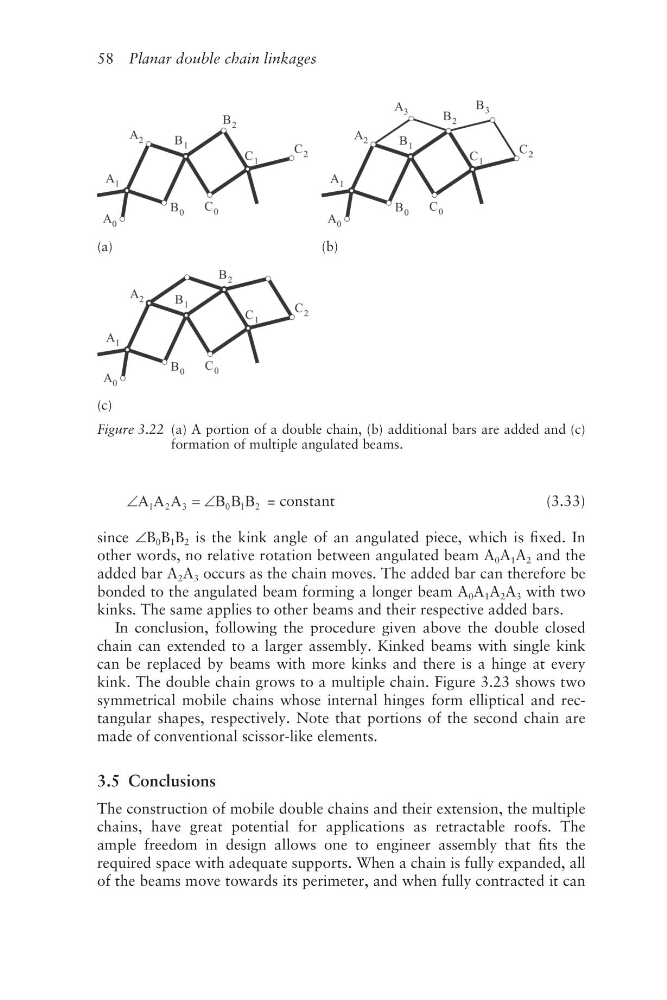
since ∠B 0 B 1 B 2 is the kink angle of an angulated piece, which is fixed. In
other words, no relative rotation between angulated beam A 0 A 1 A 2 and the
added bar A 2 A 3 occurs as the chain moves. The added bar can therefore be
bonded to the angulated beam forming a longer beam A 0 A 1 A 2 A 3 with two
kinks. The same applies to other beams and their respective added bars.
In conclusion, following the procedure given above the double closed
chain can extended to a larger assembly. Kinked beams with single kink
can be replaced by beams with more kinks and there is a hinge at every
kink. The double chain grows to a multiple chain. Figure 3.23 shows two
symmetrical mobile chains whose internal hinges form elliptical and rectangular shapes, respectively. Note that portions of the second chain are
made of conventional scissor-like elements.
3.5 Conclusions
The construction of mobile double chains and their extension, the multiple
chains, have great potential for applications as retractable roofs. The
ample freedom in design allows one to engineer assembly that fits the
required space with adequate supports. When a chain is fully expanded, all
of the beams move towards its perimeter, and when fully contracted it can
(a)
(b)
(c)
Figure 3.22 (a) A portion of a double chain, (b) additional bars are added and (c)
formation of multiple angulated beams.
= constant
(3.33)
since ∠B 0 B 1 B 2 is the kink angle of an angulated piece, which is fixed. In
other words, no relative rotation between angulated beam A 0 A 1 A 2 and the
added bar A 2 A 3 occurs as the chain moves. The added bar can therefore be
bonded to the angulated beam forming a longer beam A 0 A 1 A 2 A 3 with two
kinks. The same applies to other beams and their respective added bars.
In conclusion, following the procedure given above the double closed
chain can extended to a larger assembly. Kinked beams with single kink
can be replaced by beams with more kinks and there is a hinge at every
kink. The double chain grows to a multiple chain. Figure 3.23 shows two
symmetrical mobile chains whose internal hinges form elliptical and rectangular shapes, respectively. Note that portions of the second chain are
made of conventional scissor-like elements.
3.5 Conclusions
The construction of mobile double chains and their extension, the multiple
chains, have great potential for applications as retractable roofs. The
ample freedom in design allows one to engineer assembly that fits the
required space with adequate supports. When a chain is fully expanded, all
of the beams move towards its perimeter, and when fully contracted it can
(a)
(b)
(c)
Figure 3.22 (a) A portion of a double chain, (b) additional bars are added and (c)
formation of multiple angulated beams.