

56 Planar double chain linkages
or
d i = p i and ψ = 0.
(3.32a, b)
The first solution indicates that three fixed points have merged into one
and the entire double chain is rotating about a single fixed point. Since we
have not fixed the assembly to a stationary ground this motion is allowed.
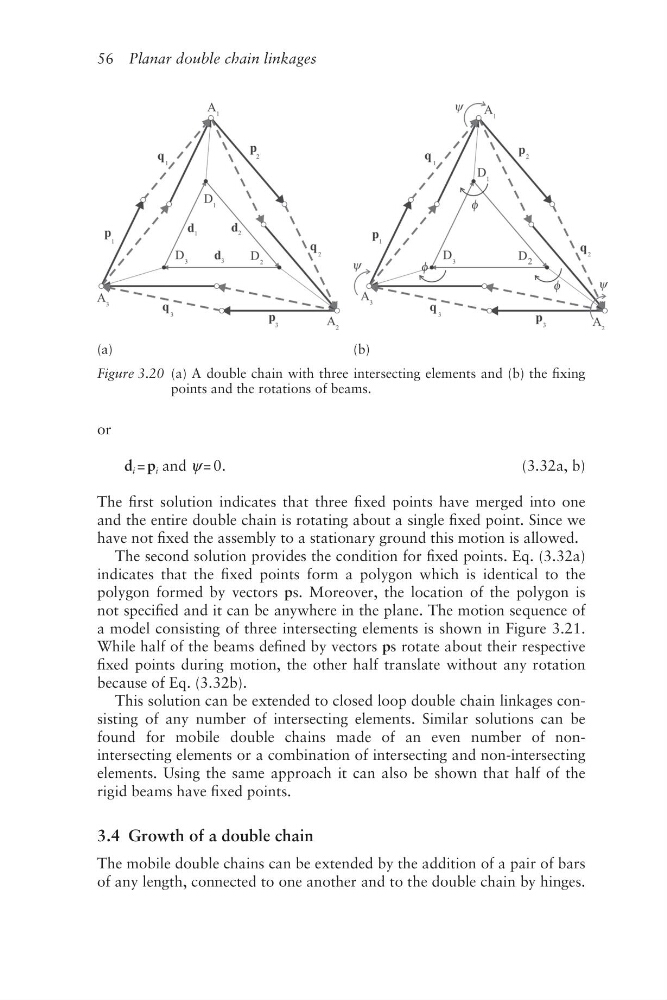
The second solution provides the condition for fixed points. Eq. (3.32a)
indicates that the fixed points form a polygon which is identical to the
polygon formed by vectors ps. Moreover, the location of the polygon is
not specified and it can be anywhere in the plane. The motion sequence of
a model consisting of three intersecting elements is shown in Figure 3.21.
While half of the beams defined by vectors ps rotate about their respective
fixed points during motion, the other half translate without any rotation
because of Eq. (3.32b).
This solution can be extended to closed loop double chain linkages consisting of any number of intersecting elements. Similar solutions can be
found for mobile double chains made of an even number of nonintersecting elements or a combination of intersecting and non- intersecting
elements. Using the same approach it can also be shown that half of the
rigid beams have fixed points.
3.4 Growth of a double chain
The mobile double chains can be extended by the addition of a pair of bars
of any length, connected to one another and to the double chain by hinges.
(a)
(b)
Figure 3.20 (a) A double chain with three intersecting elements and (b) the fixing
points and the rotations of beams.
or
d i = p i and ψ = 0.
(3.32a, b)
The first solution indicates that three fixed points have merged into one
and the entire double chain is rotating about a single fixed point. Since we
have not fixed the assembly to a stationary ground this motion is allowed.
The second solution provides the condition for fixed points. Eq. (3.32a)
indicates that the fixed points form a polygon which is identical to the
polygon formed by vectors ps. Moreover, the location of the polygon is
not specified and it can be anywhere in the plane. The motion sequence of
a model consisting of three intersecting elements is shown in Figure 3.21.
While half of the beams defined by vectors ps rotate about their respective
fixed points during motion, the other half translate without any rotation
because of Eq. (3.32b).
This solution can be extended to closed loop double chain linkages consisting of any number of intersecting elements. Similar solutions can be
found for mobile double chains made of an even number of nonintersecting elements or a combination of intersecting and non- intersecting
elements. Using the same approach it can also be shown that half of the
rigid beams have fixed points.
3.4 Growth of a double chain
The mobile double chains can be extended by the addition of a pair of bars
of any length, connected to one another and to the double chain by hinges.
(a)
(b)
Figure 3.20 (a) A double chain with three intersecting elements and (b) the fixing
points and the rotations of beams.