

18 Fundamental concepts
For such a chain to have mobility one (m = 1) seven links (n = 7) and seven
joints (j = 7) are needed. Thus, any kinematic chains with fewer links and
joints are to be either immobile or overconstrained.
Closed chains with seven links are less suitable as building blocks for
motion structures just like that heptagons are hardly used in surface tiling.
Hence, overconstrained spatial closed chains have been found to be
particularly useful in forming large motion structures by tessellation.
Before embarking on the task of building motion structures let us first
survey all of the existing overconstrained linkages with emphasis on spatial
linkages for most of the planar overconstrained linkages are variations of
the four- bar linkage, such as the one shown in Figure 2.10(b).
2.3.2 Early examples
The first published research on overconstrained mechanisms can be traced
back to Sarrus (1853) when he reported a six- bar mechanism capable of
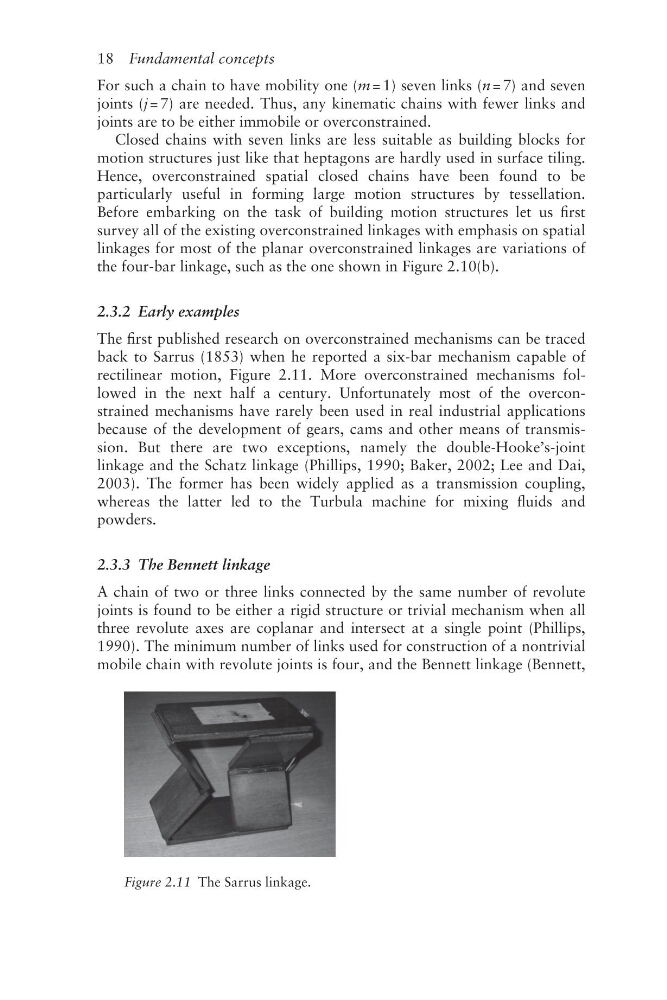
rectilinear motion, Figure 2.11. More overconstrained mechanisms followed in the next half a century. Unfortunately most of the overconstrained mechanisms have rarely been used in real industrial applications
because of the development of gears, cams and other means of transmission. But there are two exceptions, namely the double- Hooke’s-joint
linkage and the Schatz linkage (Phillips, 1990; Baker, 2002; Lee and Dai,
2003). The former has been widely applied as a transmission coupling,
whereas the latter led to the Turbula machine for mixing fluids and
powders.
2.3.3 The Bennett linkage
A chain of two or three links connected by the same number of revolute
joints is found to be either a rigid structure or trivial mechanism when all
three revolute axes are coplanar and intersect at a single point (Phillips,
1990). The minimum number of links used for construction of a nontrivial
mobile chain with revolute joints is four, and the Bennett linkage (Bennett,
Figure 2.11 The Sarrus linkage.
For such a chain to have mobility one (m = 1) seven links (n = 7) and seven
joints (j = 7) are needed. Thus, any kinematic chains with fewer links and
joints are to be either immobile or overconstrained.
Closed chains with seven links are less suitable as building blocks for
motion structures just like that heptagons are hardly used in surface tiling.
Hence, overconstrained spatial closed chains have been found to be
particularly useful in forming large motion structures by tessellation.
Before embarking on the task of building motion structures let us first
survey all of the existing overconstrained linkages with emphasis on spatial
linkages for most of the planar overconstrained linkages are variations of
the four- bar linkage, such as the one shown in Figure 2.10(b).
2.3.2 Early examples
The first published research on overconstrained mechanisms can be traced
back to Sarrus (1853) when he reported a six- bar mechanism capable of
rectilinear motion, Figure 2.11. More overconstrained mechanisms followed in the next half a century. Unfortunately most of the overconstrained mechanisms have rarely been used in real industrial applications
because of the development of gears, cams and other means of transmission. But there are two exceptions, namely the double- Hooke’s-joint
linkage and the Schatz linkage (Phillips, 1990; Baker, 2002; Lee and Dai,
2003). The former has been widely applied as a transmission coupling,
whereas the latter led to the Turbula machine for mixing fluids and
powders.
2.3.3 The Bennett linkage
A chain of two or three links connected by the same number of revolute
joints is found to be either a rigid structure or trivial mechanism when all
three revolute axes are coplanar and intersect at a single point (Phillips,
1990). The minimum number of links used for construction of a nontrivial
mobile chain with revolute joints is four, and the Bennett linkage (Bennett,
Figure 2.11 The Sarrus linkage.