

Fundamental concepts 17
2.3 Overconstrained linkages
2.3.1 Introduction
We have shown examples that the Kutzbach criterion may count idle
degrees of freedom in some mechanisms. It may also give a misleading
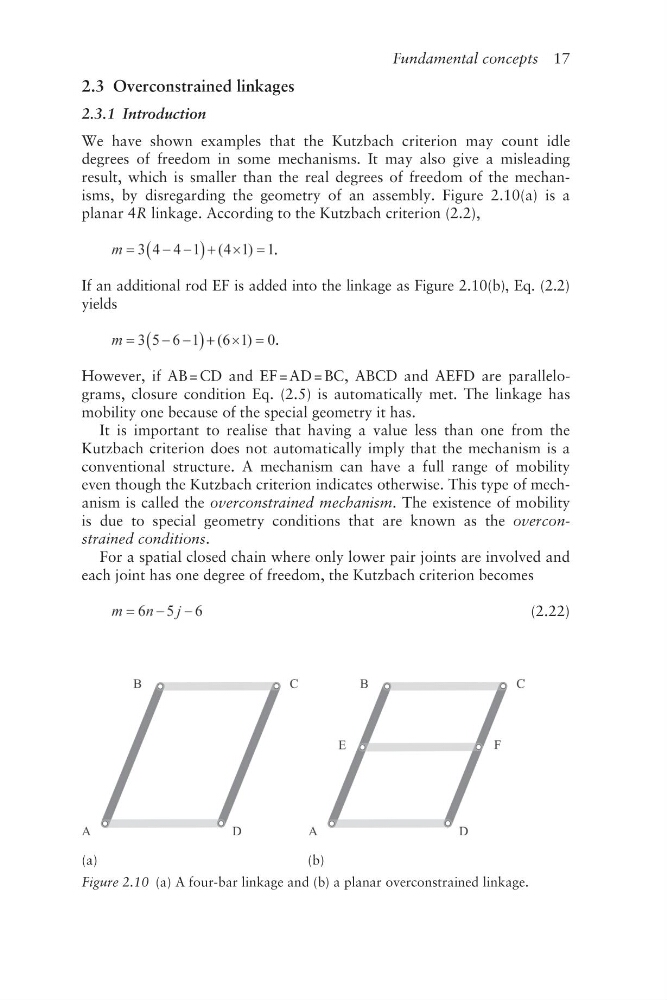
result, which is smaller than the real degrees of freedom of the mechanisms, by disregarding the geometry of an assembly. Figure 2.10(a) is a
planar 4R linkage. According to the Kutzbach criterion (2.2),
.
If an additional rod EF is added into the linkage as Figure 2.10(b), Eq. (2.2)
yields
.
However, if AB = CD and EF = AD = BC, ABCD and AEFD are parallelograms, closure condition Eq. (2.5) is automatically met. The linkage has
mobility one because of the special geometry it has.
It is important to realise that having a value less than one from the
Kutz bach criterion does not automatically imply that the mechanism is a
conventional structure. A mechanism can have a full range of mobility
even though the Kutzbach criterion indicates otherwise. This type of mechanism is called the overconstrained mechanism. The existence of mobility
is due to special geometry conditions that are known as the overconstrained conditions.
For a spatial closed chain where only lower pair joints are involved and
each joint has one degree of freedom, the Kutzbach criterion becomes
(2.22)
(a)
(b)
Figure 2.10 (a) A four-bar linkage and (b) a planar overconstrained linkage.
2.3 Overconstrained linkages
2.3.1 Introduction
We have shown examples that the Kutzbach criterion may count idle
degrees of freedom in some mechanisms. It may also give a misleading
result, which is smaller than the real degrees of freedom of the mechanisms, by disregarding the geometry of an assembly. Figure 2.10(a) is a
planar 4R linkage. According to the Kutzbach criterion (2.2),
.
If an additional rod EF is added into the linkage as Figure 2.10(b), Eq. (2.2)
yields
.
However, if AB = CD and EF = AD = BC, ABCD and AEFD are parallelograms, closure condition Eq. (2.5) is automatically met. The linkage has
mobility one because of the special geometry it has.
It is important to realise that having a value less than one from the
Kutz bach criterion does not automatically imply that the mechanism is a
conventional structure. A mechanism can have a full range of mobility
even though the Kutzbach criterion indicates otherwise. This type of mechanism is called the overconstrained mechanism. The existence of mobility
is due to special geometry conditions that are known as the overconstrained conditions.
For a spatial closed chain where only lower pair joints are involved and
each joint has one degree of freedom, the Kutzbach criterion becomes
(2.22)
(a)
(b)
Figure 2.10 (a) A four-bar linkage and (b) a planar overconstrained linkage.