

8 Fundamental concepts
In general, mechanisms are three dimensional. However, there are circumstances where the mechanisms, and in particular the way they are analysed, can be simplified. This leads to two specific types of mechanisms,
namely the planar and spherical mechanisms.
2.1.3 The planar mechanisms
A planar mechanism is a mechanism such that the trajectories of all points
on its links are parallel to a plane. The plane is known as the plane of
motion. The only lower pair joints that are properly compatible with planar
motion are revolute and prismatic joints. The axes of rotation of all revolute
joints must be normal to the plane of motion and the directions of sliding of
all prismatic joints must be parallel to the plane of motion. And only cam
and gear pairs as higher pair joints can be applied to planar mechanisms.
In a plane, each free rigid body has three degrees of freedom. The
general mobility criterion (2.1) therefore becomes
.
(2.2)
A planar mechanism becomes a planar linkage if it contains only revolute
and prismatic joints, which is also the focus of this book for they can be
effectively utilised to construct large motion assemblies. Because both revolute and prismatic joints have one degree of freedom, i.e. f i = 1, the mobility
criterion of planar linkage becomes
(2.3)
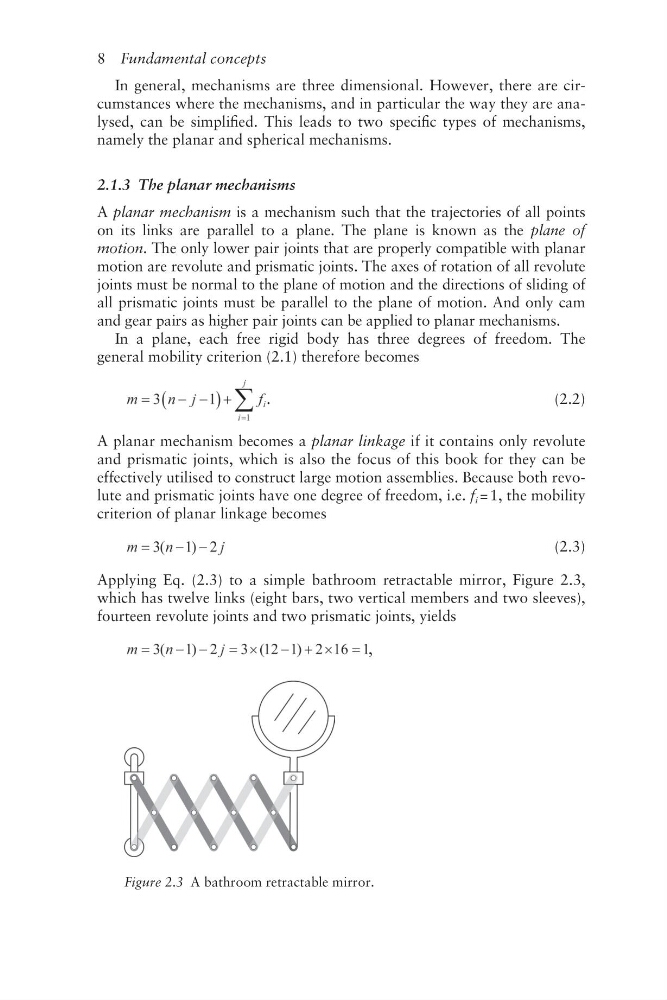
Applying Eq. (2.3) to a simple bathroom retractable mirror, Figure 2.3,
which has twelve links (eight bars, two vertical members and two sleeves),
fourteen revolute joints and two prismatic joints, yields
,
Figure 2.3 A bathroom retractable mirror.
In general, mechanisms are three dimensional. However, there are circumstances where the mechanisms, and in particular the way they are analysed, can be simplified. This leads to two specific types of mechanisms,
namely the planar and spherical mechanisms.
2.1.3 The planar mechanisms
A planar mechanism is a mechanism such that the trajectories of all points
on its links are parallel to a plane. The plane is known as the plane of
motion. The only lower pair joints that are properly compatible with planar
motion are revolute and prismatic joints. The axes of rotation of all revolute
joints must be normal to the plane of motion and the directions of sliding of
all prismatic joints must be parallel to the plane of motion. And only cam
and gear pairs as higher pair joints can be applied to planar mechanisms.
In a plane, each free rigid body has three degrees of freedom. The
general mobility criterion (2.1) therefore becomes
.
(2.2)
A planar mechanism becomes a planar linkage if it contains only revolute
and prismatic joints, which is also the focus of this book for they can be
effectively utilised to construct large motion assemblies. Because both revolute and prismatic joints have one degree of freedom, i.e. f i = 1, the mobility
criterion of planar linkage becomes
(2.3)
Applying Eq. (2.3) to a simple bathroom retractable mirror, Figure 2.3,
which has twelve links (eight bars, two vertical members and two sleeves),
fourteen revolute joints and two prismatic joints, yields
,
Figure 2.3 A bathroom retractable mirror.