

Appendix A: Some More Background
277
Figure A.1 shows some of Kapteyn’s results in terms of nodes. He finds
that these are either point-like or straight lines. Kapteyn concludes that the
point-like nodes must exist (apparently a new result), but cannot be seen in
observations. This is probably due to small imperfections in the thickness and
elasticity that in reality membranes have.
A.2 Distances and Luminosities
The distance of a star not too far from the Sun can be measured directly using
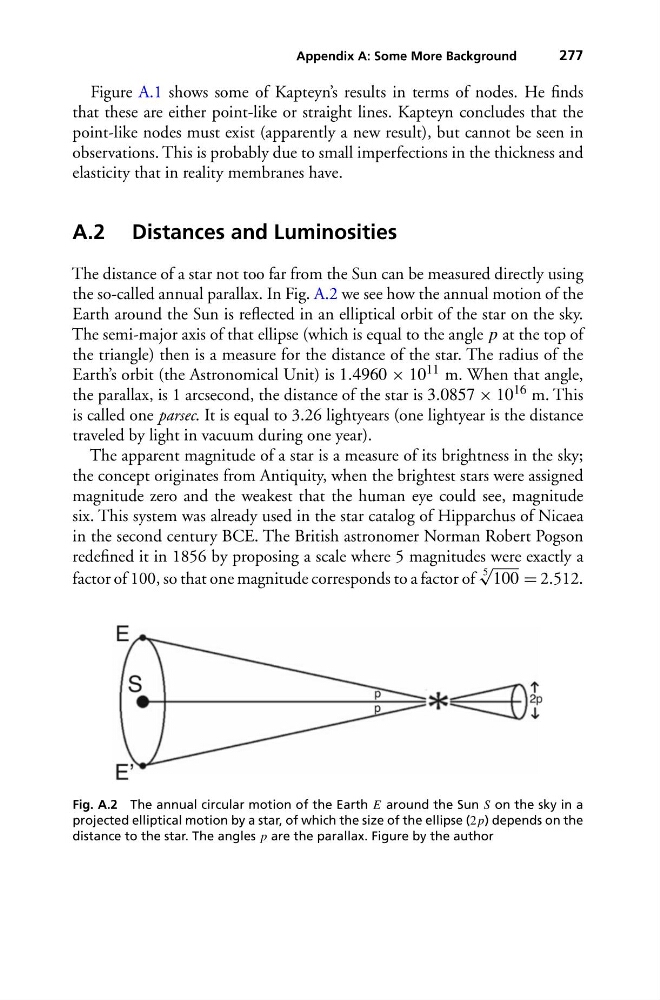
the so-called annual parallax. In Fig. A.2 we see how the annual motion of the
Earth around the Sun is reflected in an elliptical orbit of the star on the sky.
The semi-major axis of that ellipse (which is equal to the angle p at the top of
the triangle) then is a measure for the distance of the star. The radius of the
Earth’s orbit (the Astronomical Unit) is 1.4960 × 10 11 m. When that angle,
the parallax, is 1 arcsecond, the distance of the star is 3.0857 × 10 16 m. This
is called one parsec. It is equal to 3.26 lightyears (one lightyear is the distance
traveled by light in vacuum during one year).
The apparent magnitude of a star is a measure of its brightness in the sky;
the concept originates from Antiquity, when the brightest stars were assigned
magnitude zero and the weakest that the human eye could see, magnitude
six. This system was already used in the star catalog of Hipparchus of Nicaea
in the second century BCE. The British astronomer Norman Robert Pogson
redefined it in 1856 by proposing a scale where 5 magnitudes were exactly a
factor of 100, so that one magnitude corresponds to a factor of
5
√
100 = 2.512.
Fig. A.2 The annual circular motion of the Earth E around the Sun S on the sky in a
projected elliptical motion by a star, of which the size of the ellipse (2 p) depends on the
distance to the star. The angles p are the parallax. Figure by the author
277
Figure A.1 shows some of Kapteyn’s results in terms of nodes. He finds
that these are either point-like or straight lines. Kapteyn concludes that the
point-like nodes must exist (apparently a new result), but cannot be seen in
observations. This is probably due to small imperfections in the thickness and
elasticity that in reality membranes have.
A.2 Distances and Luminosities
The distance of a star not too far from the Sun can be measured directly using
the so-called annual parallax. In Fig. A.2 we see how the annual motion of the
Earth around the Sun is reflected in an elliptical orbit of the star on the sky.
The semi-major axis of that ellipse (which is equal to the angle p at the top of
the triangle) then is a measure for the distance of the star. The radius of the
Earth’s orbit (the Astronomical Unit) is 1.4960 × 10 11 m. When that angle,
the parallax, is 1 arcsecond, the distance of the star is 3.0857 × 10 16 m. This
is called one parsec. It is equal to 3.26 lightyears (one lightyear is the distance
traveled by light in vacuum during one year).
The apparent magnitude of a star is a measure of its brightness in the sky;
the concept originates from Antiquity, when the brightest stars were assigned
magnitude zero and the weakest that the human eye could see, magnitude
six. This system was already used in the star catalog of Hipparchus of Nicaea
in the second century BCE. The British astronomer Norman Robert Pogson
redefined it in 1856 by proposing a scale where 5 magnitudes were exactly a
factor of 100, so that one magnitude corresponds to a factor of
5
√
100 = 2.512.
Fig. A.2 The annual circular motion of the Earth E around the Sun S on the sky in a
projected elliptical motion by a star, of which the size of the ellipse (2 p) depends on the
distance to the star. The angles p are the parallax. Figure by the author