

278
Appendix A: Some More Background
The absolute magnitude (designated with capital M) is defined as the magnitude a star would have at a distance op 10 parsec. This definition goes back
to Kapteyn.
A.3 Sines Functions of Higher Orders
It is well known that the sine and cosine of an angle (in radians) can be expanded
as an infinite series. The brothers Jacobus and Willem Kapteyn made a study
of a set of generalized series. These are not new functions of angles but sets
of mathematical formulae of which the usual sine and cosine are special cases.
These series are therefore designated by ‘higher-order-sines’. They published
an extensive paper on this in 1886, that had been preceded by another one on
a special case different from the sine and cosine.
A.4 Kepler’s Equation
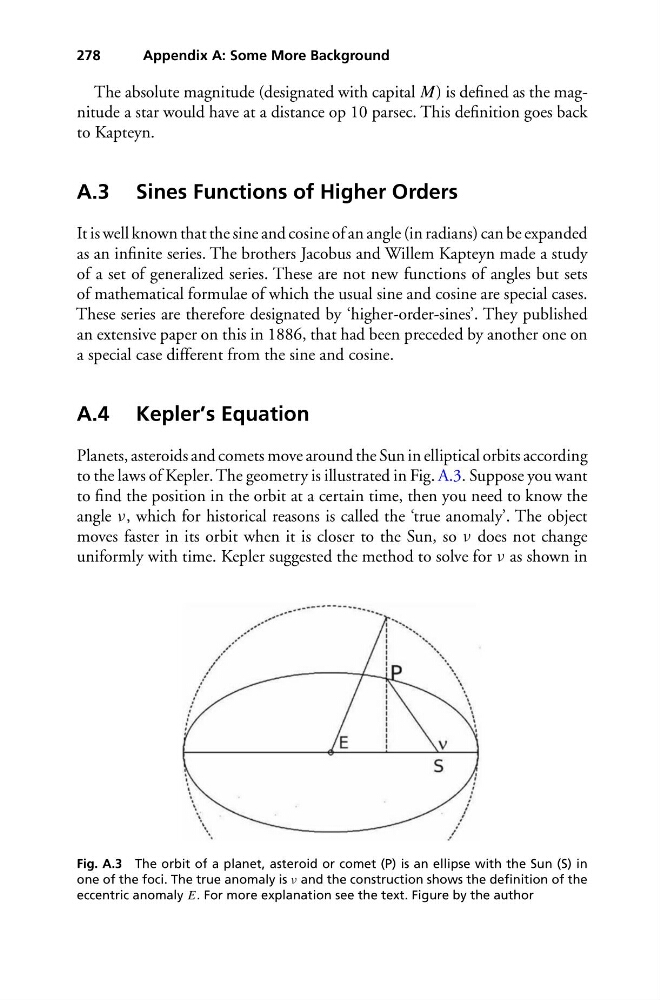
Planets, asteroids and comets move around the Sun in elliptical orbits according
to the laws of Kepler. The geometry is illustrated in Fig. A.3. Suppose you want
to find the position in the orbit at a certain time, then you need to know the
angle ν, which for historical reasons is called the ‘true anomaly’. The object
moves faster in its orbit when it is closer to the Sun, so ν does not change
uniformly with time. Kepler suggested the method to solve for ν as shown in
Fig. A.3 The orbit of a planet, asteroid or comet (P) is an ellipse with the Sun (S) in
one of the foci. The true anomaly is ν and the construction shows the definition of the
eccentric anomaly E. For more explanation see the text. Figure by the author
Appendix A: Some More Background
The absolute magnitude (designated with capital M) is defined as the magnitude a star would have at a distance op 10 parsec. This definition goes back
to Kapteyn.
A.3 Sines Functions of Higher Orders
It is well known that the sine and cosine of an angle (in radians) can be expanded
as an infinite series. The brothers Jacobus and Willem Kapteyn made a study
of a set of generalized series. These are not new functions of angles but sets
of mathematical formulae of which the usual sine and cosine are special cases.
These series are therefore designated by ‘higher-order-sines’. They published
an extensive paper on this in 1886, that had been preceded by another one on
a special case different from the sine and cosine.
A.4 Kepler’s Equation
Planets, asteroids and comets move around the Sun in elliptical orbits according
to the laws of Kepler. The geometry is illustrated in Fig. A.3. Suppose you want
to find the position in the orbit at a certain time, then you need to know the
angle ν, which for historical reasons is called the ‘true anomaly’. The object
moves faster in its orbit when it is closer to the Sun, so ν does not change
uniformly with time. Kepler suggested the method to solve for ν as shown in
Fig. A.3 The orbit of a planet, asteroid or comet (P) is an ellipse with the Sun (S) in
one of the foci. The true anomaly is ν and the construction shows the definition of the
eccentric anomaly E. For more explanation see the text. Figure by the author