

276
Appendix A: Some More Background
necessary to add much original work to the thesis and Kapteyn’s is for a large
part indeed a survey of the literature. But he does use observations that had
been obtained by others.
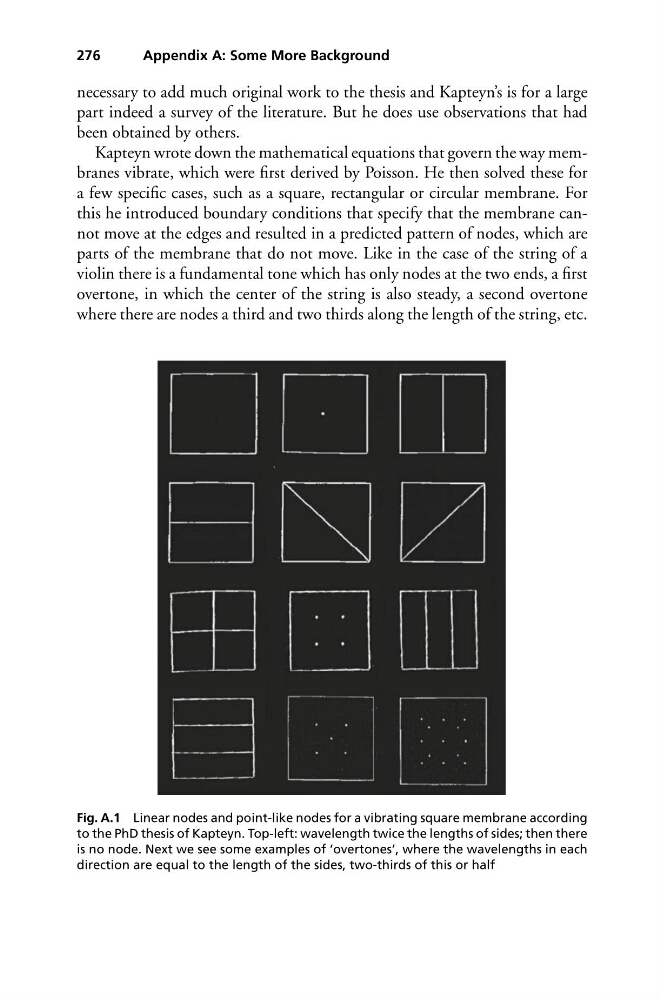
Kapteyn wrote down the mathematical equations that govern the way membranes vibrate, which were first derived by Poisson. He then solved these for
a few specific cases, such as a square, rectangular or circular membrane. For
this he introduced boundary conditions that specify that the membrane cannot move at the edges and resulted in a predicted pattern of nodes, which are
parts of the membrane that do not move. Like in the case of the string of a
violin there is a fundamental tone which has only nodes at the two ends, a first
overtone, in which the center of the string is also steady, a second overtone
where there are nodes a third and two thirds along the length of the string, etc.
Fig. A.1 Linear nodes and point-like nodes for a vibrating square membrane according
to the PhD thesis of Kapteyn. Top-left: wavelength twice the lengths of sides; then there
is no node. Next we see some examples of ‘overtones’, where the wavelengths in each
direction are equal to the length of the sides, two-thirds of this or half
Appendix A: Some More Background
necessary to add much original work to the thesis and Kapteyn’s is for a large
part indeed a survey of the literature. But he does use observations that had
been obtained by others.
Kapteyn wrote down the mathematical equations that govern the way membranes vibrate, which were first derived by Poisson. He then solved these for
a few specific cases, such as a square, rectangular or circular membrane. For
this he introduced boundary conditions that specify that the membrane cannot move at the edges and resulted in a predicted pattern of nodes, which are
parts of the membrane that do not move. Like in the case of the string of a
violin there is a fundamental tone which has only nodes at the two ends, a first
overtone, in which the center of the string is also steady, a second overtone
where there are nodes a third and two thirds along the length of the string, etc.
Fig. A.1 Linear nodes and point-like nodes for a vibrating square membrane according
to the PhD thesis of Kapteyn. Top-left: wavelength twice the lengths of sides; then there
is no node. Next we see some examples of ‘overtones’, where the wavelengths in each
direction are equal to the length of the sides, two-thirds of this or half