

7.5 Parallaxes Again
139
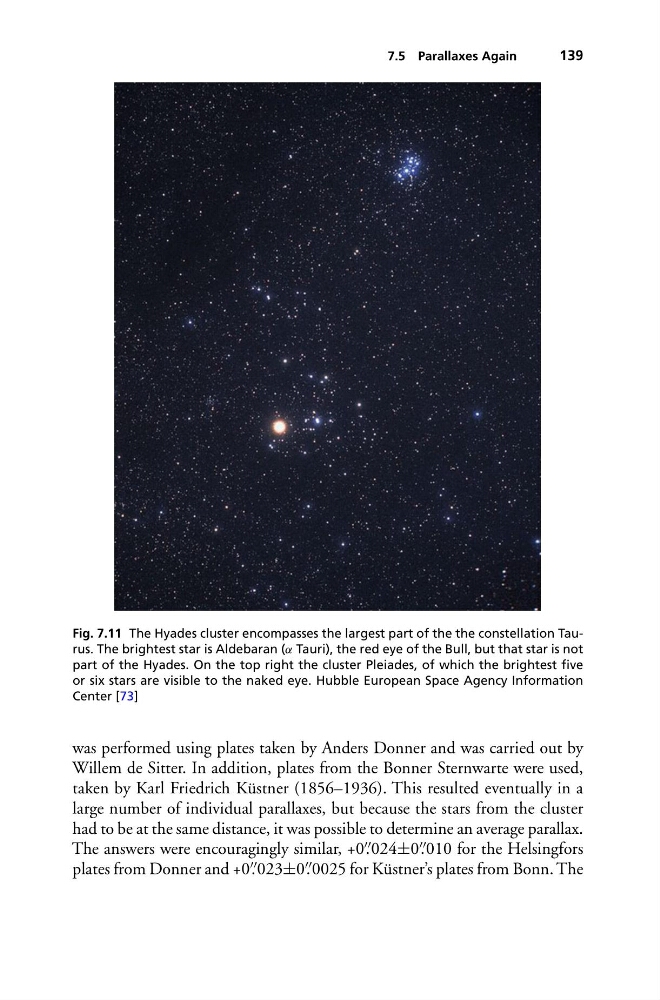
Fig. 7.11 The Hyades cluster encompasses the largest part of the the constellation Taurus. The brightest star is Aldebaran (α Tauri), the red eye of the Bull, but that star is not
part of the Hyades. On the top right the cluster Pleiades, of which the brightest five
or six stars are visible to the naked eye. Hubble European Space Agency Information
Center [73]
was performed using plates taken by Anders Donner and was carried out by
Willem de Sitter. In addition, plates from the Bonner Sternwarte were used,
taken by Karl Friedrich Küstner (1856–1936). This resulted eventually in a
large number of individual parallaxes, but because the stars from the cluster
had to be at the same distance, it was possible to determine an average parallax.
The answers were encouragingly similar, +0 .024±0 .010 for the Helsingfors
plates from Donner and +0 .023±0 .0025 for Küstner’s plates from Bonn. The
139
Fig. 7.11 The Hyades cluster encompasses the largest part of the the constellation Taurus. The brightest star is Aldebaran (α Tauri), the red eye of the Bull, but that star is not
part of the Hyades. On the top right the cluster Pleiades, of which the brightest five
or six stars are visible to the naked eye. Hubble European Space Agency Information
Center [73]
was performed using plates taken by Anders Donner and was carried out by
Willem de Sitter. In addition, plates from the Bonner Sternwarte were used,
taken by Karl Friedrich Küstner (1856–1936). This resulted eventually in a
large number of individual parallaxes, but because the stars from the cluster
had to be at the same distance, it was possible to determine an average parallax.
The answers were encouragingly similar, +0 .024±0 .010 for the Helsingfors
plates from Donner and +0 .023±0 .0025 for Küstner’s plates from Bonn. The