

138
7 Star Streams
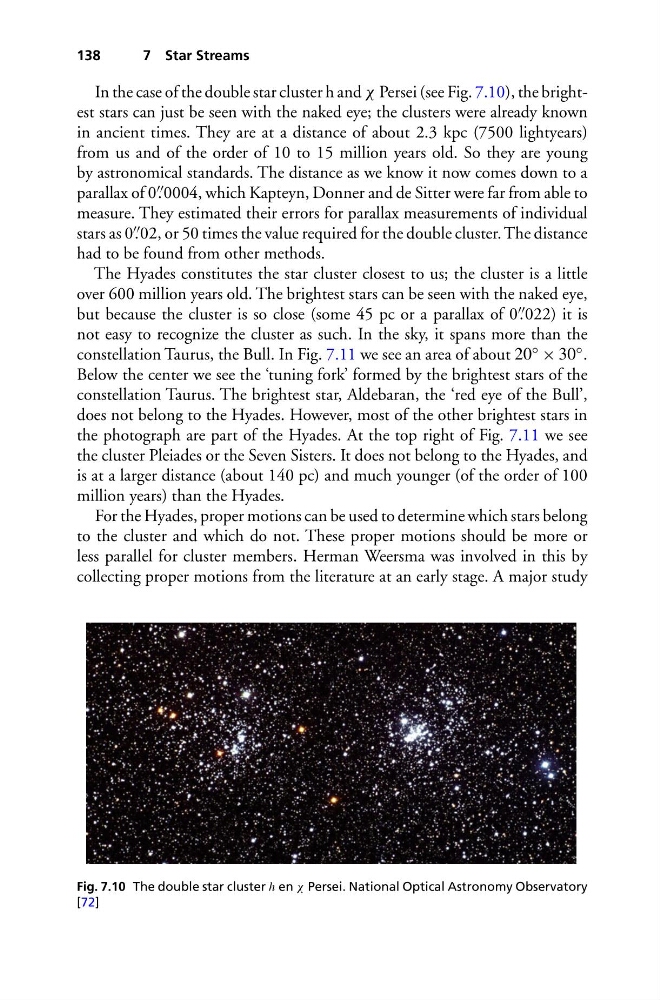
In the case of the double star cluster h and χ Persei (see Fig. 7.10), the brightest stars can just be seen with the naked eye; the clusters were already known
in ancient times. They are at a distance of about 2.3 kpc (7500 lightyears)
from us and of the order of 10 to 15 million years old. So they are young
by astronomical standards. The distance as we know it now comes down to a
parallax of 0 .0004, which Kapteyn, Donner and de Sitter were far from able to
measure. They estimated their errors for parallax measurements of individual
stars as 0 .02, or 50 times the value required for the double cluster. The distance
had to be found from other methods.
The Hyades constitutes the star cluster closest to us; the cluster is a little
over 600 million years old. The brightest stars can be seen with the naked eye,
but because the cluster is so close (some 45 pc or a parallax of 0 .022) it is
not easy to recognize the cluster as such. In the sky, it spans more than the
constellation Taurus, the Bull. In Fig. 7.11 we see an area of about 20 ◦ × 30 ◦ .
Below the center we see the ‘tuning fork’ formed by the brightest stars of the
constellation Taurus. The brightest star, Aldebaran, the ‘red eye of the Bull’,
does not belong to the Hyades. However, most of the other brightest stars in
the photograph are part of the Hyades. At the top right of Fig. 7.11 we see
the cluster Pleiades or the Seven Sisters. It does not belong to the Hyades, and
is at a larger distance (about 140 pc) and much younger (of the order of 100
million years) than the Hyades.
For the Hyades, proper motions can be used to determine which stars belong
to the cluster and which do not. These proper motions should be more or
less parallel for cluster members. Herman Weersma was involved in this by
collecting proper motions from the literature at an early stage. A major study
Fig. 7.10 The double star cluster h en χ Persei. National Optical Astronomy Observatory
[72]
7 Star Streams
In the case of the double star cluster h and χ Persei (see Fig. 7.10), the brightest stars can just be seen with the naked eye; the clusters were already known
in ancient times. They are at a distance of about 2.3 kpc (7500 lightyears)
from us and of the order of 10 to 15 million years old. So they are young
by astronomical standards. The distance as we know it now comes down to a
parallax of 0 .0004, which Kapteyn, Donner and de Sitter were far from able to
measure. They estimated their errors for parallax measurements of individual
stars as 0 .02, or 50 times the value required for the double cluster. The distance
had to be found from other methods.
The Hyades constitutes the star cluster closest to us; the cluster is a little
over 600 million years old. The brightest stars can be seen with the naked eye,
but because the cluster is so close (some 45 pc or a parallax of 0 .022) it is
not easy to recognize the cluster as such. In the sky, it spans more than the
constellation Taurus, the Bull. In Fig. 7.11 we see an area of about 20 ◦ × 30 ◦ .
Below the center we see the ‘tuning fork’ formed by the brightest stars of the
constellation Taurus. The brightest star, Aldebaran, the ‘red eye of the Bull’,
does not belong to the Hyades. However, most of the other brightest stars in
the photograph are part of the Hyades. At the top right of Fig. 7.11 we see
the cluster Pleiades or the Seven Sisters. It does not belong to the Hyades, and
is at a larger distance (about 140 pc) and much younger (of the order of 100
million years) than the Hyades.
For the Hyades, proper motions can be used to determine which stars belong
to the cluster and which do not. These proper motions should be more or
less parallel for cluster members. Herman Weersma was involved in this by
collecting proper motions from the literature at an early stage. A major study
Fig. 7.10 The double star cluster h en χ Persei. National Optical Astronomy Observatory
[72]