

140
7 Star Streams
best current value is 0 .0215±0 .0028. The results were published in 1904 in
issue 14 of the Publications of the Astronomical Laboratory at Groningen.
Not much later, in 1908, a study by the American astronomer Lewis Boss
(1846–1912) of Dudley Observatory in Schenectady, New York was published
[74]. He used his own proper motions with a method which is in fact the same
as that used to determine the Apex of the Sun and which lies at the basis of
the secular parallaxes proposed by Kapteyn. This method can be traced back
to Auguste Bravais. Now Boss had found that the Hyades cluster extends over
a much larger area in the sky than Kapteyn was aware of, and that enabled
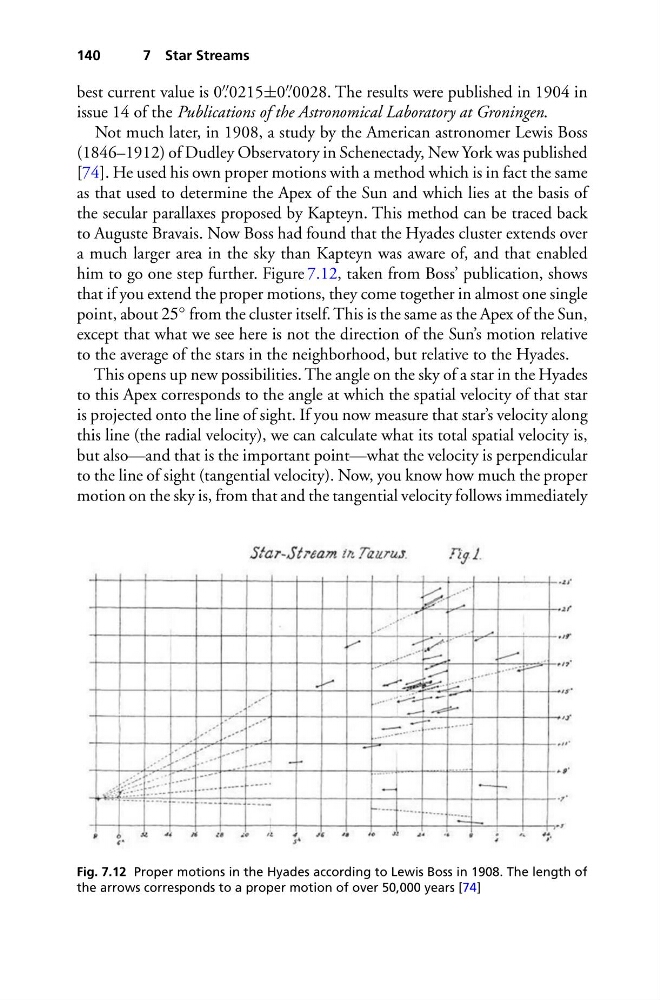
him to go one step further. Figure 7.12, taken from Boss’ publication, shows
that if you extend the proper motions, they come together in almost one single
point, about 25 ◦ from the cluster itself. This is the same as the Apex of the Sun,
except that what we see here is not the direction of the Sun’s motion relative
to the average of the stars in the neighborhood, but relative to the Hyades.
This opens up new possibilities. The angle on the sky of a star in the Hyades
to this Apex corresponds to the angle at which the spatial velocity of that star
is projected onto the line of sight. If you now measure that star’s velocity along
this line (the radial velocity), we can calculate what its total spatial velocity is,
but also—and that is the important point—what the velocity is perpendicular
to the line of sight (tangential velocity). Now, you know how much the proper
motion on the sky is, from that and the tangential velocity follows immediately
Fig. 7.12 Proper motions in the Hyades according to Lewis Boss in 1908. The length of
the arrows corresponds to a proper motion of over 50,000 years [74]
7 Star Streams
best current value is 0 .0215±0 .0028. The results were published in 1904 in
issue 14 of the Publications of the Astronomical Laboratory at Groningen.
Not much later, in 1908, a study by the American astronomer Lewis Boss
(1846–1912) of Dudley Observatory in Schenectady, New York was published
[74]. He used his own proper motions with a method which is in fact the same
as that used to determine the Apex of the Sun and which lies at the basis of
the secular parallaxes proposed by Kapteyn. This method can be traced back
to Auguste Bravais. Now Boss had found that the Hyades cluster extends over
a much larger area in the sky than Kapteyn was aware of, and that enabled
him to go one step further. Figure 7.12, taken from Boss’ publication, shows
that if you extend the proper motions, they come together in almost one single
point, about 25 ◦ from the cluster itself. This is the same as the Apex of the Sun,
except that what we see here is not the direction of the Sun’s motion relative
to the average of the stars in the neighborhood, but relative to the Hyades.
This opens up new possibilities. The angle on the sky of a star in the Hyades
to this Apex corresponds to the angle at which the spatial velocity of that star
is projected onto the line of sight. If you now measure that star’s velocity along
this line (the radial velocity), we can calculate what its total spatial velocity is,
but also—and that is the important point—what the velocity is perpendicular
to the line of sight (tangential velocity). Now, you know how much the proper
motion on the sky is, from that and the tangential velocity follows immediately
Fig. 7.12 Proper motions in the Hyades according to Lewis Boss in 1908. The length of
the arrows corresponds to a proper motion of over 50,000 years [74]