

7.3 Star Streams
129
distance from the Sun. He also showed what the distribution of the velocities
of the stars in space was. Next he talked about the two other fundamental
assumptions that had to be made, namely that everywhere the stars had to
be distributed in the same way over luminosity and that there should be no
absorption of light in space. About the latter he said that he did not agree
with the results of a study by George Cary Comstock (1855–1934), who at
that time was director of the Washburn Observatory in Madison, Wisconsin,
and he would soon discuss that in a journal paper. Comstock was one of the
listeners; he had chaired the first session of that morning.
Undoubtedly this introduction was an impressive presentation, with which
Kapteyn must have reaped great admiration. But then he really started. He now
raised the issue of the fundamental assumption—that he had made without
any justification—that the spatial velocities of stars were on average the same
everywhere and that there would be no preferred direction. I will discuss this
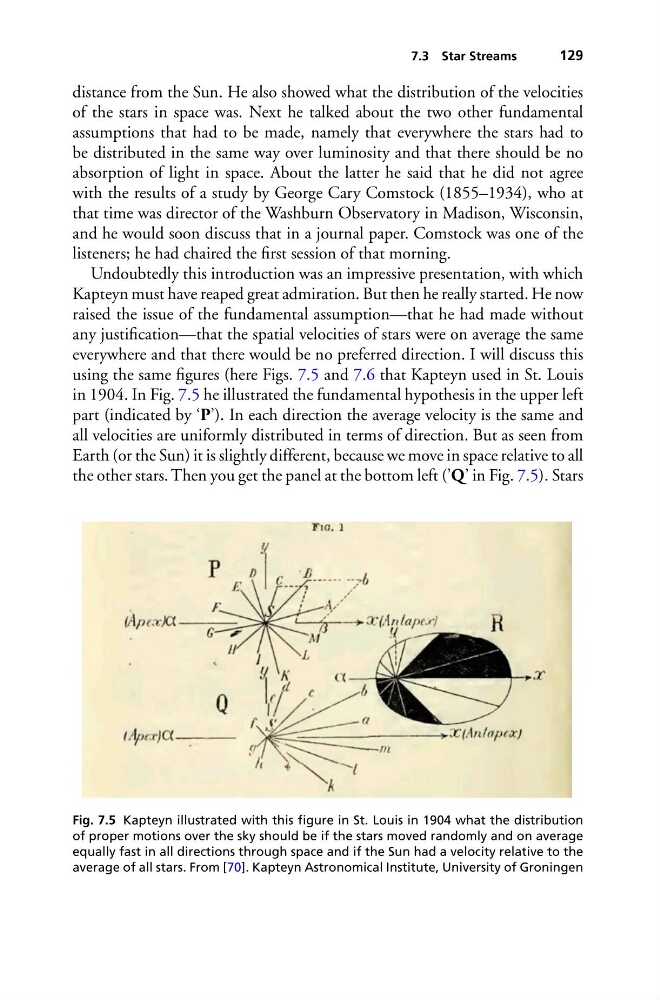
using the same figures (here Figs. 7.5 and 7.6 that Kapteyn used in St. Louis
in 1904. In Fig. 7.5 he illustrated the fundamental hypothesis in the upper left
part (indicated by ‘P’). In each direction the average velocity is the same and
all velocities are uniformly distributed in terms of direction. But as seen from
Earth (or the Sun) it is slightly different, because we move in space relative to all
the other stars. Then you get the panel at the bottom left (’Q’ in Fig. 7.5). Stars
Fig. 7.5 Kapteyn illustrated with this figure in St. Louis in 1904 what the distribution
of proper motions over the sky should be if the stars moved randomly and on average
equally fast in all directions through space and if the Sun had a velocity relative to the
average of all stars. From [70]. Kapteyn Astronomical Institute, University of Groningen
129
distance from the Sun. He also showed what the distribution of the velocities
of the stars in space was. Next he talked about the two other fundamental
assumptions that had to be made, namely that everywhere the stars had to
be distributed in the same way over luminosity and that there should be no
absorption of light in space. About the latter he said that he did not agree
with the results of a study by George Cary Comstock (1855–1934), who at
that time was director of the Washburn Observatory in Madison, Wisconsin,
and he would soon discuss that in a journal paper. Comstock was one of the
listeners; he had chaired the first session of that morning.
Undoubtedly this introduction was an impressive presentation, with which
Kapteyn must have reaped great admiration. But then he really started. He now
raised the issue of the fundamental assumption—that he had made without
any justification—that the spatial velocities of stars were on average the same
everywhere and that there would be no preferred direction. I will discuss this
using the same figures (here Figs. 7.5 and 7.6 that Kapteyn used in St. Louis
in 1904. In Fig. 7.5 he illustrated the fundamental hypothesis in the upper left
part (indicated by ‘P’). In each direction the average velocity is the same and
all velocities are uniformly distributed in terms of direction. But as seen from
Earth (or the Sun) it is slightly different, because we move in space relative to all
the other stars. Then you get the panel at the bottom left (’Q’ in Fig. 7.5). Stars
Fig. 7.5 Kapteyn illustrated with this figure in St. Louis in 1904 what the distribution
of proper motions over the sky should be if the stars moved randomly and on average
equally fast in all directions through space and if the Sun had a velocity relative to the
average of all stars. From [70]. Kapteyn Astronomical Institute, University of Groningen