

80
3 A Structuring Regime to Control Bubbling Beds
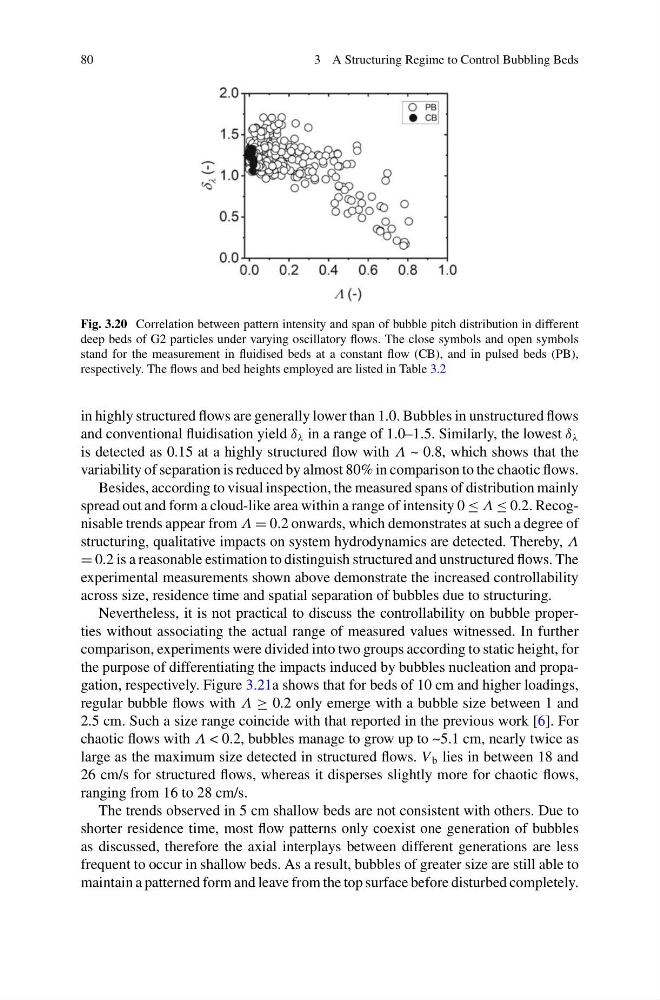
Fig. 3.20 Correlation between pattern intensity and span of bubble pitch distribution in different
deep beds of G2 particles under varying oscillatory flows. The close symbols and open symbols
stand for the measurement in fluidised beds at a constant flow (CB), and in pulsed beds (PB),
respectively. The flows and bed heights employed are listed in Table 3.2
in highly structured flows are generally lower than 1.0. Bubbles in unstructured flows
and conventional fluidisation yield δ λ in a range of 1.0–1.5. Similarly, the lowest δ λ
is detected as 0.15 at a highly structured flow with Λ ~ 0.8, which shows that the
variability of separation is reduced by almost 80% in comparison to the chaotic flows.
Besides, according to visual inspection, the measured spans of distribution mainly
spread out and form a cloud-like area within a range of intensity 0 ≤ Λ ≤ 0.2. Recognisable trends appear from Λ = 0.2 onwards, which demonstrates at such a degree of
structuring, qualitative impacts on system hydrodynamics are detected. Thereby, Λ
= 0.2 is a reasonable estimation to distinguish structured and unstructured flows. The
experimental measurements shown above demonstrate the increased controllability
across size, residence time and spatial separation of bubbles due to structuring.
Nevertheless, it is not practical to discuss the controllability on bubble properties without associating the actual range of measured values witnessed. In further
comparison, experiments were divided into two groups according to static height, for
the purpose of differentiating the impacts induced by bubbles nucleation and propagation, respectively. Figure 3.21a shows that for beds of 10 cm and higher loadings,
regular bubble flows with Λ ≥ 0.2 only emerge with a bubble size between 1 and
2.5 cm. Such a size range coincide with that reported in the previous work [6]. For
chaotic flows with Λ < 0.2, bubbles manage to grow up to ~5.1 cm, nearly twice as
large as the maximum size detected in structured flows. V b lies in between 18 and
26 cm/s for structured flows, whereas it disperses slightly more for chaotic flows,
ranging from 16 to 28 cm/s.
The trends observed in 5 cm shallow beds are not consistent with others. Due to
shorter residence time, most flow patterns only coexist one generation of bubbles
as discussed, therefore the axial interplays between different generations are less
frequent to occur in shallow beds. As a result, bubbles of greater size are still able to
maintain a patterned form and leave from the top surface before disturbed completely.
3 A Structuring Regime to Control Bubbling Beds
Fig. 3.20 Correlation between pattern intensity and span of bubble pitch distribution in different
deep beds of G2 particles under varying oscillatory flows. The close symbols and open symbols
stand for the measurement in fluidised beds at a constant flow (CB), and in pulsed beds (PB),
respectively. The flows and bed heights employed are listed in Table 3.2
in highly structured flows are generally lower than 1.0. Bubbles in unstructured flows
and conventional fluidisation yield δ λ in a range of 1.0–1.5. Similarly, the lowest δ λ
is detected as 0.15 at a highly structured flow with Λ ~ 0.8, which shows that the
variability of separation is reduced by almost 80% in comparison to the chaotic flows.
Besides, according to visual inspection, the measured spans of distribution mainly
spread out and form a cloud-like area within a range of intensity 0 ≤ Λ ≤ 0.2. Recognisable trends appear from Λ = 0.2 onwards, which demonstrates at such a degree of
structuring, qualitative impacts on system hydrodynamics are detected. Thereby, Λ
= 0.2 is a reasonable estimation to distinguish structured and unstructured flows. The
experimental measurements shown above demonstrate the increased controllability
across size, residence time and spatial separation of bubbles due to structuring.
Nevertheless, it is not practical to discuss the controllability on bubble properties without associating the actual range of measured values witnessed. In further
comparison, experiments were divided into two groups according to static height, for
the purpose of differentiating the impacts induced by bubbles nucleation and propagation, respectively. Figure 3.21a shows that for beds of 10 cm and higher loadings,
regular bubble flows with Λ ≥ 0.2 only emerge with a bubble size between 1 and
2.5 cm. Such a size range coincide with that reported in the previous work [6]. For
chaotic flows with Λ < 0.2, bubbles manage to grow up to ~5.1 cm, nearly twice as
large as the maximum size detected in structured flows. V b lies in between 18 and
26 cm/s for structured flows, whereas it disperses slightly more for chaotic flows,
ranging from 16 to 28 cm/s.
The trends observed in 5 cm shallow beds are not consistent with others. Due to
shorter residence time, most flow patterns only coexist one generation of bubbles
as discussed, therefore the axial interplays between different generations are less
frequent to occur in shallow beds. As a result, bubbles of greater size are still able to
maintain a patterned form and leave from the top surface before disturbed completely.