

3.3 Results and Discussion
81
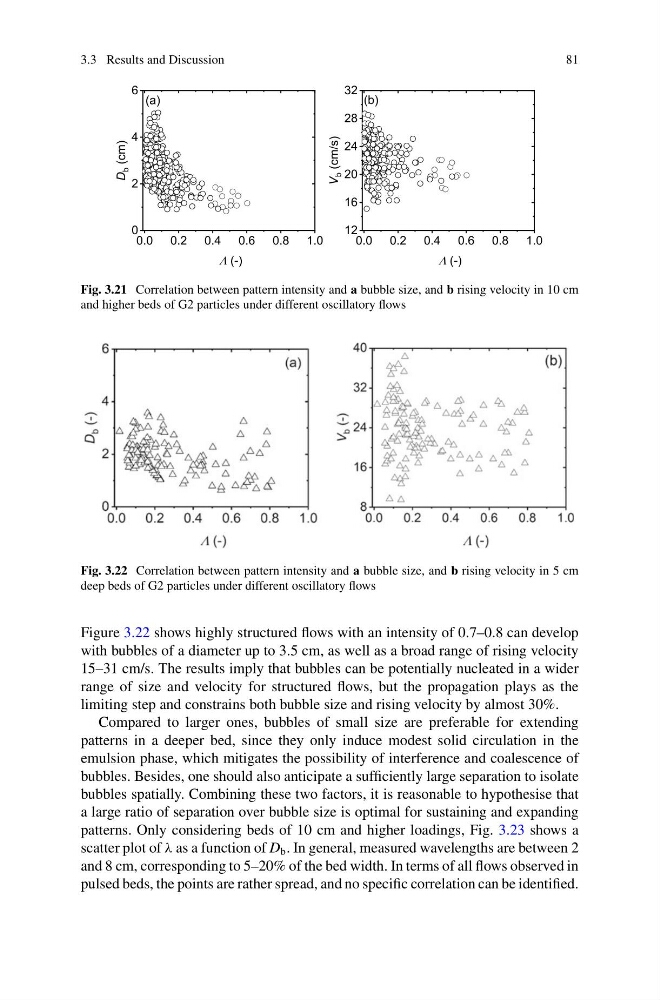
Fig. 3.21 Correlation between pattern intensity and a bubble size, and b rising velocity in 10 cm
and higher beds of G2 particles under different oscillatory flows
Fig. 3.22 Correlation between pattern intensity and a bubble size, and b rising velocity in 5 cm
deep beds of G2 particles under different oscillatory flows
Figure 3.22 shows highly structured flows with an intensity of 0.7–0.8 can develop
with bubbles of a diameter up to 3.5 cm, as well as a broad range of rising velocity
15–31 cm/s. The results imply that bubbles can be potentially nucleated in a wider
range of size and velocity for structured flows, but the propagation plays as the
limiting step and constrains both bubble size and rising velocity by almost 30%.
Compared to larger ones, bubbles of small size are preferable for extending
patterns in a deeper bed, since they only induce modest solid circulation in the
emulsion phase, which mitigates the possibility of interference and coalescence of
bubbles. Besides, one should also anticipate a sufficiently large separation to isolate
bubbles spatially. Combining these two factors, it is reasonable to hypothesise that
a large ratio of separation over bubble size is optimal for sustaining and expanding
patterns. Only considering beds of 10 cm and higher loadings, Fig. 3.23 shows a
scatter plot of λ as a function of D b . In general, measured wavelengths are between 2
and 8 cm, corresponding to 5–20% of the bed width. In terms of all flows observed in
pulsed beds, the points are rather spread, and no specific correlation can be identified.
81
Fig. 3.21 Correlation between pattern intensity and a bubble size, and b rising velocity in 10 cm
and higher beds of G2 particles under different oscillatory flows
Fig. 3.22 Correlation between pattern intensity and a bubble size, and b rising velocity in 5 cm
deep beds of G2 particles under different oscillatory flows
Figure 3.22 shows highly structured flows with an intensity of 0.7–0.8 can develop
with bubbles of a diameter up to 3.5 cm, as well as a broad range of rising velocity
15–31 cm/s. The results imply that bubbles can be potentially nucleated in a wider
range of size and velocity for structured flows, but the propagation plays as the
limiting step and constrains both bubble size and rising velocity by almost 30%.
Compared to larger ones, bubbles of small size are preferable for extending
patterns in a deeper bed, since they only induce modest solid circulation in the
emulsion phase, which mitigates the possibility of interference and coalescence of
bubbles. Besides, one should also anticipate a sufficiently large separation to isolate
bubbles spatially. Combining these two factors, it is reasonable to hypothesise that
a large ratio of separation over bubble size is optimal for sustaining and expanding
patterns. Only considering beds of 10 cm and higher loadings, Fig. 3.23 shows a
scatter plot of λ as a function of D b . In general, measured wavelengths are between 2
and 8 cm, corresponding to 5–20% of the bed width. In terms of all flows observed in
pulsed beds, the points are rather spread, and no specific correlation can be identified.