

78
3 A Structuring Regime to Control Bubbling Beds
expected to be aligned horizontally in the same level and maintain in a closely similar
size. In such a way, bubbles balance the circulation of emulsion in proximity and keep
rising at a similar velocity. As demonstrated earlier, shallower beds often contain only
one or two generations of bubbles, involving less interference. Even though bubbles
experience the acceleration from the following pulse, they elevate and escape from
the domain rapidly, leaving negligible impacts on the trailing bubbles. In contrast, the
residence time of bubbles are much longer in a deeper bed and several generations
are correlated together to maintain the structured form. Once the disturbing bubbles
occur and impact on adjacent rows, such a disturbance will propogate to a higher
level.
3.3.3 Correlation Between Pattern Intensity and Flow
Properties
Chapter 2 has demonstrated the use of oscillatory flows to easily manipulate size and
velocity of bubbles, as an effective means to provide tighter control over bubbles.
Mitigating bubble interference is the apparent feature of structured flows. Therefore,
one would also expect the enhanced homogeneity in many properties, such as spatial
separation. Given the quantification of patterns, one can naturally hypothesise that
such homogeneity is associated with the level of structuring.
The properties of structured bubbles in pulsed beds, such as bubble size, rising
velocity, and spatial separation, are examined with beds of different heights and
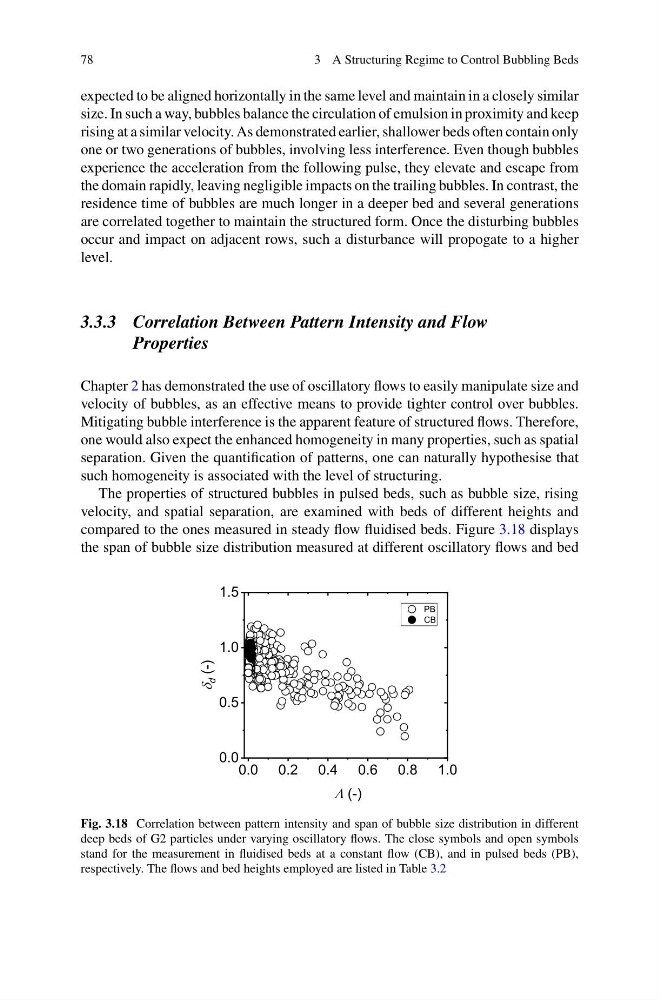
compared to the ones measured in steady flow fluidised beds. Figure 3.18 displays
the span of bubble size distribution measured at different oscillatory flows and bed
Fig. 3.18 Correlation between pattern intensity and span of bubble size distribution in different
deep beds of G2 particles under varying oscillatory flows. The close symbols and open symbols
stand for the measurement in fluidised beds at a constant flow (CB), and in pulsed beds (PB),
respectively. The flows and bed heights employed are listed in Table 3.2
3 A Structuring Regime to Control Bubbling Beds
expected to be aligned horizontally in the same level and maintain in a closely similar
size. In such a way, bubbles balance the circulation of emulsion in proximity and keep
rising at a similar velocity. As demonstrated earlier, shallower beds often contain only
one or two generations of bubbles, involving less interference. Even though bubbles
experience the acceleration from the following pulse, they elevate and escape from
the domain rapidly, leaving negligible impacts on the trailing bubbles. In contrast, the
residence time of bubbles are much longer in a deeper bed and several generations
are correlated together to maintain the structured form. Once the disturbing bubbles
occur and impact on adjacent rows, such a disturbance will propogate to a higher
level.
3.3.3 Correlation Between Pattern Intensity and Flow
Properties
Chapter 2 has demonstrated the use of oscillatory flows to easily manipulate size and
velocity of bubbles, as an effective means to provide tighter control over bubbles.
Mitigating bubble interference is the apparent feature of structured flows. Therefore,
one would also expect the enhanced homogeneity in many properties, such as spatial
separation. Given the quantification of patterns, one can naturally hypothesise that
such homogeneity is associated with the level of structuring.
The properties of structured bubbles in pulsed beds, such as bubble size, rising
velocity, and spatial separation, are examined with beds of different heights and
compared to the ones measured in steady flow fluidised beds. Figure 3.18 displays
the span of bubble size distribution measured at different oscillatory flows and bed
Fig. 3.18 Correlation between pattern intensity and span of bubble size distribution in different
deep beds of G2 particles under varying oscillatory flows. The close symbols and open symbols
stand for the measurement in fluidised beds at a constant flow (CB), and in pulsed beds (PB),
respectively. The flows and bed heights employed are listed in Table 3.2