

72
3 A Structuring Regime to Control Bubbling Beds
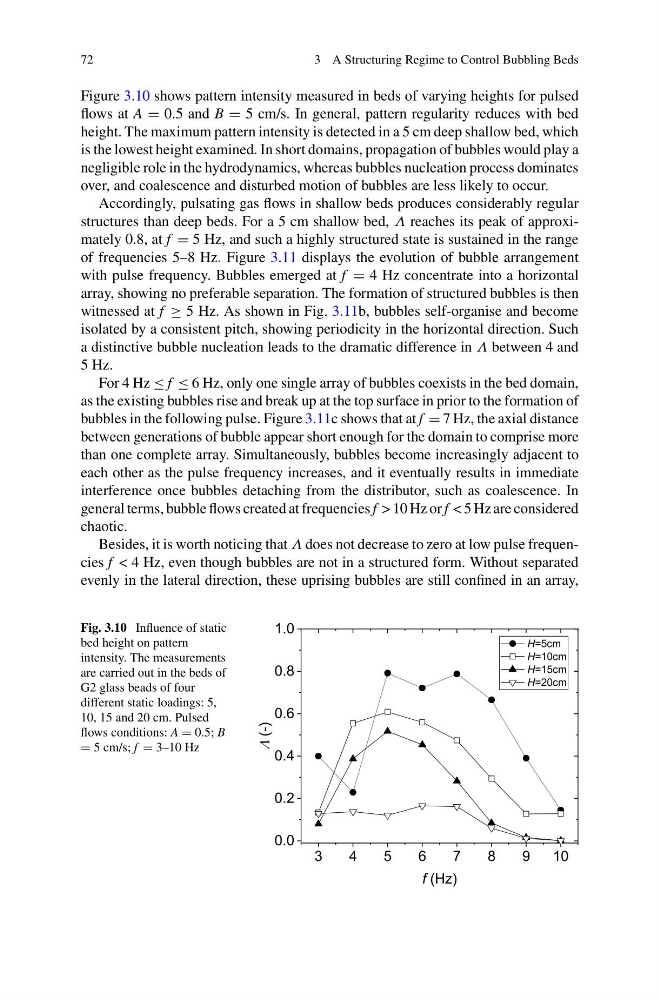
Figure 3.10 shows pattern intensity measured in beds of varying heights for pulsed
flows at A = 0.5 and B = 5 cm/s. In general, pattern regularity reduces with bed
height. The maximum pattern intensity is detected in a 5 cm deep shallow bed, which
is the lowest height examined. In short domains, propagation of bubbles would play a
negligible role in the hydrodynamics, whereas bubbles nucleation process dominates
over, and coalescence and disturbed motion of bubbles are less likely to occur.
Accordingly, pulsating gas flows in shallow beds produces considerably regular
structures than deep beds. For a 5 cm shallow bed, Λ reaches its peak of approximately 0.8, at f = 5 Hz, and such a highly structured state is sustained in the range
of frequencies 5–8 Hz. Figure 3.11 displays the evolution of bubble arrangement
with pulse frequency. Bubbles emerged at f = 4 Hz concentrate into a horizontal
array, showing no preferable separation. The formation of structured bubbles is then
witnessed at f ≥ 5 Hz. As shown in Fig. 3.11b, bubbles self-organise and become
isolated by a consistent pitch, showing periodicity in the horizontal direction. Such
a distinctive bubble nucleation leads to the dramatic difference in Λ between 4 and
5 Hz.
For 4 Hz ≤ f ≤ 6 Hz, only one single array of bubbles coexists in the bed domain,
as the existing bubbles rise and break up at the top surface in prior to the formation of
bubbles in the following pulse. Figure 3.11c shows that at f = 7 Hz, the axial distance
between generations of bubble appear short enough for the domain to comprise more
than one complete array. Simultaneously, bubbles become increasingly adjacent to
each other as the pulse frequency increases, and it eventually results in immediate
interference once bubbles detaching from the distributor, such as coalescence. In
general terms, bubble flows created at frequencies f > 10 Hz or f < 5 Hz are considered
chaotic.
Besides, it is worth noticing that Λ does not decrease to zero at low pulse frequencies f < 4 Hz, even though bubbles are not in a structured form. Without separated
evenly in the lateral direction, these uprising bubbles are still confined in an array,
Fig. 3.10 Influence of static
bed height on pattern
intensity. The measurements
are carried out in the beds of
G2 glass beads of four
different static loadings: 5,
10, 15 and 20 cm. Pulsed
flows conditions: A = 0.5; B
= 5 cm/s; f = 3–10 Hz
3 A Structuring Regime to Control Bubbling Beds
Figure 3.10 shows pattern intensity measured in beds of varying heights for pulsed
flows at A = 0.5 and B = 5 cm/s. In general, pattern regularity reduces with bed
height. The maximum pattern intensity is detected in a 5 cm deep shallow bed, which
is the lowest height examined. In short domains, propagation of bubbles would play a
negligible role in the hydrodynamics, whereas bubbles nucleation process dominates
over, and coalescence and disturbed motion of bubbles are less likely to occur.
Accordingly, pulsating gas flows in shallow beds produces considerably regular
structures than deep beds. For a 5 cm shallow bed, Λ reaches its peak of approximately 0.8, at f = 5 Hz, and such a highly structured state is sustained in the range
of frequencies 5–8 Hz. Figure 3.11 displays the evolution of bubble arrangement
with pulse frequency. Bubbles emerged at f = 4 Hz concentrate into a horizontal
array, showing no preferable separation. The formation of structured bubbles is then
witnessed at f ≥ 5 Hz. As shown in Fig. 3.11b, bubbles self-organise and become
isolated by a consistent pitch, showing periodicity in the horizontal direction. Such
a distinctive bubble nucleation leads to the dramatic difference in Λ between 4 and
5 Hz.
For 4 Hz ≤ f ≤ 6 Hz, only one single array of bubbles coexists in the bed domain,
as the existing bubbles rise and break up at the top surface in prior to the formation of
bubbles in the following pulse. Figure 3.11c shows that at f = 7 Hz, the axial distance
between generations of bubble appear short enough for the domain to comprise more
than one complete array. Simultaneously, bubbles become increasingly adjacent to
each other as the pulse frequency increases, and it eventually results in immediate
interference once bubbles detaching from the distributor, such as coalescence. In
general terms, bubble flows created at frequencies f > 10 Hz or f < 5 Hz are considered
chaotic.
Besides, it is worth noticing that Λ does not decrease to zero at low pulse frequencies f < 4 Hz, even though bubbles are not in a structured form. Without separated
evenly in the lateral direction, these uprising bubbles are still confined in an array,
Fig. 3.10 Influence of static
bed height on pattern
intensity. The measurements
are carried out in the beds of
G2 glass beads of four
different static loadings: 5,
10, 15 and 20 cm. Pulsed
flows conditions: A = 0.5; B
= 5 cm/s; f = 3–10 Hz