

3.3 Results and Discussion
71
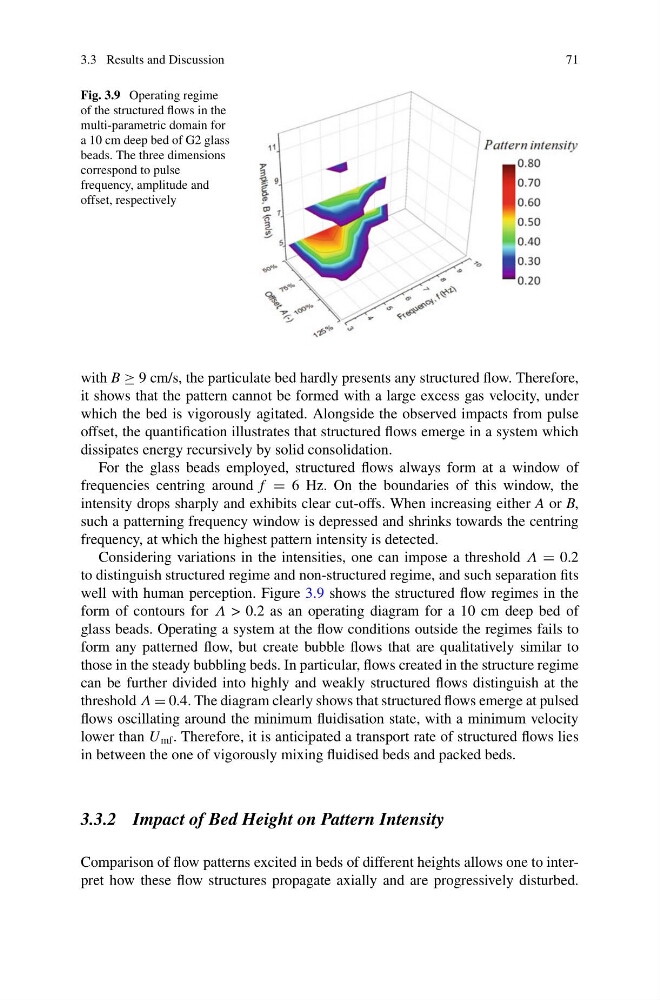
Fig. 3.9 Operating regime
of the structured flows in the
multi-parametric domain for
a 10 cm deep bed of G2 glass
beads. The three dimensions
correspond to pulse
frequency, amplitude and
offset, respectively
with B ≥ 9 cm/s, the particulate bed hardly presents any structured flow. Therefore,
it shows that the pattern cannot be formed with a large excess gas velocity, under
which the bed is vigorously agitated. Alongside the observed impacts from pulse
offset, the quantification illustrates that structured flows emerge in a system which
dissipates energy recursively by solid consolidation.
For the glass beads employed, structured flows always form at a window of
frequencies centring around f = 6 Hz. On the boundaries of this window, the
intensity drops sharply and exhibits clear cut-offs. When increasing either A or B,
such a patterning frequency window is depressed and shrinks towards the centring
frequency, at which the highest pattern intensity is detected.
Considering variations in the intensities, one can impose a threshold Λ = 0.2
to distinguish structured regime and non-structured regime, and such separation fits
well with human perception. Figure 3.9 shows the structured flow regimes in the
form of contours for Λ > 0.2 as an operating diagram for a 10 cm deep bed of
glass beads. Operating a system at the flow conditions outside the regimes fails to
form any patterned flow, but create bubble flows that are qualitatively similar to
those in the steady bubbling beds. In particular, flows created in the structure regime
can be further divided into highly and weakly structured flows distinguish at the
threshold Λ = 0.4. The diagram clearly shows that structured flows emerge at pulsed
flows oscillating around the minimum fluidisation state, with a minimum velocity
lower than U mf . Therefore, it is anticipated a transport rate of structured flows lies
in between the one of vigorously mixing fluidised beds and packed beds.
3.3.2 Impact of Bed Height on Pattern Intensity
Comparison of flow patterns excited in beds of different heights allows one to interpret how these flow structures propagate axially and are progressively disturbed.
71
Fig. 3.9 Operating regime
of the structured flows in the
multi-parametric domain for
a 10 cm deep bed of G2 glass
beads. The three dimensions
correspond to pulse
frequency, amplitude and
offset, respectively
with B ≥ 9 cm/s, the particulate bed hardly presents any structured flow. Therefore,
it shows that the pattern cannot be formed with a large excess gas velocity, under
which the bed is vigorously agitated. Alongside the observed impacts from pulse
offset, the quantification illustrates that structured flows emerge in a system which
dissipates energy recursively by solid consolidation.
For the glass beads employed, structured flows always form at a window of
frequencies centring around f = 6 Hz. On the boundaries of this window, the
intensity drops sharply and exhibits clear cut-offs. When increasing either A or B,
such a patterning frequency window is depressed and shrinks towards the centring
frequency, at which the highest pattern intensity is detected.
Considering variations in the intensities, one can impose a threshold Λ = 0.2
to distinguish structured regime and non-structured regime, and such separation fits
well with human perception. Figure 3.9 shows the structured flow regimes in the
form of contours for Λ > 0.2 as an operating diagram for a 10 cm deep bed of
glass beads. Operating a system at the flow conditions outside the regimes fails to
form any patterned flow, but create bubble flows that are qualitatively similar to
those in the steady bubbling beds. In particular, flows created in the structure regime
can be further divided into highly and weakly structured flows distinguish at the
threshold Λ = 0.4. The diagram clearly shows that structured flows emerge at pulsed
flows oscillating around the minimum fluidisation state, with a minimum velocity
lower than U mf . Therefore, it is anticipated a transport rate of structured flows lies
in between the one of vigorously mixing fluidised beds and packed beds.
3.3.2 Impact of Bed Height on Pattern Intensity
Comparison of flow patterns excited in beds of different heights allows one to interpret how these flow structures propagate axially and are progressively disturbed.