

56
2 Bubbling Properties in Pulsed Fluidised Beds
the control over separation completely vanishes. Unsurprisingly, it demonstrates that
such controllability of bubble separation ties closely with the degree of structuring.
2.3.3.3 Influence of Pulsation on Population of Bubble Rising Velocity
The third collective feature to be examined is the population of rising velocity. In
conventional fluidisation, rising velocity is considered proportional to bubble size
[7]. The context is more complex for pulsed beds, as bubbles undergo periodic
accelerations from oscillatory flows. Subsequently, it is not intuitive to correlate the
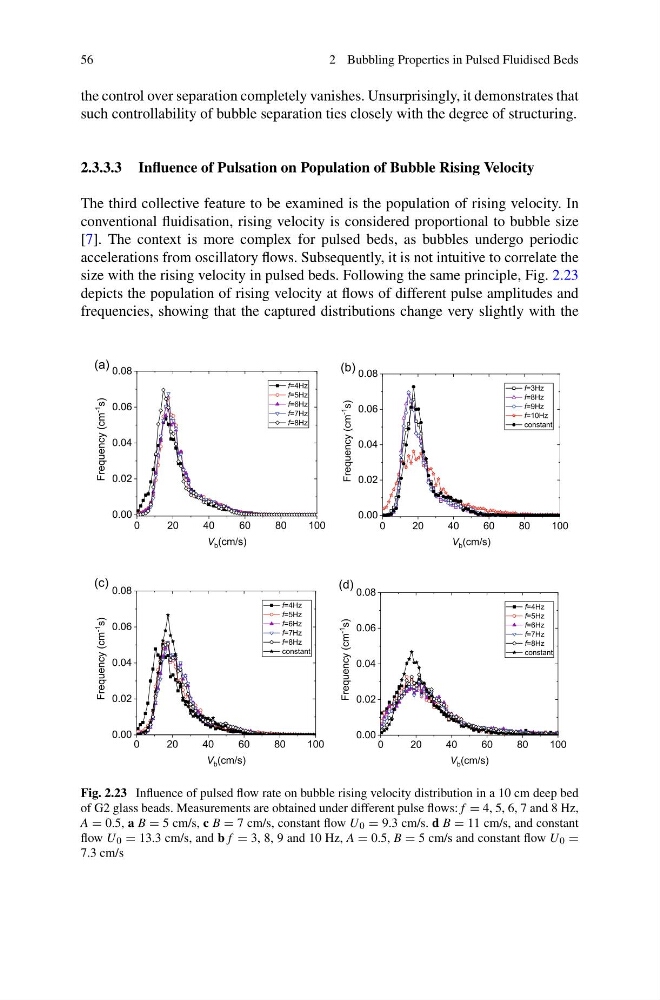
size with the rising velocity in pulsed beds. Following the same principle, Fig. 2.23
depicts the population of rising velocity at flows of different pulse amplitudes and
frequencies, showing that the captured distributions change very slightly with the
Fig. 2.23 Influence of pulsed flow rate on bubble rising velocity distribution in a 10 cm deep bed
of G2 glass beads. Measurements are obtained under different pulse flows: f = 4, 5, 6, 7 and 8 Hz,
A = 0.5, a B = 5 cm/s, c B = 7 cm/s, constant flow U 0 = 9.3 cm/s. d B = 11 cm/s, and constant
flow U 0 = 13.3 cm/s, and b f = 3, 8, 9 and 10 Hz, A = 0.5, B = 5 cm/s and constant flow U 0 =
7.3 cm/s
2 Bubbling Properties in Pulsed Fluidised Beds
the control over separation completely vanishes. Unsurprisingly, it demonstrates that
such controllability of bubble separation ties closely with the degree of structuring.
2.3.3.3 Influence of Pulsation on Population of Bubble Rising Velocity
The third collective feature to be examined is the population of rising velocity. In
conventional fluidisation, rising velocity is considered proportional to bubble size
[7]. The context is more complex for pulsed beds, as bubbles undergo periodic
accelerations from oscillatory flows. Subsequently, it is not intuitive to correlate the
size with the rising velocity in pulsed beds. Following the same principle, Fig. 2.23
depicts the population of rising velocity at flows of different pulse amplitudes and
frequencies, showing that the captured distributions change very slightly with the
Fig. 2.23 Influence of pulsed flow rate on bubble rising velocity distribution in a 10 cm deep bed
of G2 glass beads. Measurements are obtained under different pulse flows: f = 4, 5, 6, 7 and 8 Hz,
A = 0.5, a B = 5 cm/s, c B = 7 cm/s, constant flow U 0 = 9.3 cm/s. d B = 11 cm/s, and constant
flow U 0 = 13.3 cm/s, and b f = 3, 8, 9 and 10 Hz, A = 0.5, B = 5 cm/s and constant flow U 0 =
7.3 cm/s