

2.3 Results and Discussion
57
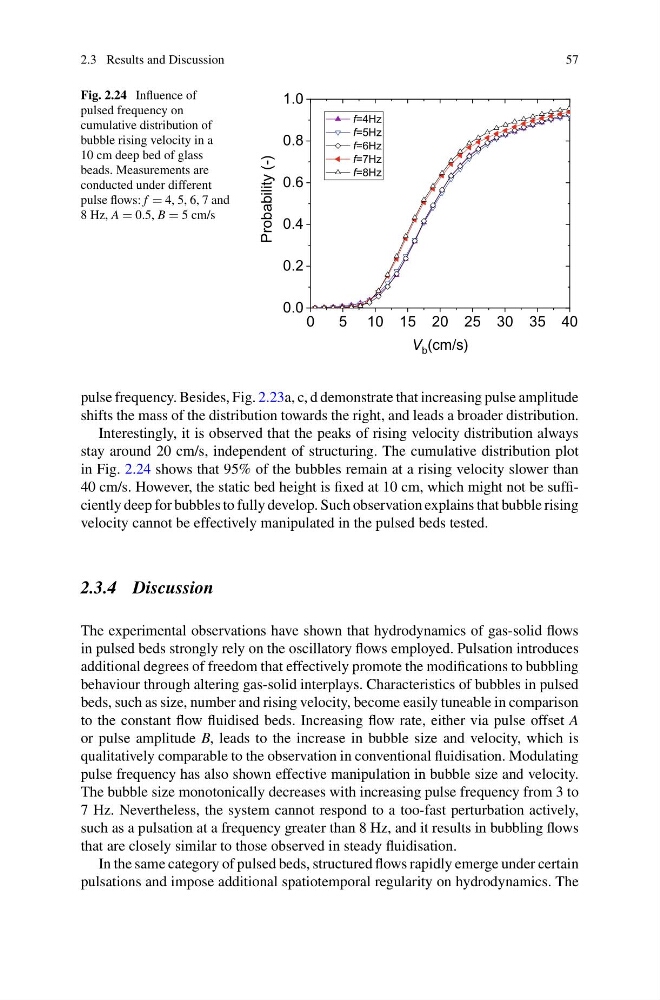
Fig. 2.24 Influence of
pulsed frequency on
cumulative distribution of
bubble rising velocity in a
10 cm deep bed of glass
beads. Measurements are
conducted under different
pulse flows: f = 4, 5, 6, 7 and
8 Hz, A = 0.5, B = 5 cm/s
0
5 10 15 20 25 30 35 40
0.0
0.2
0.4
0.6
0.8
1.0
Probability (-)
V b (cm/s)
f=4Hz
f=5Hz
f=6Hz
f=7Hz
f=8Hz
pulse frequency. Besides, Fig. 2.23a, c, d demonstrate that increasing pulse amplitude
shifts the mass of the distribution towards the right, and leads a broader distribution.
Interestingly, it is observed that the peaks of rising velocity distribution always
stay around 20 cm/s, independent of structuring. The cumulative distribution plot
in Fig. 2.24 shows that 95% of the bubbles remain at a rising velocity slower than
40 cm/s. However, the static bed height is fixed at 10 cm, which might not be sufficiently deep for bubbles to fully develop. Such observation explains that bubble rising
velocity cannot be effectively manipulated in the pulsed beds tested.
2.3.4 Discussion
The experimental observations have shown that hydrodynamics of gas-solid flows
in pulsed beds strongly rely on the oscillatory flows employed. Pulsation introduces
additional degrees of freedom that effectively promote the modifications to bubbling
behaviour through altering gas-solid interplays. Characteristics of bubbles in pulsed
beds, such as size, number and rising velocity, become easily tuneable in comparison
to the constant flow fluidised beds. Increasing flow rate, either via pulse offset A
or pulse amplitude B, leads to the increase in bubble size and velocity, which is
qualitatively comparable to the observation in conventional fluidisation. Modulating
pulse frequency has also shown effective manipulation in bubble size and velocity.
The bubble size monotonically decreases with increasing pulse frequency from 3 to
7 Hz. Nevertheless, the system cannot respond to a too-fast perturbation actively,
such as a pulsation at a frequency greater than 8 Hz, and it results in bubbling flows
that are closely similar to those observed in steady fluidisation.
In the same category of pulsed beds, structured flows rapidly emerge under certain
pulsations and impose additional spatiotemporal regularity on hydrodynamics. The
57
Fig. 2.24 Influence of
pulsed frequency on
cumulative distribution of
bubble rising velocity in a
10 cm deep bed of glass
beads. Measurements are
conducted under different
pulse flows: f = 4, 5, 6, 7 and
8 Hz, A = 0.5, B = 5 cm/s
0
5 10 15 20 25 30 35 40
0.0
0.2
0.4
0.6
0.8
1.0
Probability (-)
V b (cm/s)
f=4Hz
f=5Hz
f=6Hz
f=7Hz
f=8Hz
pulse frequency. Besides, Fig. 2.23a, c, d demonstrate that increasing pulse amplitude
shifts the mass of the distribution towards the right, and leads a broader distribution.
Interestingly, it is observed that the peaks of rising velocity distribution always
stay around 20 cm/s, independent of structuring. The cumulative distribution plot
in Fig. 2.24 shows that 95% of the bubbles remain at a rising velocity slower than
40 cm/s. However, the static bed height is fixed at 10 cm, which might not be sufficiently deep for bubbles to fully develop. Such observation explains that bubble rising
velocity cannot be effectively manipulated in the pulsed beds tested.
2.3.4 Discussion
The experimental observations have shown that hydrodynamics of gas-solid flows
in pulsed beds strongly rely on the oscillatory flows employed. Pulsation introduces
additional degrees of freedom that effectively promote the modifications to bubbling
behaviour through altering gas-solid interplays. Characteristics of bubbles in pulsed
beds, such as size, number and rising velocity, become easily tuneable in comparison
to the constant flow fluidised beds. Increasing flow rate, either via pulse offset A
or pulse amplitude B, leads to the increase in bubble size and velocity, which is
qualitatively comparable to the observation in conventional fluidisation. Modulating
pulse frequency has also shown effective manipulation in bubble size and velocity.
The bubble size monotonically decreases with increasing pulse frequency from 3 to
7 Hz. Nevertheless, the system cannot respond to a too-fast perturbation actively,
such as a pulsation at a frequency greater than 8 Hz, and it results in bubbling flows
that are closely similar to those observed in steady fluidisation.
In the same category of pulsed beds, structured flows rapidly emerge under certain
pulsations and impose additional spatiotemporal regularity on hydrodynamics. The