

50
2 Bubbling Properties in Pulsed Fluidised Beds
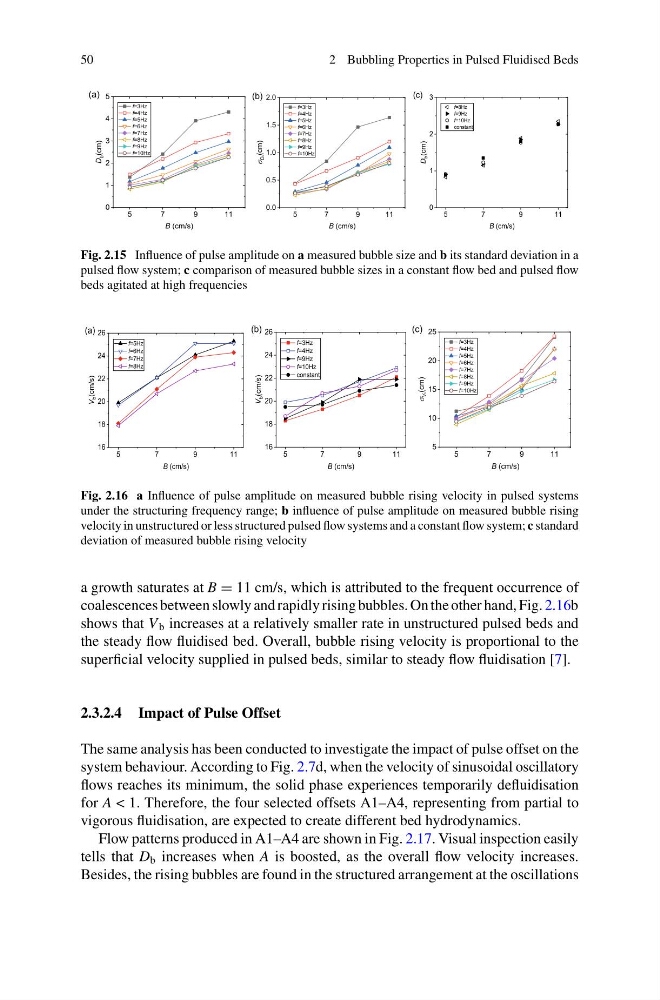
Fig. 2.15 Influence of pulse amplitude on a measured bubble size and b its standard deviation in a
pulsed flow system; c comparison of measured bubble sizes in a constant flow bed and pulsed flow
beds agitated at high frequencies
Fig. 2.16 a Influence of pulse amplitude on measured bubble rising velocity in pulsed systems
under the structuring frequency range; b influence of pulse amplitude on measured bubble rising
velocity in unstructured or less structured pulsed flow systems and a constant flow system; c standard
deviation of measured bubble rising velocity
a growth saturates at B = 11 cm/s, which is attributed to the frequent occurrence of
coalescences between slowly and rapidly rising bubbles. On the other hand, Fig. 2.16b
shows that V b increases at a relatively smaller rate in unstructured pulsed beds and
the steady flow fluidised bed. Overall, bubble rising velocity is proportional to the
superficial velocity supplied in pulsed beds, similar to steady flow fluidisation [7].
2.3.2.4 Impact of Pulse Offset
The same analysis has been conducted to investigate the impact of pulse offset on the
system behaviour. According to Fig. 2.7d, when the velocity of sinusoidal oscillatory
flows reaches its minimum, the solid phase experiences temporarily defluidisation
for A < 1. Therefore, the four selected offsets A1–A4, representing from partial to
vigorous fluidisation, are expected to create different bed hydrodynamics.
Flow patterns produced in A1–A4 are shown in Fig. 2.17. Visual inspection easily
tells that D b increases when A is boosted, as the overall flow velocity increases.
Besides, the rising bubbles are found in the structured arrangement at the oscillations
2 Bubbling Properties in Pulsed Fluidised Beds
Fig. 2.15 Influence of pulse amplitude on a measured bubble size and b its standard deviation in a
pulsed flow system; c comparison of measured bubble sizes in a constant flow bed and pulsed flow
beds agitated at high frequencies
Fig. 2.16 a Influence of pulse amplitude on measured bubble rising velocity in pulsed systems
under the structuring frequency range; b influence of pulse amplitude on measured bubble rising
velocity in unstructured or less structured pulsed flow systems and a constant flow system; c standard
deviation of measured bubble rising velocity
a growth saturates at B = 11 cm/s, which is attributed to the frequent occurrence of
coalescences between slowly and rapidly rising bubbles. On the other hand, Fig. 2.16b
shows that V b increases at a relatively smaller rate in unstructured pulsed beds and
the steady flow fluidised bed. Overall, bubble rising velocity is proportional to the
superficial velocity supplied in pulsed beds, similar to steady flow fluidisation [7].
2.3.2.4 Impact of Pulse Offset
The same analysis has been conducted to investigate the impact of pulse offset on the
system behaviour. According to Fig. 2.7d, when the velocity of sinusoidal oscillatory
flows reaches its minimum, the solid phase experiences temporarily defluidisation
for A < 1. Therefore, the four selected offsets A1–A4, representing from partial to
vigorous fluidisation, are expected to create different bed hydrodynamics.
Flow patterns produced in A1–A4 are shown in Fig. 2.17. Visual inspection easily
tells that D b increases when A is boosted, as the overall flow velocity increases.
Besides, the rising bubbles are found in the structured arrangement at the oscillations